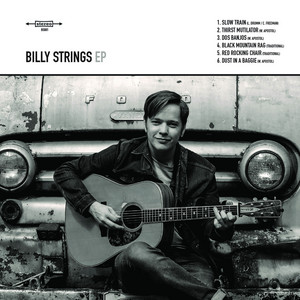
“Black Mountain Rag” was claimed by the fiddler Leslie Keith (1906–1977), who later played fiddle on the Stanley Brothers’ first records in 1947. In Keith’s account, as reported by the folklorist Charles Wolfe, he put it together from “a little bit of” the older fiddle tune “The Lost Child” and a little of two or three Carter Family tunes. Keith dated this to the early 1940s, although the piece has also been described as popular by the late 1930s. “The Lost Child” supplies the basic melody. Keith called his tune “Black Mountain Blues,” after a mountain in Cumberland County, Tennessee. It belongs to the loose family of “Lost Indian” tunes, which Wolfe, Guthrie Meade and Mark Wilson grouped by their AEac# cross-tuning more than by their melodies.
The name changed when Curly Fox recorded it, with Texas Ruby, for King in Cincinnati around December 1947. King issued it in 1948 as “Black Mountain Rag” (King 710, backed with “Come Here Son”), and Wolfe reported that the record eventually sold more than 600,000 copies. On 15 January 1949 Roy Acuff and His Smoky Mountain Boys recorded eight sides at Castle Studio in Nashville, with Art Satherley producing and Tommy Magness on fiddle. They were “Gray Eagle,” “Dance Around Molly,” “Black Mountain Rag,” “Pretty Little Widow,” “Smokey Mountain Rag,” “Lonesome Indian,” “Bully of the Town” and “Polk County Breakdown.” Columbia paired “Black Mountain Rag” with “Dance Around Molly” on 20558. Keith himself recorded the tune under his original title in 1975, in Tucson, for the album Black Mountain Blues (Sierra Briar).
The tune spread well beyond Tennessee. It appears in Vance Randolph’s 1954 list of “traditional” fiddle tunes of the Ozarks, and Texas fiddlers used it as a trick-fiddling piece. Doc Watson played it as a flatpicked guitar solo. He played it at the Newport Folk Festival in July 1963 and recorded it around January 1964 for his first Vanguard album, Doc Watson. He recorded it again in 1971–72 with the Nitty Gritty Dirt Band for Will the Circle Be Unbroken.