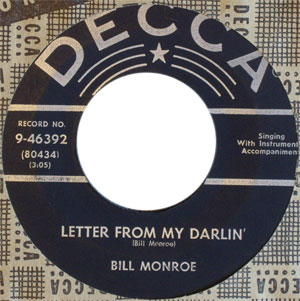
“Rawhide” is a mandolin instrumental by Bill Monroe, in the key of C. Its bridge moves around the circle of fifths. He first recorded it, under the title “Raw Hide,” for Decca on 20 January 1951 at Castle Studio in the Tulane Hotel in Nashville. The Blue Grass Boys that day were Jimmy Martin on guitar, Rudy Lyle on banjo, Joel Price on bass and Red Taylor on fiddle. At the same session they cut “Letter from My Darlin’,” “On the Old Kentucky Shore” and “Poison Love.”
Decca held the instrumental back for a year, then issued it on 19 January 1952 as the B-side of “Letter from My Darlin’” (Decca 46392). It reached a wider audience in June 1965 on Bluegrass Instrumentals (Decca DL 4601). Ralph Rinzler compiled that album from Monroe’s instrumentals of 1951 to 1963, and it was one of the first bluegrass LPs to carry extended liner notes and recording details for each track.
The tune stayed in Monroe’s stage shows for the rest of his career. He played it at the Monterey and Newport folk festivals in 1963. In November of that year it was recorded in concert at Mechanics Hall in Worcester, Massachusetts, with Del McCoury, Bill Keith, Joe Stuart and Bessie Lee Mauldin. At Jordan Hall in Boston in October 1964, he played it with Peter Rowan and Bill Keith. Live recordings from the Grand Ole Opry and Charleston, West Virginia, in 1989, and from his own Brown County Jamboree at Bean Blossom, Indiana, in 1990, show it still in the set a quarter-century on.