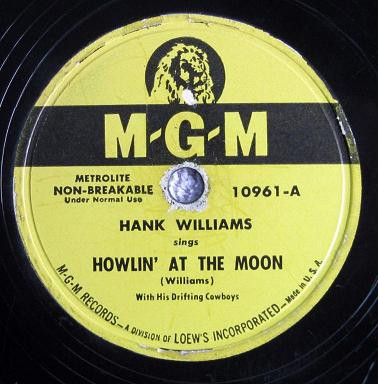
“Howlin’ at the Moon” was written by Hank Williams and recorded on March 16, 1951, at Castle Studio in Nashville with Jerry Rivers on fiddle, Don Helms on steel guitar, and Sammy Pruett driving the rhythm on electric guitar. Released in May 1951 on MGM Records, the A-side reached #3 on the Billboard country chart; the B-side, “I Can’t Help It (If I’m Still in Love with You),” actually peaked higher at #2.
Music historian Colin Escott described the performance as pointing directly toward what was coming: “It was but a short step from there to rockabilly.” The I–IV–V boogie pattern and the song’s relentless rhythmic drive — somewhere between country shuffle and rhythm-and-blues — made it a bridge between the honky-tonk tradition Williams had inherited and the rock and roll that would arrive four years after his death. The lyric itself is almost incidental: a fast, joyful celebration of being in love, the emotion expressed entirely through the song’s physical momentum.
A notable version is Williams’s own 1951 MGM recording — one of the lighter-spirited entries in a catalog that skewed heavily toward loneliness and loss. By March 1951 he had roughly twenty-one months of recording left; he died on New Year’s Day 1953 at twenty-nine. “Howlin’ at the Moon” captures the other register — the joyful, unself-conscious country boogie that sat alongside the desolation as the full measure of what he was.