Fiddlin' John Carson occupies a singular place in the history of recorded American music. On June 14, 1923, the Atlanta-based fiddler and singer walked into an improvised Okeh Records studio set up in a warehouse in Atlanta and recorded two sides — "The Little Old Log Cabin in the Lane" and "The Old Hen Cackled and the Rooster's Going to Crow" — that Okeh talent scout Ralph Peer initially dismissed as "pluperfect awful." The records sold so briskly to local buyers that Peer brought Carson back, and what followed was the effective launch of the commercial old-time recording industry.
Carson was already a known figure in Georgia before the microphone found him. He had competed in fiddle contests at the Georgia Old-Time Fiddlers' Convention in Atlanta, where he won multiple times, and had developed a following among working-class Atlanta communities. His fiddle style was raw and rhythmically driven, without the studied polish of parlor music, and that roughness was precisely what audiences responded to.
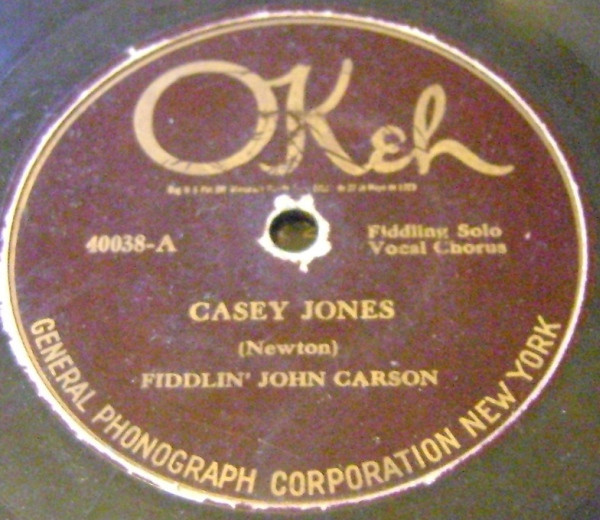
His 1924 Okeh recording of "Casey Jones" paired with "Fare You Well Old Joe Clark" captured the qualities that defined his appeal — a repertoire drawn from the broad common stock of Appalachian and Southern fiddle and song tradition, delivered with a directness that cut through the acoustic recording limitations of the era. Carson continued recording for Okeh through the late 1920s, with sessions yielding sides like "Ain't No Bugs on Me" and "The Burglar and the Old Maid" in 1928. His daughter Rosa Lee Carson — known as Moonshine Kate — frequently recorded and performed alongside him. Together they documented a Georgia string-band tradition that predated and outlasted the commercial industry built partly on Carson's own breakthrough.
Session details drawn in part from the Bluegrass Discography.
Tracklist
- 1 Casey Jones alt version 3:08
- 2 Fare You Well Old Joe Clark