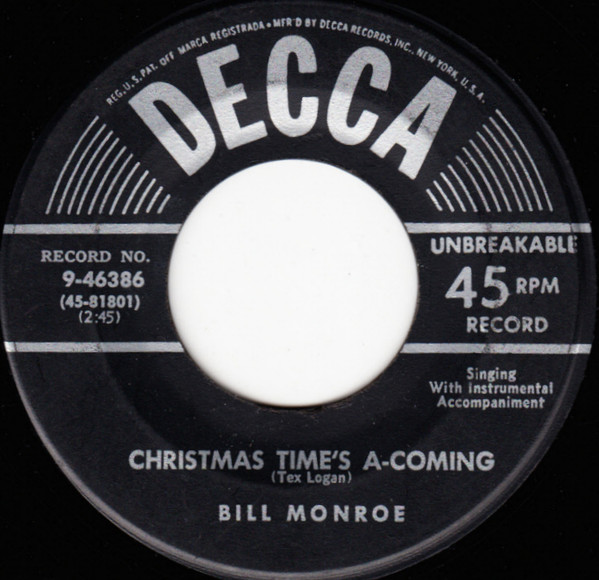
Bill Monroe had already broken up the Monroe Brothers and built a new band from scratch by the time he first recorded as a bandleader. On October 7, 1940, in a makeshift studio at Atlanta's Kimball Hotel, he cut his debut Bluebird sides with the original Blue Grass Boys — Clyde Moody on guitar, Tommy Magness on fiddle — including the breakneck "Mule Skinner Blues" that had already made him a sensation on the young Grand Ole Opry.
The war interrupted everything, and Monroe didn't record again until February 1945, when he began a four-year run for Columbia. Those sessions were cut at the WBBM-CBS studios in Chicago's Wrigley Building, and the band was still finding the sound — Stringbean on banjo, Chubby Wise on fiddle, Sally Ann Forrester's accordion — but the songs were landmarks: "Kentucky Waltz," "Footprints in the Snow," "Blue Grass Special."
Then came September 1946. Back in the Wrigley Building, Monroe recorded with the lineup that would define the music for good — Lester Flatt's guitar and lead vocal, Earl Scruggs's three-finger banjo, Wise's fiddle, Cedric Rainwater's bass. "Blue Moon of Kentucky" and "Heavy Traffic Ahead" came out of those two days; bluegrass as a thing with a name and a shape starts here.
Monroe jumped to Decca in 1950 — partly out of pique that Columbia had signed the Stanley Brothers, whom he considered imitators. His first Decca session, at Nashville's Castle Studio, introduced a 22-year-old Jimmy Martin on guitar and a teenage Vassar Clements on fiddle. The Blue Grass Boys had become a finishing school, and Monroe would run it for the rest of his life.
Session details drawn in part from the Bluegrass Discography.
Tracklist
- 1 Christmas Time’s A-Coming Source Recording 2:48
- 2 The First Whippoorwill Source Recording 2:54