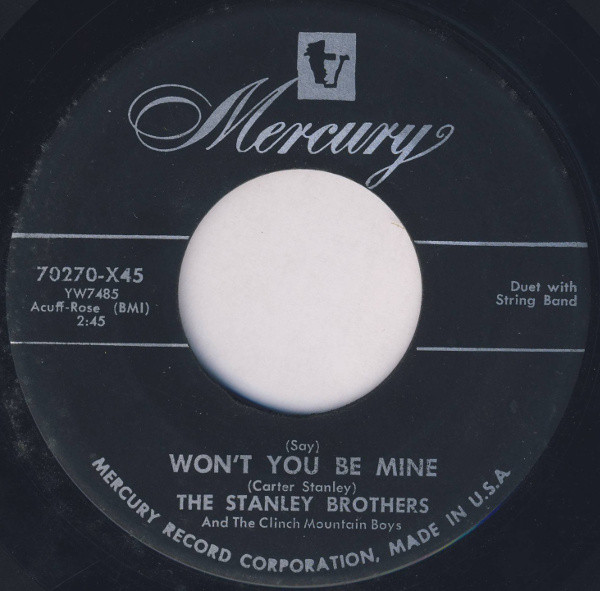
Carter and Ralph Stanley came down out of the Clinch Mountains of southwest Virginia and began recording almost as soon as bluegrass itself had a shape. Their first sides, in 1947 and 1948, were cut for Rich-R-Tone, a tiny label out of Johnson City, Tennessee — including "Molly and Tenbrooks," the Bill Monroe number the brothers learned off the radio and recorded before Monroe's own version reached the public.
Columbia signed them in 1949, and at Castle Studio in Nashville they made some of the most haunting records the music has ever produced — "The White Dove," "The Lonesome River," "A Vision of Mother" — Carter's plaintive lead and Ralph's high tenor framed by Pee Wee Lambert's mandolin. (It was the Stanleys' arrival on Columbia, the story goes, that prompted Monroe to leave the label in disgust.)
Then came a restless decade of label-hopping that tracked the whole post-war singles economy: Mercury from 1953, with sessions at Bradley's Nashville studio; Starday and Blue Ridge in the late 1950s, recorded as far afield as a radio station in Live Oak, Florida; and finally King Records in Cincinnati, where Syd Nathan put them to work. The King years leaned hard on guitarist George Shuffler's distinctive cross-picking and produced the definitive Stanley reading of "Man of Constant Sorrow."
Through it all the Clinch Mountain Boys were a revolving cast — Lambert, Art Stamper, Ralph Mayo, Bill Napier, Shuffler — but the core never wavered: two brothers and the oldest, loneliest sound in bluegrass. Carter's death in 1966 ended the partnership; Ralph carried the name another forty years.
Session details drawn in part from the Bluegrass Discography.
Tracklist
- 1 Say Won’t You Be Mine Source Recording 2:45
- 2 Our Last Goodbye alt version