Merle Haggard’s singles began on Tally, the small Bakersfield label of Fuzzy Owen, who signed him in 1962 after his parole from San Quentin and a job playing bass for Wynn Stewart. The first Tally release, “Singin’ My Heart Out” / “Skid Row,” was made in Bakersfield that year with Owen and Bob Taylor producing, and it sold few copies. “Sing a Sad Song” followed in November 1963, cut at Audio Arts in Hollywood with Roy Nichols and Wynn Stewart on guitars and Ralph Mooney on steel. The fourth Tally single, “(All My Friends Are Gonna Be) Strangers,” reached Billboard’s Top Ten in 1965, and Capitol, which signed him that year, took over the Tally masters.
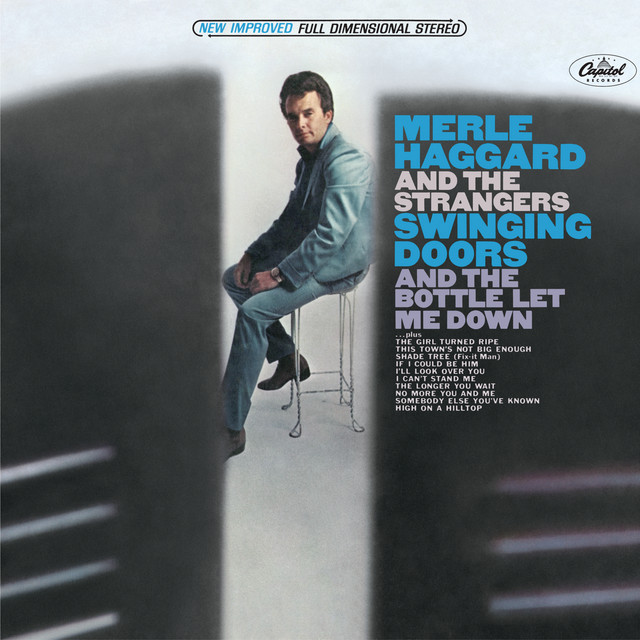
At Capitol, Ken Nelson and Fuzzy Owen produced him, mostly at Capitol’s studio on North Vine Street in Hollywood. “Swinging Doors” was cut on 1 December 1965 and issued in February 1966. On 20 September 1967, with Glen Campbell among the guitarists and Bonnie Owens singing harmony, he recorded “Sing Me Back Home,” released on 23 October backed with “Good Times.” “Mama Tried” came from sessions on 8 and 9 May 1968, with James Burton and Roy Nichols among the players, and was out that June. Haggard wrote all three. The run of singles through 1969 took in “Branded Man,” “Workin’ Man Blues” and “Okie from Muskogee,” and in 1970 he was named Entertainer of the Year by both the CMA and the Academy of Country Music. Alongside the hits he paid tribute to two of his main influences: a double album of Jimmie Rodgers songs, Same Train, a Different Time (1969), and an album of Bob Wills songs, A Tribute to the Best Damn Fiddle Player in the World (1970).
By 1974 his sessions had Roy Nichols on guitar, Norman Hamlet on steel and Tiny Moore on electric mandolin. On 16 September that year, at the Columbia studio in Nashville with Ken Nelson producing, they were joined by Johnny Gimble on fiddle and Ronnie Reno on guitar to record Dolly Parton’s “Kentucky Gambler,” with Parton herself singing harmony. Capitol 3974 paired it in October 1974 with “I’ve Got a Darlin’ (For a Wife),” which Haggard wrote with Reno. After Capitol he recorded for MCA (1977–80), Epic (1981–89) and Curb (1990–95). At Epic, “That’s the Way Love Goes” won him the 1984 Grammy for best male country vocal. He entered the Country Music Hall of Fame in 1994 and died on his seventy-ninth birthday, 6 April 2016.
Session details drawn in part from the Bluegrass Discography.
Tracklist
- 1 Swinging Doors alt version 2:48
- 2 The Girl Turned Ripe
- 3 The Bottle Let Me Down Source Recording 2:48