Uncle Dave Macon
Uncle Dave Macon (1870–1952) was a banjo player, singer and comedian from Middle Tennessee who took up show business in his fifties and became the first major star of the Grand Ole Opry, where George D. Hay billed him as “the Dixie Dewdrop.” Between 1924 and 1938 he recorded more than 170 sides, many of them with the guitarist Sam McGee, and he was elected to the Country Music Hall of Fame in 1966.
David Harrison Macon was born on 7 October 1870 at Smartt Station in Warren County, Tennessee, and was learning the songs of the area by the time he was nine. In 1884 the family moved to Nashville to run a hotel on Broadway that was a base for touring vaudeville performers, and the teenager watched them rehearse in the basement. He was taken above all with the trick banjo players of the day, particularly one called Joel Davidson, and persuaded his mother to buy him a banjo. After his father’s death in 1886 the family left Nashville, and his mother ran a stagecoach stop at Readyville, where young Macon watered the horses and played for the passengers from a stage he built over the barn door.
He settled on a farm near Kittrell and around 1900 opened a freight line between Murfreesboro and Woodbury, hauling goods by mule and wagon and singing and playing at the stops along the way. Motor trucks put the business out of operation in 1920, and his first paid performance came the next year, at a school in Morrison, Tennessee. Around 1923 he was offered work on the Loew’s vaudeville circuit; with the fiddler Sid Harkreader he opened in Birmingham, Alabama, and the tour soon reached as far north as Boston.
In July 1924 Macon went to New York to record for Vocalion. At the first session, on 8 July, he cut “Keep My Skillet Good and Greasy” and “Hill Billie Blues,” and two days later, with Harkreader, “She’s Always Chewing Gum”; these were among his best-selling records. He met Sam McGee in late 1925, and by his New York sessions of April 1926 McGee was playing guitar behind him. On 6 November 1925 Macon and Harkreader played a benefit at the Ryman Auditorium, and he became one of the earliest members of the WSM Barn Dance, appearing on 26 December 1925 with the fiddler Uncle Jimmy Thompson. At first he was the only member of the cast with a national name, but through the 1920s he appeared only now and then, earning more from touring and records.
In May 1927, back in New York, he recorded with the Fruit Jar Drinkers: Sam McGee on guitar, his brother Kirk McGee on fiddle and Mazy Todd on fiddle. In four sessions they cut “Rock About My Sara Jane,” “Sail Away Ladies,” “Bake That Chicken Pie,” “Hold the Wood-Pile Down” and “Walk, Tom Wilson, Walk,” and for the religious numbers the group took the name the Dixie Sacred Singers. Macon said he had learned “Rock About My Saro Jane” from Black stevedores on the Cumberland River in the 1880s.
His later sessions moved from city to city and label to label. In Chicago in July 1928, with McGee on guitar, he recorded “Buddy, Won’t You Roll Down the Line?,” a song drawn from the Coal Creek War of the 1890s, and “From Earth to Heaven,” about his own freight-hauling days, along with “Governor Al Smith.” In Jackson, Mississippi, in December 1930 he recorded for OKeh with McGee, including “The Wreck of the Tennessee Gravy Train,” about a scandal touching Governor Henry Horton, and “Oh Lovin’ Babe,” which was not issued until much later. He recorded for Gennett in Richmond, Indiana, with the McGee Brothers in August 1934; for Bluebird in New Orleans in January 1935 with the Delmore Brothers; and for Bluebird again in Charlotte, North Carolina, in August 1937 and January 1938, his last commercial sessions, the second of them with the guitarist Glenn Stagner. His son Dorris often played guitar with him from 1930 on, and in the 1930s he also worked with the young Roy Acuff and Bill Monroe.
In 1940 Macon appeared in the Republic film Grand Ole Opry, singing and dancing around his banjo with Dorris on “Take Me Back to My Old Carolina Home.” Around May 1950 a set of home recordings was made at his house in Kittrell, among them “Cumberland Mountain Deer Race” and “Bully of the Town.” Though his banjo playing faded in the 1940s, his singing and comedy carried his Opry shows and tours, and he was still on the Opry past eighty when he fell ill in 1952. He died on 22 March 1952 at Rutherford County Hospital in Murfreesboro. George D. Hay, Kirk McGee, Roy Acuff and Bill Monroe were among his pallbearers, and he was buried beside the Woodbury–Murfreesboro road where he had hauled freight; his monument carries the title of his favorite hymn, “How Beautiful Heaven Must Be.”
Macon played an open-backed Gibson banjo, and historians have identified at least nineteen different picking styles on his records. The Country Music Hall of Fame inducted him in 1966. Uncle Dave Macon Days, an annual festival in Murfreesboro, has been held since the late 1970s and since 1986 has hosted a national old-time banjo contest, and his house on Old Woodbury Pike in Kittrell is listed on the National Register of Historic Places.

-
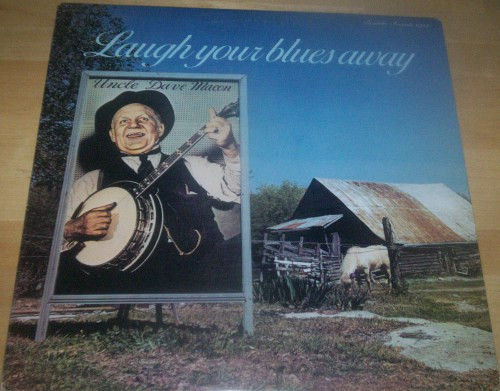 Laugh Your Blues Away1979 · Rounder Records
-
Single (Arkansas Travelers / Going Across the Sea)1926 · Vocalion 15192
-
Single (Muskrat Medley / Rooster Crow Medley)1925 · Vocalion 15101
-
Single (Bile Them Cabbage Down / Down by the River)1924 · Vocalion 14849
-
 Uncle Dave MaconPlayed on with Uncle Dave Macon
-
Sam McGeePlayed on with Uncle Dave Macon