Tennessee Ernie Ford
Tennessee Ernie Ford (1919–1991) was a bass-baritone singer and broadcaster from Bristol, Tennessee, whose Capitol records ran from hard-driving country boogie to “Sixteen Tons,” a number-one pop and country hit in 1955. He went on to host his own network television shows and recorded dozens of gospel albums, and he was elected to the Country Music Hall of Fame in 1990.
Ernest Jennings Ford was born in Bristol on 13 February 1919. He sang in school choirs and played trombone in the school band, and in 1937 he went to work as an announcer at a Bristol radio station. He left in 1938 to study at the Cincinnati Conservatory of Music, then announced at stations from Atlanta to Knoxville. During the Second World War he served in the Army Air Corps as a B-29 bombardier and a bombing instructor.
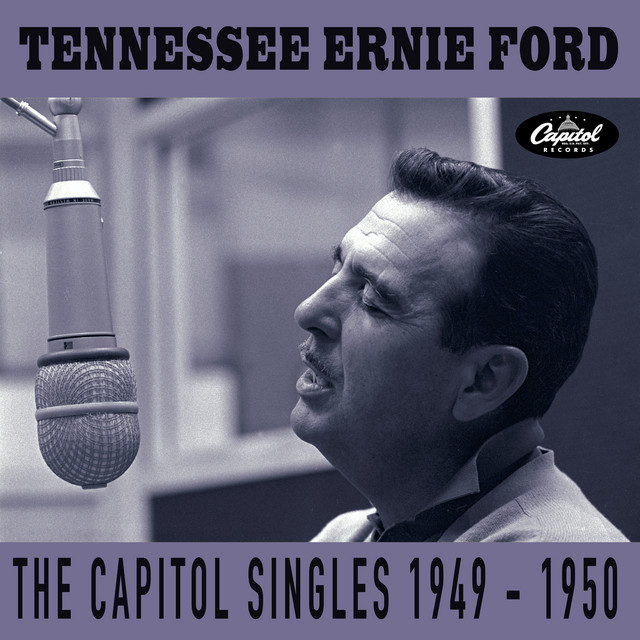
After his discharge in 1946 he settled in southern California, first as a disc jockey at KFXM in San Bernardino, where he invented the excitable hillbilly character “Tennessee Ernie” for an early-morning country show, and then at KXLA in Pasadena. There Cliffie Stone, a part-time talent scout for Capitol Records, made him a regular on his Hometown Jamboree radio and television shows and brought him to the label. Producer Lee Gillette signed him, and Ford made his first Capitol records at Radio Recorders in Hollywood on 21 January 1949, backed by Stone’s band with Merle Travis on electric guitar and Speedy West on steel. Those early sides were California country boogie, “The Shotgun Boogie” and “Blackberry Boogie” among them, and most of them made the top ten. On 28 June 1950 he recorded “I’ll Never Be Free” with Capitol’s pop singer Kay Starr, a hit on both the country and pop charts. He first guested on the Grand Ole Opry in 1950, and in 1953 he became the first country singer to appear at the London Palladium.
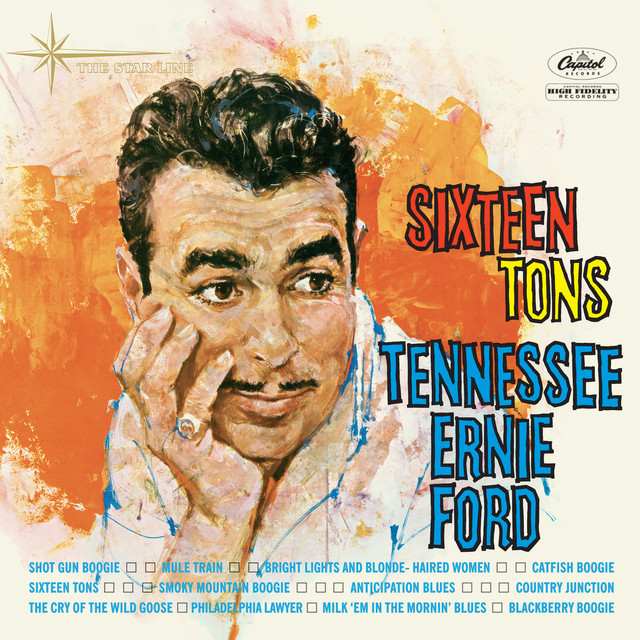
By the mid-1950s he was on national television, as host of NBC’s College of Musical Knowledge in 1954 and as “Cousin Ernie” in three episodes of I Love Lucy. He recorded “The Ballad of Davy Crockett” on 7 February 1955, and it reached number four on the country chart. On 20 September 1955 at Capitol’s Melrose Avenue studio he recorded Merle Travis’s coal-mining song “Sixteen Tons” with a small band arranged by his music director, Jack Fascinato, built around clarinet and his own snapping fingers. It spent ten weeks at number one on the country chart and seven on the pop chart, and its sales passed four million.
The hit led the Ford Motor Company to sponsor The Ford Show, his prime-time NBC variety program, which ran from October 1956 to June 1961 and closed every week with a hymn. In 1956 he released Hymns, his first gospel album, which stayed on Billboard’s album chart for 277 weeks, was certified gold in 1959 and by 1963 was the biggest-selling album in Capitol’s catalog. He went on to record 81 sacred albums, and Great Gospel Songs won a Grammy in 1964. His catchphrase, “Bless your pea-pickin’ heart,” earned him the nickname “the Ol’ Pea-Picker.”
From 1962 to 1965 he hosted a daytime show for ABC from San Francisco. He kept working through the 1970s in television specials and guest spots, among them Hee Haw, took part in a Hometown Jamboree reunion at the Los Angeles Palladium in 1973 and recorded for Capitol until the mid-1970s. He received three stars on the Hollywood Walk of Fame, for radio, records and television, and the Presidential Medal of Freedom in 1984. He died in Reston, Virginia, on 17 October 1991, a month after attending a state dinner at the White House.
- 1964: Grammy Award for Great Gospel Songs
- 1984: Presidential Medal of Freedom
- 1990: Country Music Hall of Fame
- 1994: Gospel Music Hall of Fame
These are the recordings in our catalog that credit Tennessee Ernie Ford. We add more all the time.