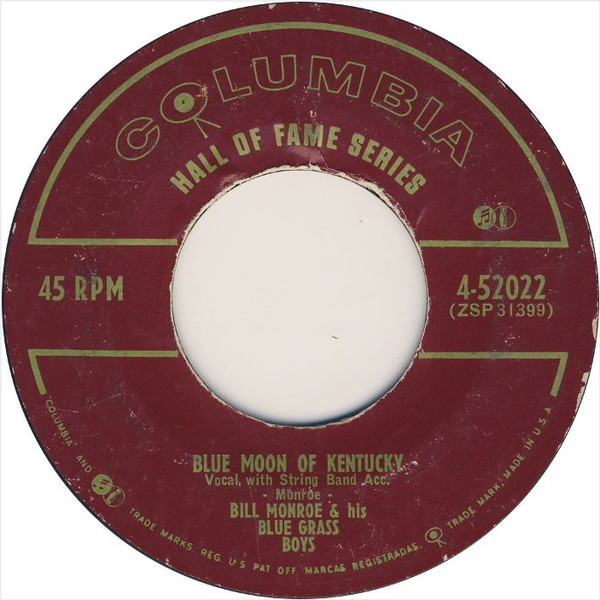
“Blue Moon of Kentucky” was written by Bill Monroe in 1945. Monroe later said he thought of it on the drive home from a tour of Florida, wanting to write about the moon he could always see over Kentucky and deciding the best way to do that was to bring a girl into the song. His earliest known performance of it was on the Grand Ole Opry on August 25, 1945. In the lyric the singer addresses the moon directly, telling it to keep shining on the one who has gone and proved untrue, and he ends up left blue.
Monroe recorded it at his first Columbia session, on September 16, 1946, at the CBS studio in the Wrigley Building in Chicago (Art Satherley producing), with Lester Flatt on guitar, Earl Scruggs on banjo, Howard Watts on bass and Chubby Wise on fiddle. It came out in 1947 as a waltz. In 2002 the Library of Congress added the recording to the National Recording Registry.
In July 1954 Elvis Presley, with Scotty Moore on guitar and Bill Black on bass, recorded it at Sun Studio in Memphis in 4/4 time. By Moore’s account, Black started joking around on the bass during a break and singing the song in imitation of Monroe’s high voice, and Presley joined in. Sun released it as the B-side of Presley’s first single, “That’s All Right.” Carl Perkins was already playing an up-tempo version at his own shows.
The Stanley Brothers recorded the song for Mercury on August 29, 1954, at Bradley Studio in Nashville, and Monroe went back into the studio on September 4, 1954, for Decca. According to Richard D. Smith, the biographer whose essay the Library of Congress published, that session produced only this one song, with no banjo; Monroe opened in the old waltz time and, after one round, shifted into 4/4. Smith also reports that Monroe, who had played the Presley record for Carter Stanley the night before the Stanleys’ own session, was soon collecting what he later called “powerful” royalty checks as the song’s writer. Presley and Monroe first met backstage at the Opry on October 2, 1954, when Presley is said to have apologized for taking liberties with the song and Monroe answered that he was for it if it helped Presley’s career.