Fiddlin’ John Carson was a fixture of the Georgia Old-Time Fiddlers’ Conventions in Atlanta, where he had been crowned state champion in 1914, and a regular on WSB radio from 1922, before he made a record. Polk Brockman, an Atlanta furniture dealer who distributed OKeh records, urged Ralph Peer to record him. In June 1923 Carson cut “The Little Old Log Cabin in the Lane” and “The Old Hen Cackled and the Rooster’s Going to Crow” (OKeh 4890) alone with his fiddle, in an improvised studio on Nassau Street in Atlanta. By Brockman’s later account, Peer called the result “pluperfect awful”. Even so, the first 500 copies sold out within days, and OKeh brought Carson to its New York studio on West 45th Street.
Those sessions, on 7 and 8 November 1923, produced “Casey Jones” and “Fare You Well Old Joe Clark”, issued together as OKeh 40038 in February 1924. They also produced “Billy in the Low Ground”, “You’ll Never Miss Your Mother Till She’s Gone” and “The Farmer Is the Man That Feeds Them All”. Through 1924 OKeh released a new Carson record almost every month. Most of his later sessions were held in Atlanta with Peer producing, either solo or with a band billed as the Virginia Reelers. The banjo player Land Norris was on a 1924 date, and fiddler Earl Johnson and T. M. Brewer played on sessions in 1927.
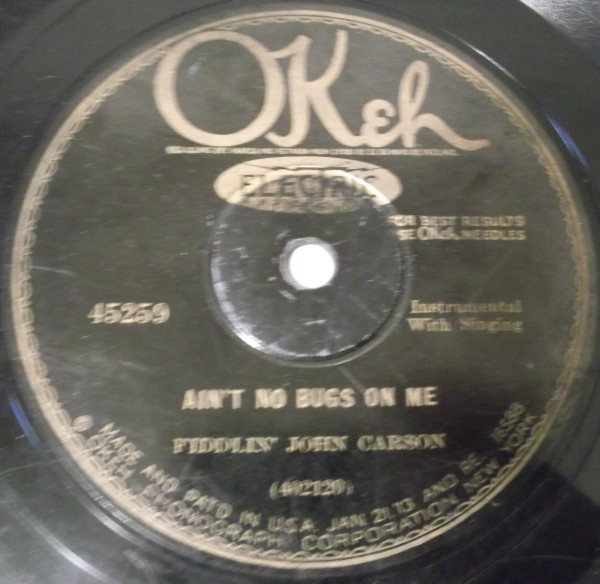
His daughter Rosa Lee Carson recorded on her own from June 1925, starting with “Little Mary Phagan”, a ballad her father had written, and played guitar on his sessions. As Moonshine Kate she shared many of his labels from 1927 on. An Atlanta session on 10 August 1928 produced “There Ain’t No Bugs on Me” and “The Burglar and the Old Maid”, issued as OKeh 45259 that October. In October 1929 Carson took part in the six-part OKeh Medicine Show in New York with Emmett Miller, Frank Hutchison and Carson Robison, issued on three records. That December he and Kate recorded in New Orleans. His last OKeh sessions were in Atlanta in 1930 and 1931, and the final OKeh single, “After the Ball” backed with “Didn’t He Ramble”, appeared in April 1932.
Carson’s final sessions, on 27 and 28 February 1934, were for Victor’s Bluebird label at Camden, New Jersey, with Moonshine Kate, Marion Brown on guitar and Bill Willard on banjo. Alongside remakes such as “There’s No Bugs on Me” and “Be Kind to a Man When He’s Down”, they produced new titles like “The Storm That Struck Miami” and “Taxes on the Farmer Feeds Them All”. Bluebird issued them into 1936. His recording career yielded some 165 songs.
Session details drawn in part from the Bluegrass Discography.
Tracklist
- 1 There Ain’t No Bugs on Me alt version 4:50
- 2 The Burglar and the Old Maid
- 3 Ain’t No Bugs on Me alt version 2:46