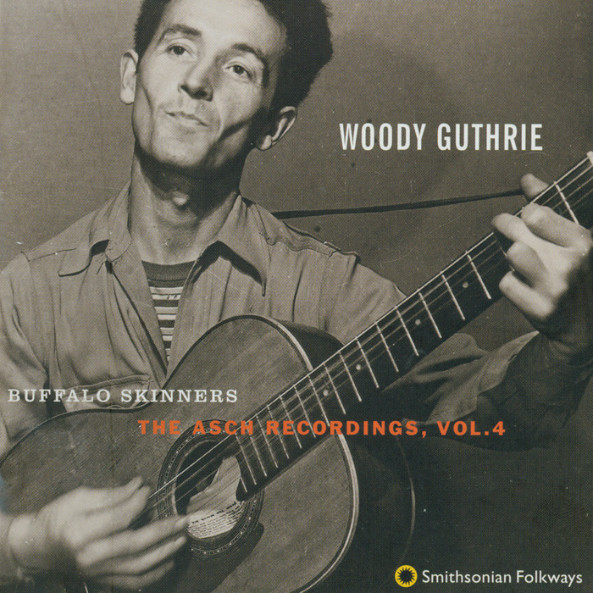
Woody Guthrie was born in Okemah, Oklahoma, on 14 July 1912, and he was singing on the radio before he ever made a record. In Los Angeles in the late 1930s he had a show on KFVD with his singing partner Maxine Crissman, “Lefty Lou,” mixing old-time songs with his own. He moved to New York in 1940, and that March Alan Lomax recorded his songs and talk for the Library of Congress in Washington.
His first commercial records followed within weeks. At Victor’s studio in Camden, New Jersey, on 26 April 1940, with a second visit on 3 May for two more titles, he recorded the songs issued that July as Dust Bowl Ballads: two albums of three 78-rpm discs each. “Tom Joad” ran over both sides of one disc, and “Pretty Boy Floyd” and “Dust Bowl Blues” were left off. After RCA refused to reissue the set, Folkways put the songs out on LP in 1950 and again in 1964.
Most of his recorded work was done for Moses Asch in New York, over a series of dates in 1944 and 1945. The first session was on 16 April 1944, and Cisco Houston, his shipmate in the merchant marine during the war, sang and played with him from 19 April. Among the songs cut that month was “This Land Is Your Land.” Sonny Terry’s harmonica is on some of the sides. Asch issued the results on a string of labels, including Asch, Asch-Stinson, Disc and later Folkways.
The traditional “Buffalo Skinners” comes from the session of 24 May 1945, which also produced “1913 Massacre,” “Ludlow Massacre” and “Mean Talking Blues.” Asch put “Buffalo Skinners” on the first side of Documentary #1: Struggle (Asch 360), a three-disc album in a David Stone Martin cover. The album’s six songs were “Buffalo Skinners,” “Pretty Boy Floyd,” “Ludlow Massacre,” “1913 Massacre,” “Lost John” and “Union Burying Ground.” Folkways reissued it on LP as Struggle in 1976.
After the war, living in Coney Island, he recorded the children’s songs of Songs to Grow On, and in January 1947 he recorded the Sacco and Vanzetti ballads, not issued until Folkways’ Ballads of Sacco & Vanzetti in 1960. Huntington’s disease, diagnosed in 1954 at Greystone Hospital in New Jersey, ended his working life, and he died at Creedmoor State Hospital in Queens on 3 October 1967. Smithsonian Folkways gathered the Asch masters on four CDs between 1997 and 1999. The last, Buffalo Skinners, collects cowboy and western songs, with Cisco Houston on ten tracks.
Session details drawn in part from the Bluegrass Discography.
Tracklist
- 1 Buffalo Skinners alt version 3:16