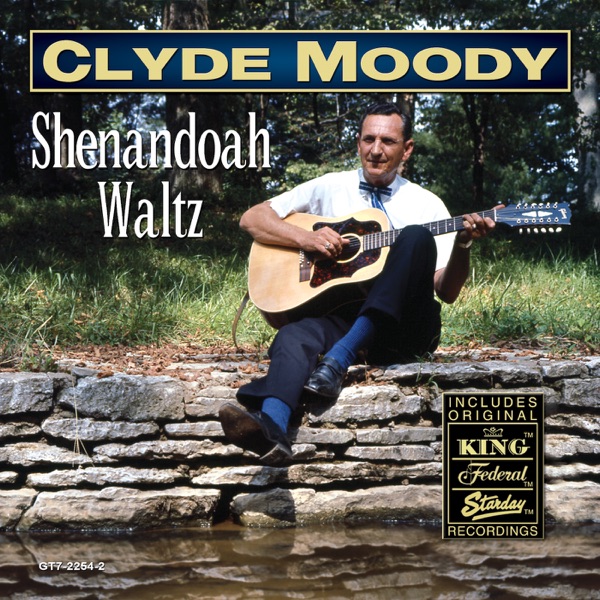
Clyde Moody arrived at Bill Monroe's Blue Grass Boys in 1945 as an experienced guitarist and vocalist who had already worked with Wade Mainer and J.E. Mainer's Mountaineers. His tenure with Monroe coincided with the period when Monroe was assembling the core elements of what would become bluegrass — the tight harmonies, the driving tempos, the modal tonalities drawn from Appalachian tradition. Moody contributed his smooth, melodic vocal style to that ensemble, offering a contrast to Monroe's high, intense lead work.
When Moody launched his solo career on King Records in 1947, he carried that bluegrass foundation into a more commercially oriented direction. "Shenandoah Waltz," recorded for King, became his signature record and a genuine country hit. The waltz form, long a staple of old-time and country repertoire, provided a vehicle for Moody's lyrical baritone, and the recording caught on with radio audiences across the South and Appalachian region. Its success established Moody as a viable solo act apart from the Monroe organization. The pairing with "There's a Big Rock in the Road" gave the single a contrasting, more uptempo number on the flip side.
Moody remained with King through the late 1940s and continued performing and recording into subsequent decades, though "Shenandoah Waltz" remained the commercial high point of his career. He was known in bluegrass circles as the "Happy-Go-Lucky Boy," a nickname that reflected the accessible, warm quality of his vocal approach. His work occupies a transitional position in the music's history — rooted in the pre-bluegrass string band tradition, shaped by his time with Monroe, and aimed at the mainstream country market that King Records actively pursued during this period.
Session details drawn in part from the Bluegrass Discography.
Tracklist
- 1 Shenandoah Waltz alt version
- 2 There's a Big Rock in the Road