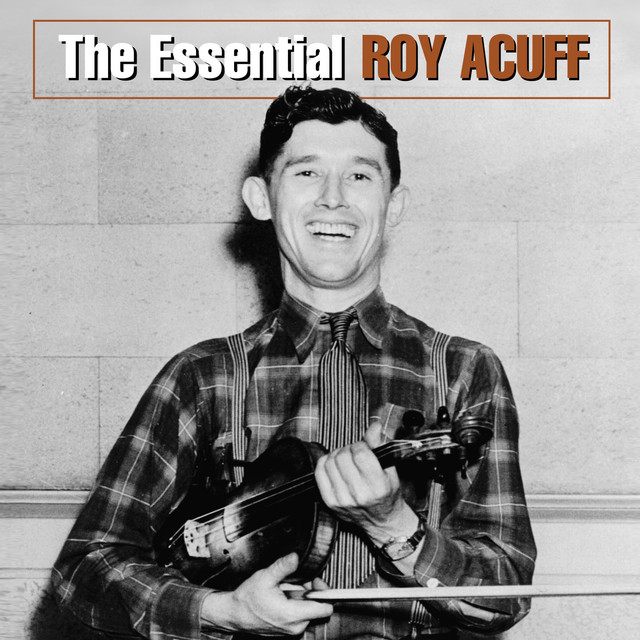
Roy Acuff’s singles cover more than four decades, from ARC’s budget 78s of the 1930s to Elektra 45s in the 1980s. Born in Maynardville, Tennessee, in 1903, he was playing Knoxville radio with a band called the Crazy Tennesseans when the ARC producer W. R. Calaway brought them to Chicago in 1936. Between 20 and 23 October, at the Furniture Mart Building on Lake Shore Drive, Acuff recorded with Jess Easterday on guitar, Clell Summey on dobro, Red Jones on bass and Sam Hatcher on harmonica. The sessions produced “Great Speckled Bird” and “Wabash Cannon Ball.” ARC spread the sides across its labels: “Great Speckled Bird” with “My Mountain Home Sweet Home” came out in January 1937, and “Wabash Cannon Ball” with “Freight Train Blues” on Vocalion and Conqueror in December 1938.
A guest appearance on the Grand Ole Opry on 5 February 1938 brought him onto the show, and the band became the Smoky Mountain Boys. The records of the next few years were made on the road. The band recorded at the Columbia Hotel in Columbia, South Carolina, in November 1938 and at the Gayoso Hotel in Memphis in July 1939, with Art Satherley producing. By then Lonnie Wilson was on guitar, Beecher “Brother Oswald” Kirby on dobro and banjo, and Easterday had moved to bass. In April 1940 Satherley recorded them in Saginaw, Texas, with Rachel Veach added on banjo and vocals. That trip yielded “Will the Circle Be Unbroken” with “When I Lay My Burden Down” (Vocalion 05587, June 1940) and “The Precious Jewel” with “Come Back Little Pal” (OKeh 05956, January 1941). “You’re My Darling” and “Branded Wherever I Go,” recorded in Chicago on 29 April 1941, were paired on OKeh 06463 that November.
The best-known OKeh records came from sessions at CBS’s KNX studio in Hollywood in May and June 1942, with Easterday on mandolin and Velma Williams on bass. “The Wreck on the Highway” with “Fire Ball Mail” (OKeh 6685) was issued in June 1942, and “Night Train to Memphis” with “Low and Lonely” (OKeh 6693) in September. That same year Acuff and the songwriter Fred Rose formed Acuff-Rose, the Nashville publishing house that signed Hank Williams in 1946. From 1944 to 1947 Satherley recorded Acuff at CBS studios in Chicago and Hollywood, with Jimmy Riddle on accordion or harmonica and, in 1947, Tommy Magness on fiddle. In 1946 Columbia began reissuing the OKeh sides on its own label.
The Columbia sessions then moved to Nashville’s Castle Studio in the Tulane Hotel. There, on 15 January 1949, with Oswald, Magness and Riddle, Acuff recorded “Tennessee Waltz” and “Sweeter Than the Flowers.” Columbia issued them together as 20551 in March 1949. Don Law produced his last Columbia dates in 1951. Capitol followed from 1953 to 1955, with Ken Nelson producing at Castle and the band of Wilson, Easterday, Oswald, Howdy Forrester on fiddle and Riddle. Decca came next, in 1955–56, under Paul Cohen; its releases included “Goodbye Mr. Brown” with “Mother Hold Me Tight,” two duets with Kitty Wells (1956). From December 1957 he was on Hickory, the label he had formed with Fred and Wesley Rose, with Wesley Rose producing. Hickory released new songs alongside remakes of old ones, among them “The Streamlined Cannonball” (1961), “Wabash Cannon Ball” (1962) and “Fire Ball Mail” with “Great Speckled Bird” (1962).
In August 1971 Acuff recorded with the Nitty Gritty Dirt Band for Will the Circle Be Unbroken, and United Artists issued their “I Saw the Light” with “The Precious Jewel” in October 1971. His Hickory singles continued into the mid-1970s. Elektra released his last, between 1978 and 1982, among them “The Stage” with Boxcar Willie. In 1962 the Country Music Hall of Fame elected him as its first living member. He died in 1992.
Session details drawn in part from the Bluegrass Discography.
Tracklist
- 1 Sweeter Than the Flowers
- 2 Tennessee Waltz alt version 2:54