
Jack Anglin
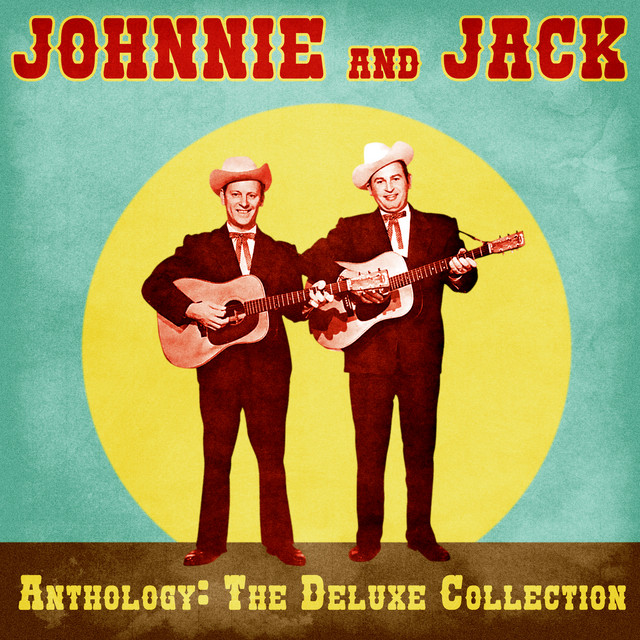
Jack Anglin (1916–1963) sang tenor and played rhythm guitar in Johnnie & Jack, the duo he formed with his brother-in-law Johnnie Wright at the end of the 1930s. Their RCA Victor records of the 1950s included “Poison Love,” a No. 4 country hit in 1950, and “(Oh Baby Mine) I Get So Lonely,” a No. 1 in 1954, and the partnership lasted until Anglin died in March 1963.
He was born on 13 May 1916 on a farm in Franklin, Tennessee, then a farming community outside Nashville, the son of John B. and Lue Anglin. His father taught him guitar, and by fourteen he was singing on local radio, though he never learned to read music. With his brothers Jim and Red he recorded for Vocalion in San Antonio on 5 and 6 November 1937, as the Anglin Twins, with Jack singing and playing guitar; “Just Inside the Pearly Gates” and “Don’t Say Goodbye When You Go” were among the six sides issued. As the Anglin Brothers they recorded again in Columbia, South Carolina, on 12 November 1938. Jim Anglin went on to write many of Johnnie & Jack’s best-known songs.
Jack met Johnnie Wright at WSIX in Nashville in 1936, when Wright was leading Johnnie Wright and the Harmony Girls with his wife, Muriel Deason, later known as Kitty Wells, and his sister Louise. Anglin married Louise in 1938. He and Wright first sang together as the Backwater Boys at a benefit for flood victims, began singing as a duo in 1938 and formed Johnnie & Jack in 1939, with Kitty Wells as their “girl singer” on the radio. Wright sang lead and Anglin the tenor above him. From the winter of 1940–41 they worked at WBIG in Greensboro, North Carolina, then at WCHS in Charleston, West Virginia, and from June 1942 in Knoxville, where wartime gasoline rationing stopped them. Anglin joined Roy Acuff’s band and in July 1943 was drafted into the Army Medical Corps.
After the war the duo worked in Raleigh and then at WSM in Nashville, and on 25 March 1947 they made their first records, for Apollo in New York, with Ray Atkins on Dobro, Paul Buskirk on mandolin, Eddie Hill on bass and Paul Warren on fiddle. Early in 1948 they and Kitty Wells joined the Bailes Brothers at KWKH in Shreveport and were already there when the station started the Louisiana Hayride that April. Chet Atkins persuaded Steve Sholes to sign them to RCA Victor, and their first session there, in Atlanta on 31 January 1949, included Jim Anglin’s “What About You.”
“Poison Love,” recorded in Nashville on 27 March 1950, took the bassist Ernie Newton’s suggestion of a Latin rhythm and reached No. 4. “Cryin’ Heart Blues” reached No. 5 in the autumn of 1951, and the October 1951 session that produced “Three Ways of Knowing” also gave them Jim Anglin’s “Ashes of Love,” not a hit for them but later charted by Don Gibson and the Desert Rose Band. The run of records brought them back to the Grand Ole Opry in January 1952, and from then on they were based in Nashville. In February 1954 they recorded the Four Knights’ “(Oh Baby Mine) I Get So Lonely,” their biggest hit, at No. 1, and they followed it with the Spaniels’ “Goodnight, Sweetheart, Goodnight.” Their cover of “Stop the World (And Let Me Off),” recorded with the Jordanaires, was their last Top Ten record, at No. 7 early in 1958.
After a session in August 1960 they left RCA for Decca, and a remake of “Slow Poison” gave them a last chart entry in 1962. On 7 March 1963 Anglin was driving alone from Madison, Tennessee, to the memorial service for Patsy Cline, Hawkshaw Hawkins and Cowboy Copas, who had been killed two days earlier, when his car left the road on Due West Avenue and he was killed. He was buried in Goodlettsville. His death ended Johnnie & Jack; Wright went on as a solo singer and reached No. 1 with “Hello Vietnam” in 1965. In 1992 Bear Family gathered every Johnnie & Jack recording, from Apollo to Decca, in a six-CD set.
These are the recordings in our catalog that credit Jack Anglin. We add more all the time.
-
Johnnie and Jack: The Tennessee Mountain BoysPlayed on with Johnnie and Jack: The Tennessee Mountain Boys



