
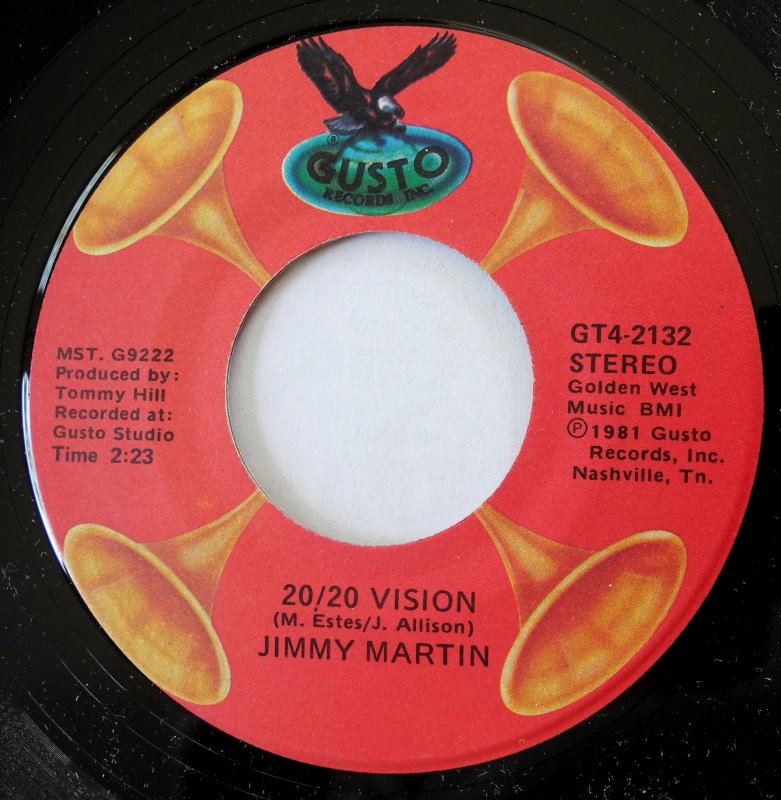
“20/20 Vision” (also billed as “20/20 Vision and Walking Around Blind”) was written by Joe Allison and Milton Estes. Both men worked in radio as well as writing songs. Estes had come to the Grand Ole Opry in 1937 as a singer and master of ceremonies with Pee Wee King’s Golden West Cowboys. Allison, a Texan, later wrote “He’ll Have to Go” and helped found the Country Music Association.
Gene Autry made the first recording on 19 May 1954, at Castle Studio in Nashville’s Tulane Hotel. Columbia issued it in June as “Twenty-Twenty Vision,” the B-side of “You’re the Only Good Thing.” Six months later, on 16 November 1954, Jimmy Martin and the Osborne Brothers cut it at RCA Victor’s Nashville studio. Martin sang lead, with Bobby Osborne on the high baritone part and on mandolin and Sonny Osborne on tenor and banjo. Red Taylor played fiddle and Cedric Rainwater bass. RCA Victor released it that December, backed with “Save It! Save It!”
The lyric sets good eyes against a blind heart. The doctor tells the singer he is all right, but he knows he is losing his sight: the doctor “should have examined the eyes of my mind.” He lies awake with his eyes wide open, and says that if it weren’t for dying he’d wish he were dead. Then he turns to the man who has taken her, predicting that “the eyes of your heart will have trouble like mine.” He allows that she may be as wicked as the other man says, but she is no longer his.
Martin kept coming back to the song. He re-recorded it for Decca on 22 April 1964 in Nashville, with Mike Miller singing tenor and Vernon Derrick high baritone, and Decca put it out in March 1965, backed with “Sunny Side of the Mountain.” He cut it again for Gusto in 1979, and it was in his set on a 1990 live recording with Grant Turner. Other versions include Lenny Wright and the Carolina Travelers’ single for Bryte (1961), Chris Thile and Michael Daves’s mandolin-and-guitar duet on Sleep with One Eye Open (Nonesuch, 2011), Del & Dawg’s Hardcore Bluegrass in the Dawg House (Acoustic Disc, 2012), and Dan Tyminski’s track on the Smithsonian Folkways collection Industrial Strength Bluegrass (2021).




