Bill and Earl Bolick grew up in East Hickory, North Carolina, and made their first records as the Blue Sky Boys on 16 June 1936, when Victor recorded them for its Bluebird label at the Hotel Charlotte in Charlotte. Earl played guitar, and Bill played mandolin and sang tenor. On the prewar records nobody else plays. That first session produced ten sides, and Bluebird issued “The Sunny Side of Life” with “Where the Soul Never Dies” (B-6457) in July 1936.
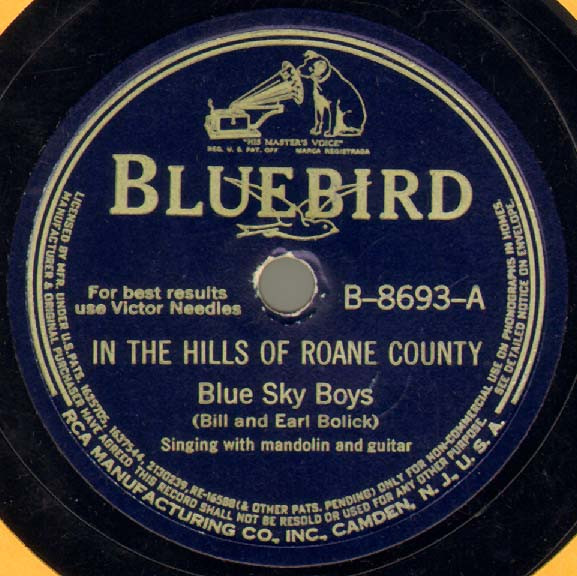
Until the war they recorded in hotels: in Charlotte again in October 1936, August 1937 and January 1938; at the Andrew Jackson Hotel in Rock Hill, South Carolina, in September 1938; and in Atlanta in 1939 and 1940, the last of these on 7 October 1940 at the Kimball House. Bluebird issued their records in a steady run, and most were also released on the Montgomery Ward label. Their repertoire paired hymns and gospel songs with old ballads and parlour songs. “Story of the Knoxville Girl” and “Beautiful Brown Eyes” shared Bluebird B-7755 in 1938, and “Mary of the Wild Moor” followed in 1940. The Kimball House session produced “In the Hills of Roane County,” “Brown Eyes,” “Kneel at the Cross” and “Turn Your Radio On,” issued through 1941.
Both brothers entered the armed forces in 1941, and Bill was discharged on Christmas Day 1945. The duo returned to RCA Victor at its New York studio on 24th Street on 30 September 1946 and recorded “Dust on the Bible” and “Speak to Me, Little Darling” (20-2022, November 1946). The postwar records added a fiddle. “Kentucky” and “Sold Down the River” came from a May 1947 session. “Behind These Prison Walls of Love” was cut in December 1947 and held back until January 1949, when it came out with “The Cross on the Hill.” They made no records in 1948. Sessions in Atlanta in January 1949 and Nashville in March 1950 completed their RCA work, and the final single, a remake of “Sunny Side of Life” with “Drop Your Net,” appeared in August 1950.
Frustrated by the honky-tonk style then in fashion, the brothers disbanded in 1951. In 1962 Starday issued an album of their radio transcriptions, and the interest it drew brought them back. In about August 1963 they recorded two albums for Starday in Nashville, produced by Tommy Hill. Two singles from those sessions followed, “Kentucky” with “Don’t Trade” in 1963 and “A Satisfied Mind” with “Why Not Confess” in 1964. In May 1965 they spent two days at Capitol’s studio in Hollywood on an album of songs they had not recorded before. After a last return in the mid-1970s they made one more album, for Rounder.
Session details drawn in part from the Bluegrass Discography.
Tracklist
- 1 In the Hills of Roane County alt version 3:19
- 2 Brown Eyes