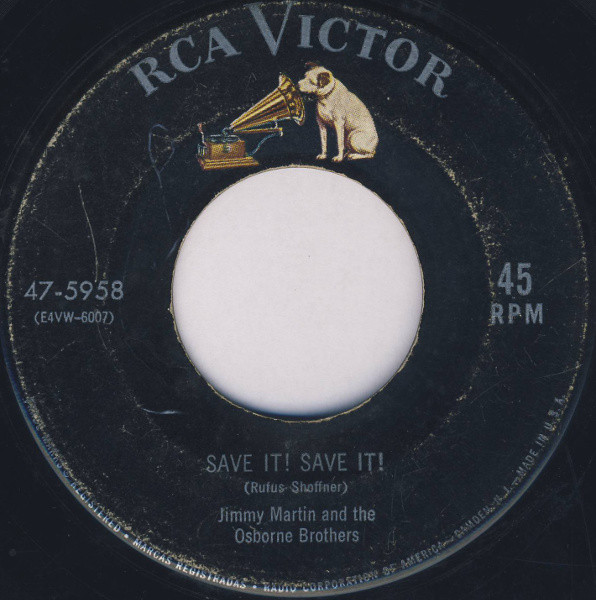
Jimmy Martin and Bobby Osborne first recorded together as members of the Lonesome Pine Fiddlers. Martin, just off his first stint as lead singer and guitarist with Bill Monroe’s Blue Grass Boys, joined the Fiddlers in June 1951. Osborne switched from guitar to mandolin, and on 27 August 1951 the two cut four songs under their own names at King’s studio in Cincinnati, with the Fiddlers’ Charlie Cline on banjo and Curly Ray Cline on fiddle. King issued “Blue Eyed Darlin’” and “You’ll Never Be the Same” in March 1952, credited to Jimmy Martin & Bob Osborne & the Sunny Mountain Boys. Osborne then joined the Marines. He fought in Korea and was discharged in late 1953.
While he was away, his younger brother Sonny had become a banjo player good enough to tour and record with Monroe at fourteen. The brothers first played together professionally in Knoxville on 6 November 1953, and they soon teamed with Martin as Jimmy Martin and the Osborne Brothers. They started at WPFB in Middletown, Ohio, then moved to WJR radio in Detroit and CKLW television in Windsor, Ontario. RCA Victor signed them, and all six of their sides were recorded at one session on 16 November 1954 at RCA Victor’s Nashville studio. Martin played guitar and sang lead, Bobby played mandolin and sang tenor, and Sonny played banjo, with Red Taylor on fiddle and Cedric Rainwater on bass. On “20/20 Vision” and “Chalk Up Another One,” Sonny added a third voice. The songs came from outside writers, and RCA spread them over three singles. “Save It! Save It!” with “20/20 Vision” (RCA Victor 20-5958) came out in December 1954, “Chalk Up Another One” with “I Pulled a Boo Boo” (20-6037) in March 1955, and “They Didn’t Know the Difference (But I Did)” with “That’s How I Can Count on You” (20-6111) in June.
The partnership lasted about a year. The Osbornes left for Wheeling in 1955 and spent a few months working with Charlie Bailey. From early 1956 they worked as a trio with the singer and guitarist Red Allen, and an audition with MGM led to “Once More,” a number 13 country single. Martin stayed in Detroit at the head of a band he called the Sunny Mountain Boys, and in 1956 he began eighteen years with Decca.
Session details drawn in part from the Bluegrass Discography.
Tracklist
- 1 Save It! Save It! Source Recording 2:01
- 2 20-20 Vision alt version 2:43