The “Crawdad Song,” also found as “Crawdad” and “You Get a Line and I’ll Get a Pole,” is a traditional song with no known author. The oldest collected version I could document is Cecil Sharp’s “The Crow-Fish Man,” which he took down from a Mrs. Wilson at Pineville in Bell County, Kentucky, in 1917 and which was published in English Folk Songs from the Southern Appalachians in 1932. The Kodaly Center’s catalogue of the collection classifies it as a street cry of African-American origin, and the Ballad Index notes that Sharp’s informant learned the song from an African-American singer and that the song runs together with the “Sweet Thing” family of songs.
Honeyboy and Sassafras (George Fields and Johnnie Welsh) recorded a “Krawdad Song” in Dallas on 27 October 1929, issued on Brunswick 417 in August 1930, according to Tony Russell’s Country Music Records as cited by Discogs.
The verses float from singer to singer, but the ones in Doc Watson’s version show the usual material. One person tells another to get a line while he gets a pole, and they will go down to the crawdad hole; they sit on the bank until their feet are cold, watching the crawdads jump back into the hole. A man comes along with a sack of crawdads on his back, falls, and busts the sack; and a hen duck tells the drake there are no crawdads in this lake. Each verse ends on the refrain “honey, baby mine.”
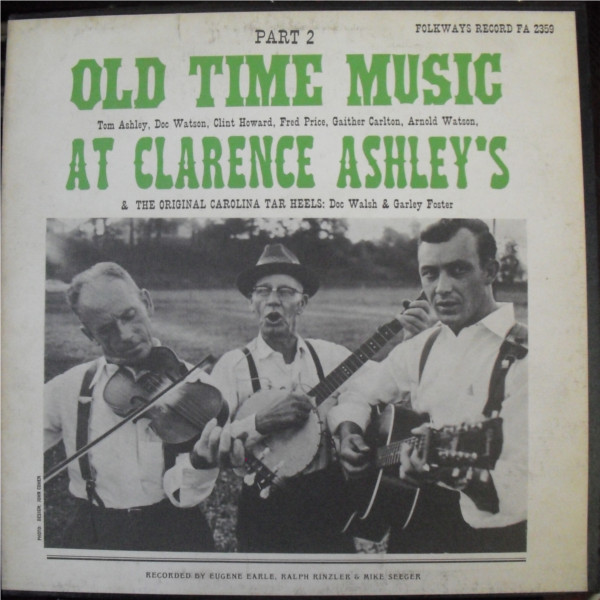
Ralph Rinzler recorded the song for Folkways in the early 1960s, and it is on Old Time Music at Clarence Ashley’s, Part 2 (Folkways FA 2359); the 1994 Smithsonian Folkways CD The Original Folkways Recordings of Doc Watson and Clarence Ashley, 1960–1962 opens with it. Watson later recorded it on Sings Songs for Little Pickers (Sugar Hill, 1990) and as “Crawdad Hole” on The Best of Doc Watson, 1964–1968 (Vanguard). The Flatt and Scruggs television show performed it, according to the 2009 DVD Best of the Flatt & Scruggs TV Show, Vol. 5, and Frank Wakefield recorded it on Blues Stay Away from Me (Takoma, 1980).