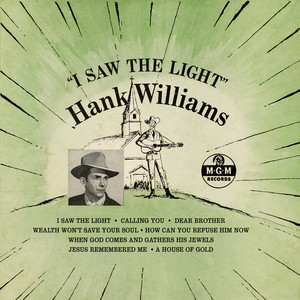
“I Saw the Light” is a country gospel song written by Hank Williams. According to Wikipedia, Williams was returning from a show in Fort Deposit, Alabama, in January 1947, asleep in the back of the car while his mother, Lilly, drove the band back to Montgomery. As she neared the city she spotted the lights of Dannelly Field Airport and woke him with the words “I just saw the light.” He wrote the first draft on 26 January 1947.
The melody is close to Albert E. Brumley’s gospel song “He Set Me Free,” published in 1939 and recorded by the Chuck Wagon Gang in March 1941. Williams’s biographer Colin Escott judged that Brumley could have sued, while also pointing out that Williams’s lyric was a different thing: the prayer of a backslider who hopes for redemption. The words describe a man who wandered through life in sin and would not let his Savior in until Jesus came to him like a stranger in the night; they compare him to the blind man given back his sight, and call him a fool to have strayed from the straight and narrow way.
Williams recorded it at Castle Studio in Nashville on 21 April 1947, the second song of his first MGM session, with Fred Rose producing; MGM held the record until September 1948, when it came out as MGM 10271 with “Six More Miles (To the Graveyard)” on the flip side. By then another singer had beaten him to the market: Clyde Grubb recorded it on 13 August 1947 and RCA issued his version that October. Roy Acuff cut it for Columbia on 11 November 1947. Williams’s own record was not a commercial success on release, but the song later became one of his best-known, and he used it to close his live shows.
The Stanley Brothers recorded it in June 1960 at Magnum Studio in Jacksonville, Florida, for the Starday LP Sacred Songs from the Hills, with Carter Stanley on lead and Ralph Stanley on tenor. Bill Monroe made it the title song of his first gospel album, I Saw the Light (Decca, released 11 August 1958), recorded in Nashville on 25 February 1958 with Edd Mayfield singing lead and Monroe on tenor. At Williams’s funeral in 1953 Roy Acuff led the singing of it, joined on the chorus by Red Foley, Webb Pierce, Carl Smith, Bill Monroe and others.