“The Waves on the Sea” reaches back well before bluegrass, into the broad family of British and Anglo-American sea ballads about ships that never come home. Its closest ancestor is “The Mermaid” — the old sea-disaster ballad that the folklorist Francis Child catalogued as number 289 in his canon of English and Scottish ballads — in which sailors sight a mermaid, an omen, and the vessel goes down. In circulation by the 1760s, the song shed and gathered verses across generations and traveled under a tangle of titles, among them “The Wrecked Ship,” “Three Sailor Boys,” and “The Raging Sea.” By the time it settled into the Southern repertoire the supernatural warning had largely fallen away, leaving the plainer, harder grief at the song’s center.
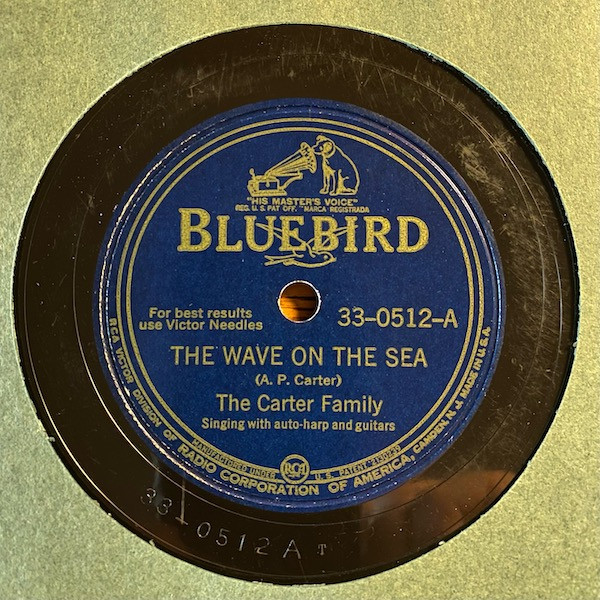
It entered the recorded canon through the Carter Family, who cut it on October 5, 1941, in New York City — part of the last sessions the original trio ever made — and Bluebird issued it on a 78 (33-0512) a few years later. The writer credit reads A.P. Carter, and that credit says something about how the Carter Family worked: A.P. ranged across the mountains collecting and reshaping older songs, then registered them under his own name as arrangements. So the attribution is real and the song is older than the credit — both are true at once, as they are for much of the Carter catalog. Their version keeps no mermaid; what remains is a first-person lover’s lament built on a chorus that turns on the same image each time: “The waves on the sea, how they roll / The chilly winds, how they do blow / My own true love got drownded in the deep / And the ship never got to the shore.”
The song belongs to the maritime-as-grief strain that also carries “Drifting Too Far from the Shore” and “Midnight on the Stormy Deep” — deep water standing in for separation, distance, and death. Bluegrass took it up decades later, and its best-known reading in that idiom is the Johnson Mountain Boys’ 1983 Rounder recording. That band — Dudley Connell’s hard-mountain lead and rhythm guitar, Eddie Stubbs on fiddle, Richard Underwood on banjo, David McLaughlin on mandolin, Larry Robbins on bass — was among the most committed of the early-1980s traditionalists, working in deliberate conversation with the Stanley Brothers and Flatt & Scruggs. Their arrangement is unhurried and restrained, a moderate-tempo vocal in the key of G with a clean slot for chorus harmony, and Connell sings the old lyric straight, letting the loss carry itself.