Johnny Cash’s singles span almost fifty years and four labels. Born in Kingsland, Arkansas, in 1932, he settled in Memphis in 1954 after four years in the Air Force. There he played with two mechanics, Luther Perkins on electric guitar and Marshall Grant on upright bass. Sam Phillips recorded the trio at Sun’s studio at 706 Union Avenue in 1955: “Hey Porter” on 22 March and “Cry Cry Cry” in May. The two were issued together as Sun 221 on 21 June 1955. “Folsom Prison Blues” followed in December. “I Walk the Line,” recorded on 2 April 1956, came out with “Get Rhythm” as Sun 241 that May. “I Walk the Line,” “Ballad of a Teenage Queen” and “Guess Things Happen That Way” all crossed over from the country to the pop charts.
Cash signed with Columbia in mid-1958. His first Columbia session, produced by Don Law on 24 July 1958 at the Bradley Film and Recording Studio on 16th Avenue South in Nashville, had Perkins, Grant, Morris Palmer on drums and Marvin Hughes on piano. It gave him his first Columbia single, “What Do I Care,” issued in September 1958. Sun went on releasing the recordings it still held, the last single appearing in 1964. At Columbia, “Don’t Take Your Guns to Town” (1959) was an early hit, and W. S. Holland joined on drums in 1960.
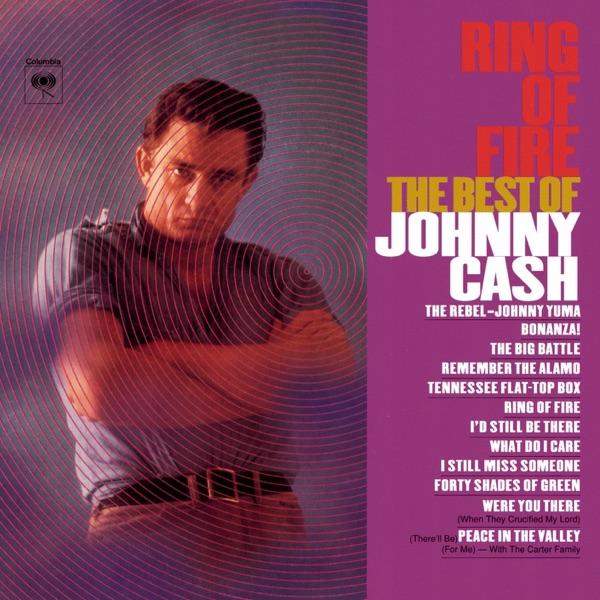
“Ring of Fire” was written by June Carter and Merle Kilgore. Her sister Anita Carter recorded it first, as “(Love’s) Ring of Fire,” in October 1962. Cash cut it on the afternoon of 25 March 1963 at the Columbia Recording Studio, 804 16th Avenue South. Karl Garvin and Bill McElhiney played trumpets, Jack Clement and Perkins guitars, Bill Pursell piano, and Grant and Holland completed the rhythm section, with the Carter Family singing behind him. “I’d Still Be There” was recorded that evening, and the two sides were issued as Columbia 4-42788 on 19 April 1963. The record held No. 1 on the country chart for seven weeks. Cash’s own “Understand Your Man” was recorded on 12 November 1963 with the same trumpeters and Norman Blake on dobro. It came out on 13 January 1964 backed with “Dark as a Dungeon” and spent six weeks at No. 1.
Law encouraged Cash toward the folk revival. The singles of the next years include “It Ain’t Me, Babe” with June Carter (1964), “Orange Blossom Special” (1965) and their duet “Jackson” (1967); the two married on 1 March 1968. His live albums then supplied the hits. A new “Folsom Prison Blues,” from the concert at Folsom Prison on 13 January 1968, went to No. 1. “A Boy Named Sue,” recorded at San Quentin on 24 February 1969 with Bob Johnston producing, reached No. 1 country and No. 2 pop and was the Country Music Association’s Single of the Year.
Columbia singles continued into the mid-1980s. They included “Highwayman” (1985), a No. 1 with Waylon Jennings, Willie Nelson and Kris Kristofferson. Cash left Columbia in 1986 and recorded for Mercury until the early 1990s. He then signed with American Recordings and the producer Rick Rubin, and the label issued “Delia’s Gone” as a single in August 1994. His recording of Trent Reznor’s “Hurt” followed in 2003, the year he died.
Session details drawn in part from the Bluegrass Discography.
Tracklist
- 1 Ring of Fire alt version 2:35
- 2 I'd Still Be There