Bobby and Sonny Osborne were born in Roark, Kentucky, and grew up near Dayton, Ohio. Their first discs were home recordings made at the family farmhouse there and issued on the tiny Kitty label. In the summer of 1952, at fourteen, Sonny was hired by Bill Monroe, and that July he played banjo on Monroe’s Decca sessions in Nashville. On his own he cut banjo instrumentals for the Gateway label, starting with “Sunny Mountain Chimes.” Bobby, meanwhile, was in the Marines. After he came home the brothers teamed up with Jimmy Martin, and their only session together, on 16 November 1954 at RCA Victor’s Nashville studio with Steve Sholes producing, produced six sides, among them “Save It! Save It!” and “20/20 Vision.”
Their own singles began at MGM. The first session, on 1 July 1956 with Red Allen on guitar and vocals, produced “Ruby Are You Mad,” issued that August. It led to a regular place on the WWVA Jamboree in Wheeling that October. On 17 October 1957 they recorded “Once More,” which made the country chart in 1958. It is built on the trio sound they became known for: Bobby sings the lead as the highest part, Sonny the baritone, and Allen the tenor as the lowest voice. The MGM sessions, produced by Wesley Rose and Jim Vienneau, used Nashville studio players early on. Buddy Harman played drums in 1957, and Jimmy Crawford steel guitar in February 1958. Ira Louvin sang the third part on “Give This Message to Your Heart” in January 1959. The Carter Family’s “Fair and Tender Ladies,” cut in November 1960 with Hank Garland on guitar and Pete Drake on steel, came out that December. MGM kept them until early 1963.
Decca signed them in 1963. Their first session there, on 21 August 1963 with Harry Silverstein producing, produced “Take This Hammer” and “Don’t Even Look at Me” and the pairing “The Cuckoo Bird” and “Bluegrass Express.” They joined the Grand Ole Opry on 8 August 1964. Piano, usually Hargus Robbins, appears on their sessions from late 1965. From May 1966 they recorded at Bradley’s Barn in Mount Juliet, Tennessee, where they cut “The Kind of Woman I Got” and “Roll Muddy River.” “Rocky Top,” a song by Boudleaux and Felice Bryant, was recorded there on 16 November 1967, with Hal Rugg on steel and Robbins on piano. Released at the end of that year, it sold 85,000 copies in two weeks. In 1982 Tennessee named it an official state song. “Son of a Sawmill Man” followed in 1968.
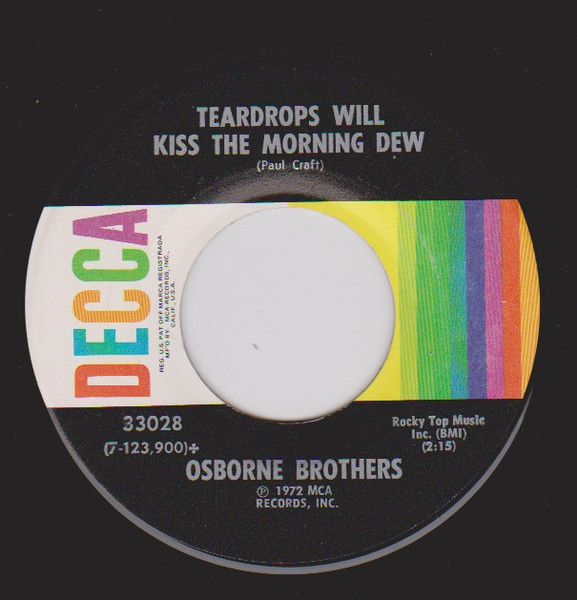
When Decca became MCA the brothers stayed on. “Midnight Flyer,” backed with “Teardrops Will Kiss the Morning Dew,” came out in October 1972. Their last MCA single, “A Born Ramblin’ Man” with “Don’t Let the Smokey Mountain Smoke Get in Your Eyes,” came out in December 1975, before a move to the CMH label in 1976.
Session details drawn in part from the Bluegrass Discography.
Tracklist
- 1 Teardrops Will Kiss the Morning Dew
- 2 Midnight Flyer alt version