“In the Pines” is a traditional song of unknown authorship, formed from the merger of two older songs, “In the Pines” and “The Longest Train.” The folklorist Judith McCulloh, in a 1970 dissertation, traced about 160 variants. She suggested that the songs began around the 1870s, probably in Georgia or nearby, though neither turns up in print or on record from that decade. Norm Cohen, in Long Steel Rail, found three recurring elements: a chorus about the pines, a verse about the longest train, and a verse about a decapitation, with no version carrying all three. Some versions of the train verse mention “Joe Brown’s coal mine,” which may refer to Joseph E. Brown, the Georgia governor who leased convicts to work coal mines in the 1870s.
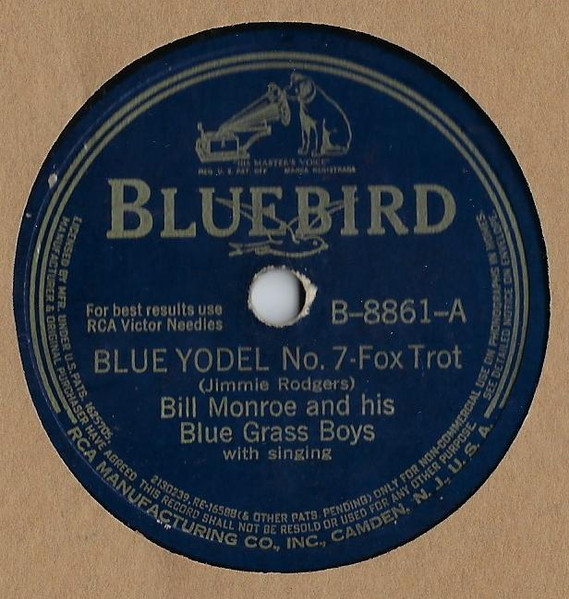
The first commercial recording was made by Dock Walsh, who sang it with banjo for Columbia in Atlanta on 17 April 1926 (Columbia 15094-D). Bill Monroe recorded it twice. The first session was on 2 October 1941 at the Kimball Hotel in Atlanta, with Bill Wesbrooks singing lead, Monroe on tenor and mandolin, Pete Pyle on guitar and Art Wooten on fiddle; Bluebird issued it in November 1941 on B-8861, paired with Jimmie Rodgers’s “Blue Yodel No. 7.” Monroe cut it again at Castle Studio in Nashville on 18 July 1952, this time with Jimmy Martin on lead, Monroe on tenor, Sonny Osborne on banjo, Charlie Cline on fiddle and Ernie Newton on bass. In Monroe’s version the verses are the longest train that went down the Georgia line, the captain who threw his watch away, a long steel rail and a short cross tie, and a girl who has treated the singer badly and caused him to leave home; it has no decapitation verse.
Lead Belly recorded a different branch of the song, “Where Did You Sleep Last Night?” (also known as “Black Girl”), for Musicraft in 1944. A man questions a girl about where she spent the night, and the answer is that her husband has been killed, his head found in a train wheel. That version was the model for Nirvana’s performance on MTV Unplugged on 18 November 1993, released the next year on MTV Unplugged in New York. Because of Lead Belly’s records he is sometimes named as the song’s author, as Kurt Cobain did in introducing Nirvana’s version, but he did not write it. The Louvin Brothers put it on their 1956 album Tragic Songs of Life, and David Grisman’s Dawg Plays Big Mon (Acoustic Disc, 2012) includes a version.