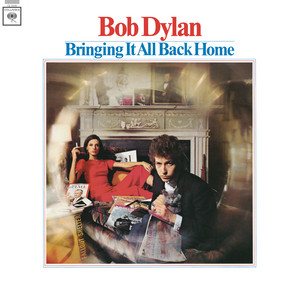
Bob Dylan began writing “Mr. Tambourine Man” in February 1964, after a visit to Mardi Gras in New Orleans during a cross-country road trip, and finished it that spring. He first sang it in public at London’s Royal Festival Hall on 17 May 1964. A June 1964 studio attempt, with Ramblin’ Jack Elliott singing harmony, went unused, and he performed the song at the Newport Folk Festival on 24 July 1964. The released recording was made on 15 January 1965, at the last session for Bringing It All Back Home, with Bruce Langhorne’s electric guitar the only accompaniment to Dylan’s own guitar and harmonica. The album came out on 22 March 1965, with the song opening its acoustic side.
The singer, weary but still unable to sleep at daybreak, calls on the tambourine man to play him a song and promises to follow him; through the verses he asks to be carried away on the music and lose himself in it. Dylan denied that it was a song about drugs. Langhorne, a Greenwich Village session guitarist who often worked with Dylan, has been named as the inspiration for the title figure. He played a large, deep Turkish frame drum that served as a giant tambourine and had brought it to an earlier Dylan session.
The Byrds recorded the song on 20 January 1965, five days after Dylan, using only one of its four verses. Columbia released it in April as the group’s first single, and it reached No. 1 on the Billboard Hot 100 on 26 June 1965 and also topped the British chart; it helped bring folk rock into the pop mainstream, and both the Byrds’ and Dylan’s recordings later received Grammy Hall of Fame Awards. Lester Flatt and Earl Scruggs recorded it at Columbia’s Nashville studio on 20 October 1967, with Flatt singing lead, Paul Warren on fiddle, Buck Graves on dobro and Jake Tullock on bass. It appeared on Changin’ Times (Columbia, January 1968), which set five Dylan songs, among them “Blowin’ in the Wind” and “It Ain’t Me Babe,” beside “Where Have All the Flowers Gone,” “Four Strong Winds” and “This Land Is Your Land.”