“How Great Thou Art” began as a Swedish poem. Carl Boberg (1859–1940), a young preacher in his home town of Mönsterås, wrote “O store Gud” (“O great God”), and it was first printed on the front page of the local newspaper, Mönsterås Tidningen, on 13 March 1886, in nine stanzas of six lines. One account, told by J. Irving Erickson, traces it to an afternoon when Boberg and friends were walking home from a service at Kronobäck. A thunderstorm broke over the fields and then passed, leaving a rainbow, and later, at home, Boberg heard a thrush across the bay and the evening church bells. The poem moves from thunder, rain and birdsong to the Gospel story and the soul’s final rest.
The tune is a Swedish folk melody. By 1890 text and tune had reached Swedish-American churchgoers in Chicago, in the songbook Sionsharpan. Boberg printed the poem with the melody in his own paper, Sanningsvittnet, on 16 April 1891, and the Swedish Mission Covenant’s songbook of 1894 gave the melody the shape still sung today. The poem then spread east. I. S. Prokhanov published a Russian translation in St. Petersburg by 1908, and Manfred von Glehn of Estonia made a German one, “Wie gross bist Du!,” in 1912. The first English translation, by E. Gustav Johnson, was printed in the Covenant Hymnal of 1931.
The English words now sung come from a different route. Stuart K. Hine and his wife, Mercy, British missionaries, went to Western Ukraine in 1923 and learned the hymn there in Prokhanov’s Russian. Hine later wrote that a thunderstorm echoing through a Carpathian village gave him his first English verse. The second came after he heard young believers in Bukovina, over the border in Romania, sing the Russian hymn in the woods to mandolins and guitars. A third verse followed in another village, and he wrote the fourth in 1948, after the couple had returned to Britain. Hine printed the hymn in 1949 in Grace and Peace, the Russian-language magazine he edited, which went free to refugees in many countries.
J. Edwin Orr brought the hymn to the United States in 1954, and Manna Music published it as sheet music in 1955, with two words of the first verse changed. George Beverly Shea had been handed a leaflet of it during Billy Graham’s 1954 London crusade at Harringay Arena. He first sang it at the Toronto crusade in 1955, and at the 1957 New York meetings the choir joined him in it ninety-nine times. Elvis Presley made it the title track of his 1967 gospel album, and his recording won the Grammy for Best Sacred Performance. A live version brought him a second Grammy in 1974.
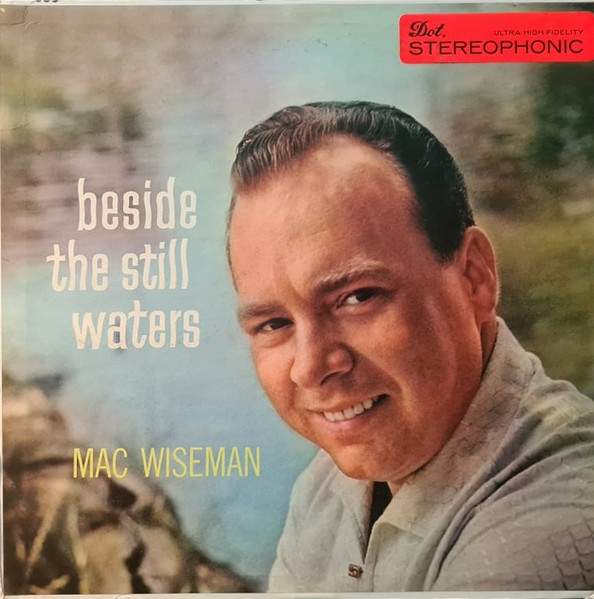
Bluegrass singers took it up early. Mac Wiseman recorded it in Nashville on 22 January 1959, with his own guitar and Joe Zinkan’s bass, for Beside the Still Waters (Dot, 1959). The Osborne Brothers cut it at Bradley’s Barn in Mount Juliet, Tennessee, on 19 February 1968 for Favorite Hymns (Decca, 1969). Bobby Osborne sang the lead and played mandolin, and Sonny Osborne played a five-string dobro.