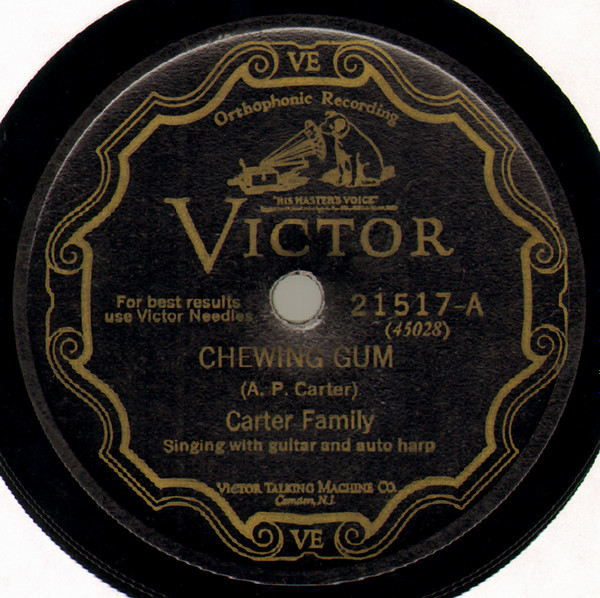
The Carter Family recorded “I Ain’t Goin’ to Work Tomorrow” for Victor on 10 May 1928 at the company’s studio in the Trinity Baptist Church in Camden, New Jersey: Sara Carter singing and playing autoharp, A. P. Carter singing, and Maybelle Carter singing and playing guitar. The same day produced “John Hardy Was a Desperate Little Man,” “Will You Miss Me When I’m Gone?” and “Chewing Gum,” which became the other side of this song’s 78, Victor 21517, credited to A. P. Carter. Montgomery Ward reissued the coupling in 1937. The researcher Richard Matteson calls it a traditional song the Carters arranged, notes that its lyrics turn up in collected versions of “Darlin’ Corey,” and lists it in the repertoire of the Kentucky musician Lily May Ledford.
The singer says he won’t work tomorrow or the day after, since it may be a rainy day, and that he is leaving the country and going around the world “for the sake of one little girl.” The Carter Family’s verses add that she said she loved him and is now courting whoever she pleases, and that he has lost his money gambling and is “nobody’s darling.” The song ends with his banjo ringing, pretty girls laughing on the cold ground, and the singer hanging his head in sorrow as his darling passes by.
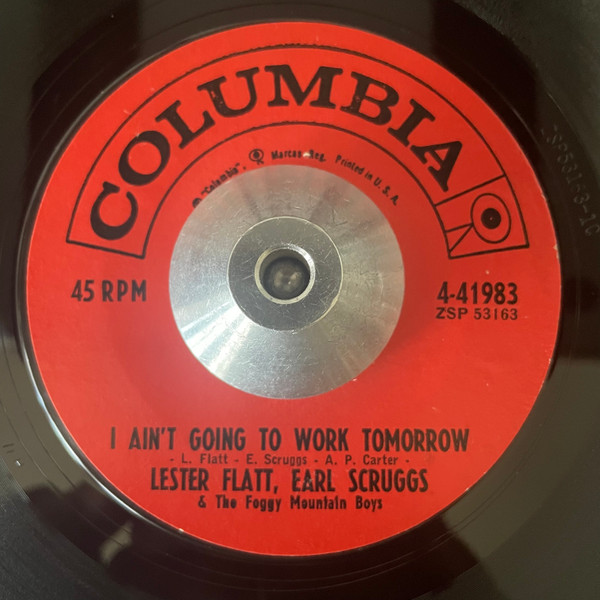
Wilma Lee and Stoney Cooper recorded it for Columbia in New York on 20 February 1950, with Wilma Lee singing lead and playing clawhammer banjo and Tex Logan among the fiddlers; Columbia 20686 came out that April. The Country Gentlemen cut it in January 1960 at Capitol Transcriptions in Washington, with John Duffey singing the verses and tenor, Charlie Waller singing lead in the chorus, Eddie Adcock on banjo and Jim Cox on bass; Starday did not release it until December 1962, on an LP titled The Mountain Music Sound of the Stanley Brothers. Lester Flatt and Earl Scruggs recorded it on 3 February 1961 at the Bradley Film and Recording Studio in Nashville, with Flatt singing lead, Curly Seckler singing tenor and playing mandolin, Josh Graves on dobro, Paul Warren on fiddle, Jake Tullock on bass and Doug Kirkham on drums. Columbia released it on 3 April 1961 with “If I Should Wander Back Tonight” (4-41983), crediting Flatt, Scruggs and A. P. Carter. Maybelle Carter recorded it again, as “Ain’t Gonna Work Tomorrow,” for her 1964 Smash album Pickin’ and Singin’.