“Midnight Special” is a traditional song thought to have come from prisoners in the American South. It takes its name from a passenger train, and its chorus asks the Midnight Special to shine its “ever-loving light” on the singer. Some of its lines were printed by the folklorist Howard Odum in 1905, but those were floating verses shared with other African-American songs of the time, among them songs about prison captains that mention no train. The first printed reference to the song itself came in the pulp magazine Adventure in 1923, and Carl Sandburg published two versions in The American Songbag in 1927.
The first commercial recording was made in 1926 for OKeh by Dave “Pistol Pete” Cutrell of McGinty’s Oklahoma Cow Boy Band. He called it “Pistol Pete’s Midnight Special” and added comic verses about the band. The band, by then under Otto Gray, recorded it again in March 1929 with the traditional words. In between, in 1927, Sam Collins recorded “Midnight Special Blues” for Gennett, the first version to name the woman in the story, Little Nora. That same year Wilmer Watts and Frank Wilson recorded essentially the same song as “Walk Right In Belmont,” placing it in North Carolina.
In 1934 John and Alan Lomax recorded Huddie “Lead Belly” Ledbetter singing it at Angola prison. The Lomaxes wrongly attributed the song to him, though his version seems to add stanzas about a 1923 Houston jailbreak. In their telling, the Midnight Special was a train out of Houston whose light shone into a cell at the Sugar Land prison farm. Sandburg read the song differently, as a convict who would sooner die under the train than serve out his time. A legend of uncertain origin holds that a prisoner the light fell on would soon be freed. Lead Belly recorded it again in June 1940 with the Golden Gate Quartet, and Victor issued it in 1941.
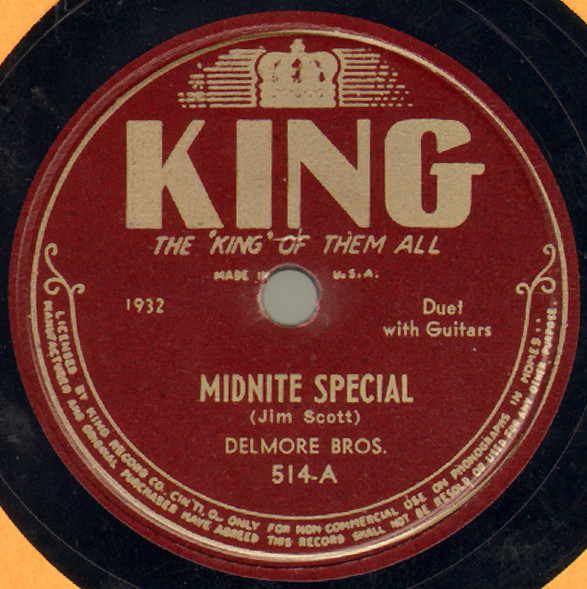
Country performers took it up early. The Delmore Brothers cut it as “Midnite Special” for King in 1945. Wilma Lee and Stoney Cooper recorded a reworking, “Big Midnight Special,” at Bradley Studio in Nashville on 18 March 1958, and in 1959 the Hickory single reached number four on Billboard’s country chart. Mac Wiseman recorded it in Akron, Ohio, in April 1966 for Rural Rhythm. Cliff Waldron and Bill Emerson cut it in 1969 at Unity Recording Studio in Washington, D.C., for their Rebel album Bluegrass Country, with Waldron singing lead, Emerson tenor and Mike Auldridge baritone. On the pop charts, Paul Evans took it to number 16 in 1960 and Johnny Rivers to number 20 in 1965. Rivers’s version became the theme of NBC’s The Midnight Special.