Murder Ballads: The Dark Spine of the Bluegrass Songbook
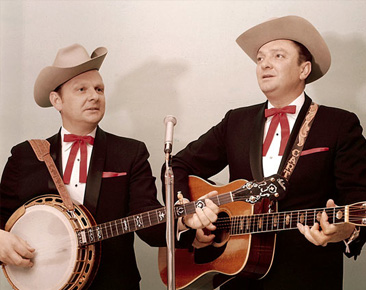
The song begins with a young man, Willie, courting a young woman, Polly. He persuades her to come walking with him over mountains and valleys. As they go on she grows afraid; she tells him so. He confirms her fear: he has spent most of the night before digging her grave. They walk a little farther and there it is, a new-dug grave with a spade lying by. She kneels and pleads. He refuses. He stabs her in the heart, throws a little dirt over her, and runs — leaving, as the last verse has it, a debt to the devil to pay. The melody is modal, played over a five-string banjo that drones underneath the voice. The voice is high and keening, and it tells the story without any particular distress. The song is “Pretty Polly,” and it is a bluegrass standard. The Stanley Brothers recorded it for Columbia in February 1950. It is in the working repertoire of effectively every working bluegrass musician alive. People play it at jams — and for the murder ballad the whole room sings along on, there is “Banks of the Ohio.”
That is the disquieting fact this piece is about. The bluegrass and old-time canon contains an astonishingly deep catalog of songs about real and fictional murders, sung in straightforward language by performers who do not flag the violence as exceptional or psychologically interesting. The songs are unstrange, in performance. They are sing-along material. Where they come from, who they are about, why the tradition holds onto them, and how the contemporary scene has begun to grapple with their gender politics — those are the questions this essay tries to address.
The broadside trade as cheap journalism
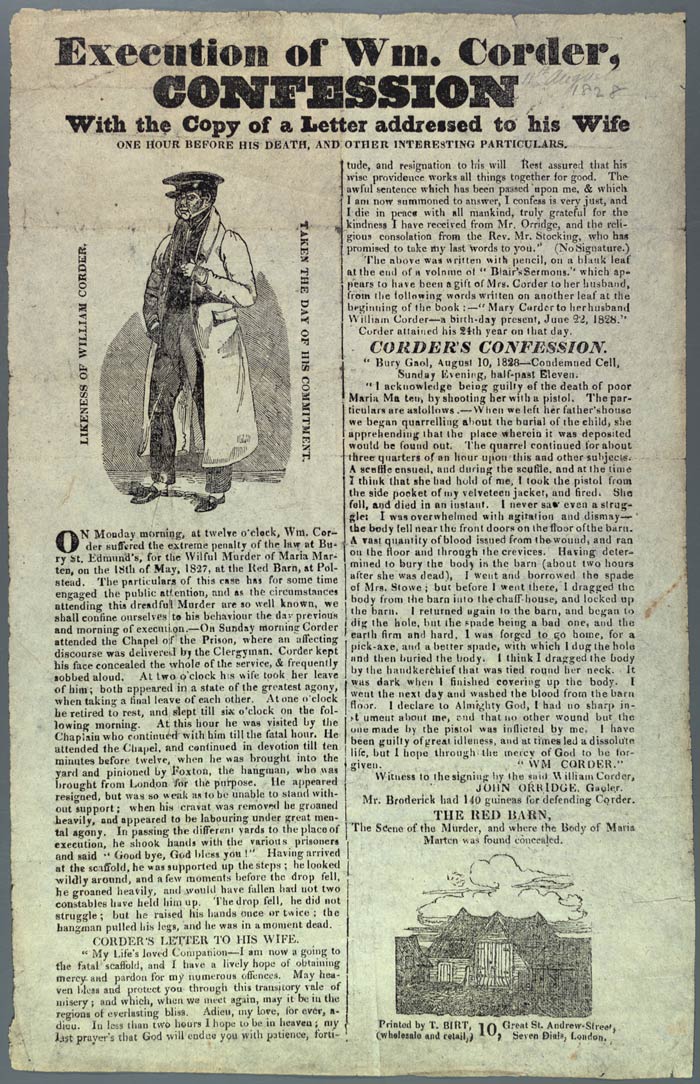
Pretty Polly is not, despite what its mountain-music sound suggests, one of the ancient ballads catalogued by the Victorian scholar Francis James Child, nor an ancient English folk song at all. It is a compressed and Americanized version of a 1720s English broadside titled “The Gosport Tragedy, or The Perjured Ship Carpenter,” which ran to forty-seven verses in its original printing and told a longer and more melodramatic story. The broadside was a printed half-sheet of cheap paper, sold for a penny or two at hangings and at country fairs across England in the seventeenth, eighteenth, and nineteenth centuries. The trade in broadsides was, in commercial terms, the era’s tabloid press. Printers in London and Newcastle and Bristol ran small-format presses that turned out new ballads after every notable execution, every notable scandal, every notable shipwreck or murder. The songs were sold for entertainment, for moral edification, and for the same prurient pleasure that the murder-podcast economy serves today. The folklorist D.K. Wilgus wrote in his 1959 study Anglo-American Folksong Scholarship Since 1898 that the broadsides were “the journalism of an age before journalism.” That is the right framing.
When the broadsides crossed the Atlantic in the eighteenth century — carried by indentured servants, by deck passengers, by the printed sheet-music trade — they took up residence in Anglo-American oral tradition and shortened. The forty-seven-verse Gosport Tragedy became, by the time it was being sung in the mountains of western Virginia and eastern Kentucky in the nineteenth century, the twelve-or-fewer-verse “Pretty Polly.” The full backstory dropped out: the sailor’s perjury, the ghost that appears to him at sea, his eventual confession and execution. What survived was the part of the story that worked as song — the courtship, the betrayal, the murder, the burial. Bluegrass and old-time inherited the lean version.
The same pattern produced most of the British-derived murder ballads inside the bluegrass canon. “The Berkshire Tragedy,” another lurid eighteenth-century broadside, became “The Wexford Girl,” then “The Oxford Girl,” and finally, in mid-nineteenth-century Appalachia, “Knoxville Girl.” The Louvin Brothers cut a widely-known version for Capitol in 1956. “Down in the Willow Garden,” another broadside-derived song under the alternate title “Rose Connolly,” entered the catalog by the same route. None of these songs are old in the sense of having been collected by Francis James Child. They were the popular journalism of their day, and their journey from London-printed half-sheet to Appalachian dance call took roughly a century.
What Francis Child kept out
This is the place to address the most common misconception about murder ballads in the bluegrass canon — that they are old English songs in some quasi-medieval sense. Most of them are not. The misconception comes from the way the music’s revival audience first encountered the catalog, which was through the work of Francis James Child, the Harvard professor of English who, between 1882 and 1898, compiled five volumes of English and Scottish Popular Ballads. Child collected 305 ballads — what he believed were the genuinely traditional, pre-broadside songs of the British Isles. He rejected most broadsides outright. They were, in his view, “vulgar,” “of inferior origin,” “the products of hack writers and ballad-mongers.” The Child Canon, as it became known after his death, set the standard for what a “real” English ballad was.
Murder ballads in the bluegrass canon — “Pretty Polly,” “Knoxville Girl,” “Banks of the Ohio,” “Down in the Willow Garden,” “Omie Wise,” “Tom Dooley,” “Poor Ellen Smith” — are, with a few exceptions, not in the Child Canon. They are exactly the kind of broadside material Child would not have included. The ballads in the canon that are Child ballads — “House Carpenter,” “Matty Groves” (which the Stanley Brothers recorded as “Little Mathie Grove”), “The Two Sisters” (which the Carolina Tar Heels and dozens of others recorded as “Dreadful Wind and Rain”) — are murder ballads of a different kind: older, more allegorical, more concerned with revenants and otherworld punishment. The newer broadside murder ballads are more concrete. They name a county. They sometimes name a victim. They sound like newspaper stories that got set to music, because, in their original broadside form, they essentially were.
The scholarly correction to the Child-canon myth runs through the 1959 Wilgus monograph, through Bertrand Bronson’s mid-century work on melodic tradition, and most pointedly through Anne Cohen’s 1973 book Poor Pearl, Poor Girl: The Murdered-Girl Stereotype in American Folksong, which traced the genre as a continuous American tradition from broadside to twentieth-century recording. Cohen’s work is what scholars now build on. The point her book makes that is most useful for a listener of bluegrass is that the murder ballads are not artifacts. They are a working form that has been continuously updated, in song after song, across three centuries, and was being added to as late as the mid-twentieth century.
Real American crimes
The American murder ballads — the ones not directly imported from British broadsides — come from a deep run of nineteenth- and early-twentieth-century crimes that became famous regionally and then nationally through their ballads.
Naomi “Omie” Wise was a young woman in Randolph County, North Carolina, who was drowned in the Deep River around 1808. Her killer was Jonathan Lewis, who had courted her with a promise of marriage, then murdered her when she became pregnant and her social class threatened his plans to marry a wealthier woman. Lewis fled the area, was caught and returned, was tried in Asheboro in 1815, and was acquitted on what appears to have been local-political grounds. The ballad — “Omie Wise” or “Naomi Wise” or “Poor Omie” — circulated locally from the time of the murder and was first published in the 1850s. It has been recorded by Doc Watson, Joan Baez, Bob Dylan, Pentangle, and dozens of bluegrass and old-time bands.
Frankie Silver, in Burke County, North Carolina, killed her husband Charles with an axe in 1831 and was hanged for it on July 12, 1833, in Morganton — often cited as the first woman executed by the state of North Carolina, though local records make the precise priority debatable. The ballad attributed to her — “The Ballad of Frankie Silver,” in which the singer assumes Frankie’s first-person voice on the gallows — was almost certainly not written by Frankie herself, but the convention that she wrote it on her last night has persisted. The Frankie Silver case has become, in recent decades, a feminist counter-reading project; several modern scholars and novelists have argued that the killing was self-defense against an abusive marriage and that the local-court verdict was a class judgment.
Tom Dula, a young Confederate veteran, was hanged in Statesville, North Carolina, on May 1, 1868, for the murder of Laura Foster in Wilkes County. The case was sensational at the time — Dula was defended by former North Carolina governor Zebulon Vance, who took the case pro bono — and the resulting ballad, “Tom Dooley,” circulated in the region for the next sixty years before G.B. Grayson and Henry Whitter recorded the first commercial version for Victor in 1929. The Kingston Trio’s 1958 folk-pop hit version sold more than three million copies and prompted the second wave of the urban folk revival. Doc Watson’s 1964 reading on his self-titled Vanguard record is the version most contemporary listeners come to.

Poor Ellen Smith, in Forsyth County, North Carolina, was shot in July 1892. Her boyfriend Peter DeGraff was hanged for the killing in February 1894. The ballad, “Poor Ellen Smith,” has been recorded by the Carolina Tar Heels, Wade Mainer, the New Lost City Ramblers, and many bluegrass bands. Pearl Bryan, of Greencastle, Indiana, was found decapitated in Fort Thomas, Kentucky, in February 1896; two Cincinnati dental students, Scott Jackson and Alonzo Walling, were hanged for her murder in March 1897. Her case, which made the front pages of newspapers across the country, generated multiple competing ballads, which Anne Cohen catalogued in her book.
The form continued to absorb new American crimes well into the twentieth century. Charlie Lawson, a tobacco farmer in Stokes County, North Carolina, murdered his wife and six of his seven children on Christmas Day 1929, then killed himself. The Stanley Brothers’ 1961 recording “The Story of the Lawson Family,” written by Walter “Kid” Smith within months of the killings, is one of the genre’s most documentary entries; the song lays out the day’s events in newspaper-narrative form.
Even the assassination of President William McKinley — shot in Buffalo on September 6, 1901, by the anarchist Leon Czolgosz; dead a week later — got the broadside-ballad treatment, as “White House Blues” / “McKinley’s Rag.” Charlie Poole and the North Carolina Ramblers recorded it on September 20, 1926 for Columbia; Bill Monroe re-recorded it in 1954. The murder-ballad form, in other words, was still working as journalism into the early twentieth century, well after the establishment of regular daily newspapers.
Beyond the real-crime ballads ran a parallel run of first-person killer narratives whose protagonists may or may not have ever existed. “Little Sadie” is the form working at its most economical: a man goes out at night, meets Sadie, shoots her down, goes home and sleeps with his pistol under his head, wakes the next morning to see her funeral procession passing through town, runs for it, is caught at Jericho by the sheriff from Thomasville, and confesses (“I shot little Sadie in the first degree”). The song has been a bluegrass and old-time standard since the 1920s; Doc Watson, the Stanley Brothers, and Bob Dylan have all recorded versions. “Lonesome Wind” runs the same form slower — the killer-narrator is alone at night with the wind howling and the woman he killed “in the cold hard ground beneath the setting sun,” the song’s chorus a confession he keeps repeating to nobody. Both songs sit on the same emotional architecture as “Pretty Polly” without the narrative scaffolding of a Gosport-Tragedy ancestor: they are American compositions in the older British form, and the form has kept producing them.
Why bluegrass holds onto them
The murder ballad’s persistence in bluegrass and old-time has a few overlapping explanations. The first is structural. The form is musically simple — usually a sixteen- or twenty-bar AABA or AABB melodic structure, often in a modal key, often with a single repeated melodic figure that varies only at the cadence — and the lean structure suits an oral tradition in which the song has to be remembered without sheet music. Murder ballads are easy to learn and easy to teach. They survive because they are easy to carry.
The second is theological. The bluegrass musicians who built the canon — Bill Monroe, the Stanley Brothers, Lester Flatt, the Carter Family before them — came from a religious world (hard-shell Baptist, Pentecostal, Methodist) in which sin and judgment were operative, daily, and the songs were doctrinally consistent with the rest of their music. Pretty Polly never goes to heaven. The killer’s grief is not redemptive; he just hangs. The same artists who recorded these songs recorded gospel records about salvation, and the two bodies of work were understood as complementary — the gospel records about the road home, the murder ballads about the road that does not lead there.
The third is more specific. The Stanley Brothers, in particular, made murder ballads central to their identity, in a way Bill Monroe and Flatt and Scruggs did not. Their early Columbia and King records contain a higher proportion of murder material than any other major bluegrass act’s catalog: “Pretty Polly,” “Little Glass of Wine,” “Hills of Roan County,” “Wild Bill Jones,” “The Story of the Lawson Family.” Carter Stanley wrote “Little Glass of Wine” himself in the late 1940s — a new murder-suicide ballad in the older form, in which the jealous lover poisons the wine, drinks the same glass, and tells his dying girlfriend, in the final verse, that he has drunk the same poison; they fold their arms around each other and die together. It is one of the clearest pieces of evidence that the form was still a working compositional idiom for traditional musicians as late as the 1940s.
The fourth explanation has to do with where these songs were sung. In the mountain South of the early twentieth century, where the courthouse was distant and the local law was personal, the ballad was a form of community memory. When a real murder happened in a county, the ballad about it carried, across the generations after, the information about who did it, who was killed, and what the locals knew. The verdict in the courtroom was one record; the ballad was another. Sometimes they agreed; sometimes they did not. The Frankie Silver case is a well-documented instance, but the pattern holds elsewhere. The ballad functioned as a form of vernacular history that the legal record could not erase.
The gender problem
An uncomfortable structural feature of the bluegrass murder-ballad canon is that the victim is, in nearly every case, a young woman, and the killer is, in nearly every case, the young man who has been courting her. The folklorist Anne Cohen, in her 1973 monograph, named this the “murdered-girl stereotype” and documented its persistence from eighteenth-century broadsides through twentieth-century country recordings. Pretty Polly is murdered by Willie. Omie Wise is drowned by Jonathan Lewis. Poor Ellen Smith is shot by Peter DeGraff. The Knoxville Girl, the Wexford Girl, the Berkshire Tragedy girl, Rose Connolly of the Willow Garden — all murdered by their lovers. The songs are not, generally, told from the woman’s perspective. They are told from the killer’s, or from a narrator who sits closer to him than to her.
The contemporary engagement with this canon has, over the last thirty years, taken the form of inversion and reclamation. Gillian Welch and David Rawlings wrote “Caleb Meyer” for the 1998 record Hell Among the Yearlings. In the song, the title character finds the narrator Nellie Kane alone in her cabin and attacks her. She fights back and kills him. The song uses the modal, droning mountain-murder-ballad form — two guitars and a voice — but the woman survives and the man dies — a direct reversal of the genre’s standard architecture.
Around “Caleb Meyer,” a broader contemporary engagement has formed. Anna and Elizabeth (Anna Roberts-Gevalt and Elizabeth LaPrelle), working in the Virginia and Appalachian old-time tradition, have spent the last decade recording and re-staging the older ballads with attention to whose voice is in the song and what the song is doing politically. Sarah Jarosz, Sierra Ferrell, Aoife O’Donovan, the I’m With Her trio, and the various Andrew Marlin projects have all engaged with the canon’s gender architecture in their own work. The Carolina Chocolate Drops, before the band split, were a significant presence in the same conversation, particularly through Rhiannon Giddens’s recovery of Black string-band murder ballads (such as “Snowden’s Jig” and the work she has done on the Pearl Bryan case in her later solo records).
None of this engagement is calling for the older songs to be retired. The contemporary musicians, almost without exception, continue to record and perform Pretty Polly, Knoxville Girl, Omie Wise, Tom Dooley, and the rest. The work is, instead, to keep the songs alive while also being audible about what they are — to sing them with the understanding that the form’s standard victim is a young woman, the form’s standard narrator is the killer or his sympathetic neighbour, and the form’s politics have always been worth thinking about.
What survives
The closing thing worth saying about the murder ballads in the bluegrass and old-time canon is that they are, for the women they are about, often the only surviving voice. Naomi Wise left no diary. Laura Foster left no letters. Pearl Bryan’s family destroyed most of her papers after her death. What we have, three hundred or one hundred and fifty or one hundred years later, is the song that someone wrote about the killing, which a community kept singing because the killing mattered to it. The song is, in nearly every case, a kind of memorial — an imperfect, often misogynist, often factually unreliable memorial, but a memorial nevertheless. The ballads about the killers are also the ballads about the women they killed. The form is the only one that carried the names this long.
The ethical problem in performing them now is not, in the end, the existence of the songs. It is the question of what a singer can do with their attention. The best contemporary engagement with this canon — in the Welch-Rawlings work, in the Anna and Elizabeth projects, in the way Sarah Jarosz reads Pretty Polly — refuses neither the song nor the woman. The performer holds both at once. That is, finally, what the bluegrass murder-ballad tradition has been doing, in its better moments, all along.