The Blues and the Roots of Bluegrass
On October 7, 1940, in Atlanta, Bill Monroe and His Blue Grass Boys walked into RCA’s studio and recorded eight sides for Bluebird. The third song they recorded that day was a Jimmie Rodgers number from a decade earlier, “Blue Yodel No. 8,” which Rodgers had subtitled “Mule Skinner Blues.” Monroe sang it in his high tenor, his band pushed the tempo into what would, half a decade later, be heard as the founding bluegrass groove, and the song became a Monroe standard for the rest of his career. The form comes straight out of the blues — Rodgers’s blue-yodel family, its phrases stretched and bent around Monroe’s drive rather than squared to a tidy twelve-bar grid — and Monroe sang it with the blue thirds intact. (When Monroe wanted an actual textbook twelve-bar, he wrote one: “Rocky Road Blues,” cut in 1945, is a standard AAB blues that traveled back out of bluegrass into blues and rock and roll.) The single — Bluebird B-8568 — became, retroactively, one of the source documents of bluegrass.
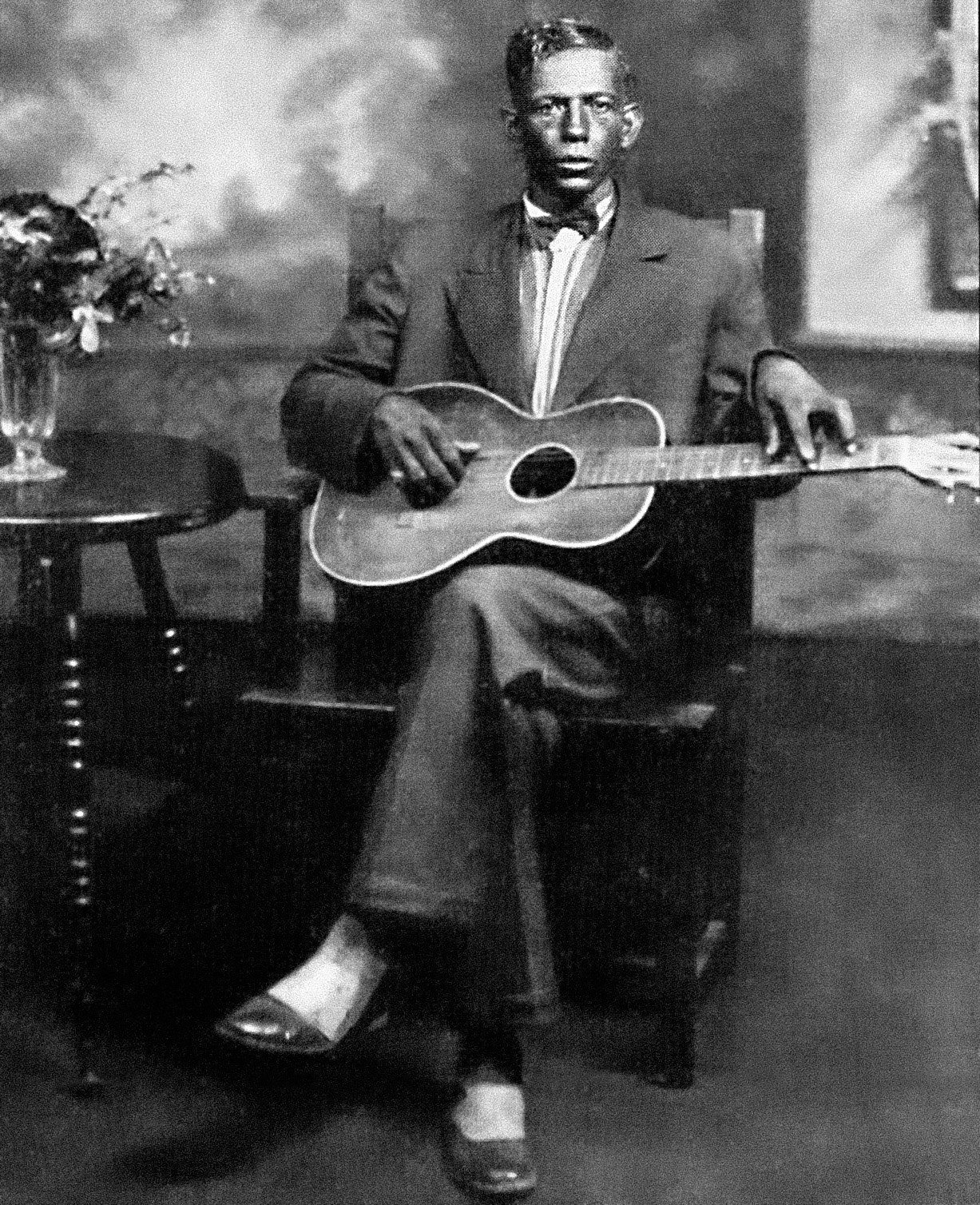

This piece is about the blues vocabulary inside the bluegrass and old-time tradition — what it sounds like, where it came from musically, and how it has been put to use in the recorded catalog. The vocabulary is older than any of the genre labels involved. It runs from the early-twentieth-century commercial recordings of Charlie Poole and Dock Boggs through the Monroe catalog and the Stanley Brothers’ modal G material and forward into the contemporary scene. Most working bluegrass listeners hear it without naming it. It is one of the things that makes the music sound the way it sounds.
What blues means inside bluegrass
The word blues in a bluegrass context does not mean the twelve-bar electric form that Muddy Waters, B.B. King, and the postwar Chicago labels built into a distinct commercial genre. It means something older and more specific: the inflection of an otherwise major-key melody with blue notes — the flatted third (a half-step below the major third), the flatted seventh (a half-step below the major seventh), and the flatted fifth where it occurs. The blue notes are not in the standard Western major scale. They are in the scale the early American banjo and fiddle and guitar players were actually using, which was a working hybrid of the European major scale, the Anglo-Celtic pentatonic, and the African-derived inflections that came up through the southern oral tradition.
A working musician hears it as feeling. The melodic line bends downward at the third or seventh; the cadence resolves more slowly than a strict major-key piece would; the singer drags the bent note a fraction of a beat. In Bill Monroe’s mandolin solo on “Bluegrass Stomp,” the figure that opens the second eight bars is built around a flatted third. In Dock Boggs’s banjo playing on “Country Blues” or “Sugar Baby,” the modal G tonality reaches consistently for the flatted seventh. In Charlie Poole’s vocal on “White House Blues” or “Don’t Let Your Deal Go Down Blues,” the bent thirds come in at the cadence of nearly every verse. The musicians did not have a vocabulary for what they were doing — the term “blue note” is mid-twentieth-century musicology — but they were doing it consistently.
The blues vocabulary, in this older sense, was already part of Anglo-American string-band music by the 1920s, when the commercial recording industry first began capturing the tradition. Where it came from musically is the next question.
The banjo’s deep history
The five-string banjo, the instrument at the literal center of bluegrass, is a West African instrument by descent. It is the same family as the Senegambian akonting and the Wolof xalam — a gourd or wooden body with a stretched skin head and a long fretless neck. The instrument was carried to the Americas across the colonial period and through the nineteenth century. The earliest American printings of banjo notation date to the 1830s, with the minstrel-show banjoist Joel Walker Sweeney; the fifth string (the drone string that any bluegrass banjo player uses today) appears to have been added in the 1830s as well, possibly by Sweeney from a Black source. The folklorist Cecelia Conway documented the instrument’s earlier African and African-American American history in her 1995 book African Banjo Echoes in Appalachia, drawing on field recordings she had made with elderly North Carolina Piedmont banjoists in the 1970s. The instrument was already two centuries old in the New World by the time it reached the southern Appalachian musicians who would, in the 1920s, begin recording it commercially.
This deep history matters for a listener of bluegrass because the instrument’s tonal vocabulary — the open drone string, the rhythmic right-hand attack, the modal scale possibilities — sits closer to its older origins than to the European fingerpicking traditions the bluegrass guitar comes from. The banjo lends itself naturally to blue inflections. Earl Scruggs’s three-finger style adapted these older possibilities into a forward-driving postwar virtuoso form. Clawhammer banjo retained more of the older idiom directly. Both styles, when a working bluegrass musician plays them, are using a tonal vocabulary that has been continuously evolving for several centuries.
Jimmie Rodgers’s Blue Yodels
The single most important conduit by which twelve-bar blues form entered the country and early bluegrass tradition was Jimmie Rodgers, the Mississippi-born singer who had worked as a railroad brakeman before his tuberculosis forced him into entertainment and who recorded continuously between 1927 and his May 1933 death. Across his six-year recording career, Rodgers cut thirteen songs in a series he labeled “Blue Yodels,” numbered 1 through 13 — “T for Texas” (Blue Yodel No. 1, 1927), Blue Yodel No. 8 subtitled “Mule Skinner Blues” (1930, the one Monroe would later cover), Blue Yodel No. 9 recorded with Louis Armstrong on cornet, and the rest. The songs are mostly twelve-bar blues, with the standard AAB lyric structure, sung in Rodgers’s high voice with a yodel break at the end of each verse and (in most cases) acoustic guitar accompaniment.
Rodgers was, in essence, importing Mississippi blues phrasing and song form into the white southern country idiom. He had grown up around Black musicians in Meridian, Mississippi; he played in mixed-race work environments in his railroad-brakeman years; and the blues language was a working part of his musical vocabulary from the start. The Blue Yodels sold enormously — estimated twenty million records across his catalog before his death — and put the twelve-bar blues form in front of every working country and early bluegrass musician who came of age in the 1930s and 1940s. Bill Monroe’s “Mule Skinner Blues” is a Jimmie Rodgers cover, recorded a decade after Rodgers cut it himself, in Monroe’s own arrangement.
The blues vocabulary in the bluegrass canon
By the time bluegrass coalesced as a commercial category in the late 1940s, the blues vocabulary had become a normal part of its working syntax. Several distinct forms of the language run through the catalog.
The first is the literal twelve-bar blues. Bill Monroe’s “Rocky Road Blues” is the textbook case — a standard twelve-bar AAB that blues and rock-and-roll bands later claimed right back. The traditional “Lonesome Road Blues,” recorded by effectively every generation of pickers, and the Delmore-lineage “Blues Stay Away From Me” are blues in form and feel, and Monroe’s “Bluegrass Stomp” works the same blues-derived ground as an instrumental. The subgenre that Earl Scruggs developed — the breakdown — sits structurally on the same family of forms.

The second is the modal-with-blue-thirds material. The Stanley Brothers’ early Columbia catalog is full of it: “Pretty Polly” with its droning modal banjo and flatted third, “Little Maggie” with its bent vocal phrasing, “Man of Constant Sorrow” with its modal opening and slow blues-form resolution. Ralph Stanley’s banjo playing across the band’s whole career used the older drone-and-blue-third idiom that Cecelia Conway’s research had traced back to the older African-American banjo tradition. Roscoe Holcomb’s modal banjo recordings on Folkways in the 1960s pushed the same vocabulary further than any commercial bluegrass act did.
The third is the song repertoire itself — songs that crossed back and forth between blues and bluegrass with no particular border check. “John Henry” (the ballad of the real Big Bend Tunnel steel-driver, killed by his own hammer race against a steam drill around 1870) was recorded by Mississippi John Hurt, Furry Lewis, the Lilly Brothers, Hylo Brown, Earl Taylor, Ralph Stanley, Doc Watson, and the Del McCoury Band, in versions that ran from acoustic country-blues through hard-traditional bluegrass. “Going Down This Road Feeling Bad” appears on a 1923 Henry Whitter record, a 1929 record by Black guitarist Sam McGee and his partner Henry Lewis, in the Carter Family’s 1934 Decca catalog, in Woody Guthrie’s mid-1940s Library of Congress recordings, and as a Bill Monroe staple from 1945 onward. The songs did not know they were supposed to be in one genre or the other. The musicians who recorded them did not care.
Arnold Shultz
The most direct documented influence on Bill Monroe’s mandolin style is the Western Kentucky guitarist Arnold Shultz. Shultz was born around 1886 in Ohio County, Kentucky, and worked his life in the coal-camp economy around Rosine, where Monroe grew up. He played fiddle, banjo, and especially guitar, in a thumb-and-fingers style with a blues vocabulary, and was widely admired across both Black and white musical circles in the region. He died in 1931 at about forty-five years old.
Monroe told the story of Shultz throughout his life, in interviews with Ralph Rinzler and others. He had attended square dances as a boy in Rosine where Shultz played, had sat in with him on mandolin when the older man let him, and had watched how Shultz used blue notes inside what was otherwise a fiddle-tune and square-dance repertoire. Monroe’s mandolin style — the bent strings, the blue-thirded melodies on “Bluegrass Stomp” and “Wheel Hoss,” the long bluesy improvisations on certain tunes — came in part from listening to Shultz play. Monroe was the only one of bluegrass’s founding generation who was explicit about a specific guitarist as a source for what he was doing. Other founding figures had absorbed similar influences from similar sources without naming them.
The contemporary scene
The bluegrass and old-time tradition’s engagement with this vocabulary has continued, in fresh recordings, across the recent generation. The Carolina Chocolate Drops, formed in 2005 by Rhiannon Giddens, Dom Flemons, and Justin Robinson, learned the older string-band repertoire directly from the elder North Carolina Piedmont fiddler Joe Thompson and recorded a catalog that drew on blues, country, ragtime, and minstrel-era material in approximately equal proportions. Their second record, Genuine Negro Jig, won the Grammy for Best Traditional Folk Album in February 2011. The band brought a range of older repertoire back into the contemporary scene that had been out of working circulation for a generation.
Giddens has gone on to a major solo career. Her 2015 Nonesuch record Tomorrow Is My Turn, produced by T Bone Burnett, drew on songs by Dolly Parton, Patsy Cline, and Odetta. Her 2017 Freedom Highway and 2023 You’re the One have continued the work. In 2023 she co-wrote the libretto for the opera Omar, with composer Michael Abels, which won the Pulitzer Prize for Music.
The blues vocabulary in current bluegrass
Inside contemporary working bluegrass, the blues vocabulary is in continuous use, often in places a casual listener does not notice. The SteelDrivers, the Nashville band Chris Stapleton co-founded in 2005, made the bluegrass-blues fusion the explicit core of their identity; their catalog of minor-key, twelve-bar-derived songs (“Where Rainbows Never Die,” “Drinkin’ Dark Whiskey,” “Blue Side of the Mountain”) demonstrated that the older blues language could carry an entire band’s sound. Larry Sparks’s lead vocal across his fifty-plus-year career has worked the same vocabulary continuously — the long-held blue notes, the slurred phrasing at the end of a line, the gospel-and-blues hybrid that any working bluegrass singer hears as the genre’s deepest tradition. Tony Rice’s catalog made the bluesy guitar break a standard feature of bluegrass instrumental work; his readings of “Salty Dog Blues,” “Cattle in the Cane,” and “Blackberry Blossom” all sit on bent thirds and slid-into resolutions. Billy Strings, in the contemporary jam-grass scene, plays unaccompanied solo banjo material that draws on Skip James and Mississippi John Hurt as readily as on Earl Scruggs, and stitches blues passages into his improvisations in nearly every set. Sierra Hull’s mandolin work, Bryan Sutton’s flatpicking, Sam Bush’s fiddle — the blue thirds are in all of them, all the time.
The vocabulary is also still in use as a compositional resource. The contemporary songbook contains a steady flow of new bluegrass-blues compositions: Donna Hughes’s catalog of bluegrass songs with twelve-bar structures, Darrell Scott’s “You’ll Never Leave Harlan Alive,” Tim O’Brien’s “Wichita Blues,” dozens more. The form has not stopped producing songs. It has, if anything, accelerated since the late 1990s as the bluegrass-and-Americana audience overlap has grown.
Why it survives
What the blues vocabulary does inside bluegrass — what it gives the music that the straight major-key Anglo-Celtic dance-tune tradition does not — is emotional weight. A fiddle tune played at festival tempo in a pure major key is exhilarating. The same tune with a flatted third in the right place carries grief. A vocal line that bends downward at the cadence sounds like a confession, where the straight Western-classical resolution sounds like a statement. Bluegrass needed both kinds of resource, and the music’s working vocabulary contains both. The blue notes are the part of the syntax that lets the form do sorrow, longing, the murder ballad, the gospel set, the lost-love song, and the working-man’s lament. Without them, the music would be brighter and shallower. With them, it does what the audience has always needed it to do.
Every bluegrass listener who has heard Bill Monroe sing “Mule Skinner Blues,” Flatt and Scruggs play “Salty Dog Blues,” Ralph Stanley sing “Little Maggie,” or any working bluegrass band play “John Henry” has been hearing the vocabulary in action. It is one of the deepest things in the music. It is also, by 2026, one of the most continuously alive.