Chapter 2: Bluegrass — The Early Years
On the evening of December 26, 1946 — the day after Christmas — two brothers from Dickenson County, Virginia stepped up to a microphone at WCYB Bristol, on the Tennessee-Virginia border, and went live on the air for the first time. The show was called Farm and Fun Time; it ran weekday afternoons on a 10,000-watt station whose signal reached eastern Tennessee, southwest Virginia, eastern Kentucky, and most of West Virginia. Carter Stanley, then twenty-one, sang lead on Hank Williams‘s “Six More Miles.” His younger brother Ralph, nineteen, played the banjo and sang the high harmony. Together with the bandmates they had assembled in the months after Ralph’s discharge from the Army (Carter, also just out of the service, had mustered out a little earlier) — Pee Wee Lambert on mandolin, Roy Sykes on guitar — they were the Stanley Brothers and the Clinch Mountain Boys, named for the long limestone ridge that runs from southwest Virginia down into east Tennessee, where they had grown up.
It was three months after Bill Monroe and the Blue Grass Boys had recorded “Heavy Traffic Ahead” in Chicago. The Stanleys had not yet heard those records — they wouldn’t be commercially released until the following year. What they were playing on Bristol radio that December had been worked up from listening to Monroe’s Opry broadcasts and from their own deep Primitive Baptist hymn-singing upbringing in McClure, Virginia. Within eighteen months, they would walk into a tiny studio at WOPI across town and cut “Molly and Tenbrooks” — the first time another band had ever deliberately recorded in Monroe’s new style.
This is the chapter about the decade and a half between that 1946 Bristol broadcast and a Labor Day weekend in 1965 when a North Carolina promoter named Carlton Haney staged the first festival anyone called a bluegrass festival. In between, the music acquired a canon, a touring circuit, a half-dozen record labels willing to record it, a working radio network, two distinct schools of harmony singing, an unmistakable instrumental vocabulary, an internal argument about what to call the sound, and, eventually, the name bluegrass.
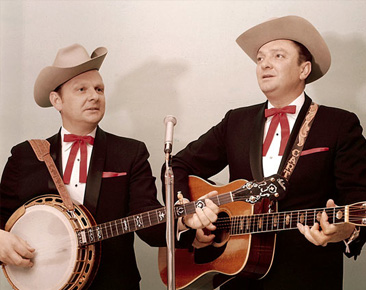
What it didn’t yet have, for almost the entire span of the chapter, was the name. The musicians called what they played “old-time,” “mountain music,” “hillbilly,” or simply nothing — they used the band names, said “we play like the Blue Grass Boys,” and let it go at that. The word bluegrass as a genre label belongs to the folklorists, the urban revivalists, and Mike Seeger’s 1957 Folkways liner notes. By the time the bandleaders themselves consistently used it — at Carlton Haney’s festival in September 1965 — the music it described had been a working idiom for almost twenty years.
This is the chapter about that gap.
After the classic band, 1946-48
The Blue Grass Boys lineup that walked into Columbia’s WBBM studio in Chicago in September 1946 — Monroe, Lester Flatt, Earl Scruggs, Chubby Wise, Howard Watts — held together for less than two years. In February 1948 Scruggs gave Monroe two weeks’ notice. His mother was ill in Flint Hill, North Carolina; he was twenty-three and exhausted from two years of one-night stands in a station wagon. Flatt followed within a few weeks. Watts, going by his stage name Cedric Rainwater, left before Flatt’s notice expired. By March, three of the five sidemen on the first true bluegrass recordings were gone.
Monroe took it personally. He believed Scruggs and Flatt had colluded, which both men denied for the rest of their lives. He refused to speak to either of them socially for the better part of twenty years. The reconciliation with Flatt came, by some accounts, in 1971 at the Ryman, brokered through Monroe’s son James. The reconciliation with Scruggs would take longer — the two men didn’t play music together on a single stage until 1994, two years before Monroe’s death.
The replacements for the lost banjo chair were close at hand. Don Reno, the North Carolina three-finger picker who had turned down Monroe’s job offer in 1943 to enlist in the Army, drove to Nashville the moment he heard on the Opry that Scruggs was leaving. He joined Monroe’s band onstage, by the standard account, in Taylorsville, North Carolina in the spring of 1948, mid-set. He stayed with Monroe through July 1949 — fifteen months — and recorded nothing in the studio with him. The entire Reno-era Blue Grass Boys catalog exists only on Opry transcription discs and the occasional radio recording. By the time Monroe got back into a studio with a banjo player, Reno had left to form the band that would become Reno and Smiley.
Flatt and Scruggs, meanwhile, had wasted no time. Within weeks of their departures they had formed the Foggy Mountain Boys — the name borrowed from the Carter Family’s “Foggy Mountain Top” — with Watts back on bass and the fiddler Jim Shumate, who had arranged Scruggs’s original audition with Monroe and was now returning from a brief furniture-business retirement. By the fall of 1948 they had signed with the Cincinnati-based Mercury Records and cut their first sides. One of them, an instrumental of Scruggs’s titled “Foggy Mountain Breakdown,” would become — twenty years later, via Bonnie and Clyde — the most famous banjo recording ever made.

And in Bristol, the Stanley Brothers had spent the eighteen months between their WCYB debut and the late summer of 1948 building their repertoire and tightening up. Their first recordings, for the tiny Rich-R-Tone label out of Johnson City, Tennessee, came in late 1947 — vocal duets, gospel quartets, and Carter’s compositions in the Anglo-Celtic ballad tradition. Then, in September 1948, came “Molly and Tenbrooks.” It was Monroe’s tune — he had introduced it on the Opry and was preparing to record it for Columbia — but the Stanleys’ version, with Pee Wee Lambert singing the high tenor lead in a register close to Monroe’s own and Ralph Stanley playing Scruggs-style three-finger banjo on Carter’s guitar lines, was on the radio first. Monroe heard it. He took it as theft, and it shaped the next phase of his career.
Within twelve months of the dissolution of the original Blue Grass Boys, three of the four bands that would define the genre’s first decade existed. The music was no longer in Monroe’s sole possession. It had escaped.
Monroe in Nashville
The post-1948 Blue Grass Boys are sometimes described as a band in decline. They weren’t, quite — Monroe’s records from 1949 through the mid-1950s contain some of the most enduring tracks in the bluegrass canon — but he was undeniably no longer alone in the field. The center of gravity in Nashville had shifted, and the next eight years would be a continuous turnover of personnel as he tried to assemble lineups that could match what the original five had achieved.
Rudy Lyle replaced Don Reno on banjo in the summer of 1949. Mac Wiseman, who would go on to a major solo career and become known as the Voice with a Heart, sang lead briefly in the spring and summer of 1949 — “Travelin’ Down This Lonesome Road,” “Can’t You Hear Me Calling” — and was gone within months. (Wiseman’s whole tenure with Monroe lasted about half a year, and any history that overstates it is missing the larger story, which is his own solo career on the Dot label from 1951 forward.) Chubby Wise rejoined briefly. In November 1949, Monroe left Columbia for Decca. He recorded his last Columbia session — “Can’t You Hear Me Calling” and “Blue Grass Stomp” — at the Castle Studio in Nashville’s Tulane Hotel, 206 8th Avenue North, on October 22. The first Decca session followed, at the same studio under the producer Paul Cohen, on February 3, 1950.
The Castle Studio was housed, by coincidence or otherwise, in the same hotel where Earl Scruggs had auditioned for the Blue Grass Boys four years earlier. The recording rooms were one floor up from where the band had practiced before the first Opry shows. It was, in a small but pointed way, where the music had been born; it was now where Monroe was trying to start again.
The lead vocalist for most of the early Decca era was a young East Tennessean named Jimmy Martin, who had joined the band in late 1949 and stayed through 1954. Martin’s voice — nasal, behind-the-beat, urgent — set against Monroe’s piercing high tenor became what later critics, looking for a phrase, would call the high lonesome sound. The fiddler from late 1949 forward was a twenty-one-year-old from Florida named Vassar Clements, in the first of what would be several stints. And in June 1952, at Bean Blossom, Indiana — the country-music park Monroe had acquired the previous year — a fourteen-year-old banjo player named Sonny Osborne joined the band on Jimmy Martin’s recommendation. He cut nine sides with Monroe at the next Decca session in July, including “Pike County Breakdown.” He was the youngest Blue Grass Boy ever hired, and the recordings of that summer are some of the strongest Monroe ever made.

By the early 1950s, then, Monroe was not failing — he was simply no longer the only one. Down the road in Hyden, Kentucky, the Stanley Brothers were now on Columbia (since March 1949), having signed almost immediately after Monroe heard “Molly and Tenbrooks.” Up in Bristol, Tennessee, Flatt and Scruggs had a daytime radio show and were touring through the upper South. In Roanoke, Don Reno had teamed up with a smooth-voiced lead singer from Asheville named Red Smiley to form the band that would dominate the King Records bluegrass catalog. In Coeburn, Virginia, the McReynolds brothers were preparing for their first sessions with Capitol. The genre had a half-dozen working bandleaders and was about to acquire several more.
Three bands, one genre
The story of bluegrass between 1949 and 1955 is, in part, the story of three bands trading record labels and chasing each other across the same radio markets. The Stanley Brothers were on Columbia from March 1949 through 1952. Flatt and Scruggs were on Mercury from 1948 through 1950, then signed with Columbia. In 1953, the two bands more or less swapped: the Stanleys moved to Mercury, where they would record some of their finest work through 1958, and Flatt and Scruggs settled in for the long run on Columbia that would last through 1969. The shared catalog of the two bands — the same source pool, the same labels in rotation — gives a sense of how tightly bounded the new music’s commercial world was.
The Stanleys’ Columbia and Mercury work is, by general agreement, the heart of their catalog. Their gospel quartets — Carter’s lead, Ralph’s tenor, George Shuffler’s baritone, and various bassists across the years — established the bluegrass-gospel template that the Country Gentlemen, the Country Boys, and a hundred contemporary bands would later inherit. Their secular songs were where Carter Stanley’s compositional gifts emerged: “White Dove” (1949), “The Lonesome River” (1950), “I’m a Man of Constant Sorrow” (1951 — Ralph had absorbed the song from his father’s singing; the Soggy Bottom Boys version in O Brother, Where Art Thou? almost fifty years later would make it famous to a generation that had never heard of Carter and Ralph). They left Columbia for Mercury in 1953 and moved again to King Records of Cincinnati in 1958, where they would stay until Carter’s death from cirrhosis on December 1, 1966, at the age of forty-one.
Ralph Stanley, throughout this period and for the rest of his life, refused to call what they played bluegrass. The label that the folklorists and the urban revivalists were attaching to the music in the late 1950s struck him as inaccurate and as a kind of theft. In a 2001 interview, he put it this way: “I don’t know whether I play bluegrass or whether I play old-time country, but I would rather be old-time.” The Stanleys, in his telling, were continuing a Primitive Baptist mountain-music tradition that long predated Bill Monroe. Whatever Monroe’s Blue Grass Boys were doing, the Stanleys had not learned it from him.
Flatt and Scruggs were a different proposition entirely. Where the Stanleys preserved an austere mountain register, Flatt and Scruggs went after the commercial market and largely caught it. The Foggy Mountain Boys’ early Mercury sides — “Foggy Mountain Breakdown” (1949), “Salty Dog Blues” (1950), “Cabin in Caroline” — are tighter, cleaner, less harmonically severe than anything the Stanleys cut, and far more radio-friendly than what Monroe was cutting in the same months. By 1953 they had signed with the Martha White Flour company for a daytime radio show on Nashville’s WSM, the same station that carried the Grand Ole Opry on Saturday nights. The arrangement gave them, for the first time, a reliable national-scale audience.
The Opry membership campaign for Flatt and Scruggs lasted nearly two years and ended in January 1955. The story sometimes told — that Bill Monroe personally blocked them, motivated by the unresolved 1948 grievance — is true but incomplete. Monroe did circulate a backstage petition against their induction; his opposition was personal and consequential. But Opry management had its own institutional reasons to slow-walk a second bluegrass act onto the stage — sponsorship conflicts, slot scarcity, internal politics. Martha White Flour used its WSM advertising leverage to force the issue. The Foggy Mountain Boys joined the Opry in January 1955. Monroe did not speak to either Flatt or Scruggs offstage for years afterward.
The three founding bands now had different home institutions, different sounds, and different audiences. They were all playing what would eventually be called the same music.
The second wave, 1948-1955
A music with three bands is not yet a genre. A music with a dozen bands and a recognizable shared vocabulary is. Between 1948 and the mid-1950s, the second wave arrived.
The most consequential of them, structurally, was the band that no one outside the Appalachian belt has ever quite heard of: the Lonesome Pine Fiddlers. Originally founded in 1938 by the bass player Ezra Cline as a regional string band in southern West Virginia, the Fiddlers reorganized themselves around 1949 as a bluegrass band, with Cline now leading a lineup that included the banjoist Larry Richardson and a young singer-mandolinist from Hyden, Kentucky named Bobby Osborne. RCA Victor signed them in 1952 and they recorded a handful of strong sides — “Windy Mountain,” “Dirty Dishes Blues” — that have since become regional standards. But the real importance of the Lonesome Pine Fiddlers, in retrospect, is that they functioned as a finishing school for the next generation. Bobby Osborne passed through. So did Jimmy Martin, briefly, on his way to Monroe. So did Melvin Goins, Paul Williams, and the great Curly Ray Cline. A band whose own records sold modestly nevertheless trained, by indirection, a quarter of the second-generation bluegrass musicians who would later define the music in the 1960s.
Mac Wiseman, after his brief Monroe tenure in 1949, signed with Dot Records — a small label out of Gallatin, Tennessee — in 1951. His first major hit, “‘Tis Sweet to Be Remembered,” came that same year. Wiseman’s sound was the smoothest in early bluegrass: a clear, sustained tenor with very little of the high-lonesome edge, paired with an unobtrusive backing band that often included Reno or other top-tier sidemen. His commercial instincts ran more toward country than toward Monroe’s hard-driving mountain style, and his repertoire drew heavily on older sentimental material — “Love Letters in the Sand,” “I Wonder How the Old Folks Are at Home,” “The Bluebirds Are Singing for Me.” For a certain segment of the 1950s audience, Wiseman was the bluegrass sound: more accessible than Monroe, less austere than the Stanleys, more melodic than Flatt and Scruggs.
Don Reno and Red Smiley first met in 1949 in Roanoke, where both were working with the fiddler Tommy Magness. Their partnership — Reno’s three-finger banjo and complex compositional sense paired with Smiley’s warmer lead vocal — coalesced into a band by 1951, and their first King Records session came in early 1952. Reno wrote or co-wrote every one of the sixteen songs they cut at that first session; he would go on to be one of the most prolific songwriters of the era. The Tennessee Cut-Ups (their backing band’s name) developed a sound that was distinct from both Monroe and from Flatt and Scruggs — Reno’s banjo arrangements drew as much from the older Snuffy Jenkins playing he had grown up with as from Scruggs’s innovations, and the band’s gospel quartet work, with Smiley’s clear lead voice on top, became some of the most beloved in the genre’s history.

The McReynolds brothers from Coeburn, Virginia — Jim on guitar and tenor, Jesse on mandolin and lead — signed with Capitol in 1952 and cut their first sides that year. Jesse McReynolds was, at twenty-three, in the process of developing what would become the single most influential mandolin technique of the post-Monroe era: a flatpicked pattern that adapted Earl Scruggs’s banjo rolls to the mandolin, with the pick crossing the strings in a way that produced a continuous, ringing texture. The technique, eventually known as crosspicking, was Jesse’s own — he had been working on it through 1951 and refined it during the two years of his Korean War military service from 1952 to 1954, when he and Jim could only record on Jesse’s brief leaves. The earliest Capitol sides — “Are You Missing Me,” “Just Wondering Why” — already show the crosspicking style emerging. By the mid-1950s, every ambitious bluegrass mandolin player in the country was studying Jesse McReynolds’s records.

By 1955, then, the second wave had arrived. A music that had been three bands seven years earlier was now a half-dozen touring acts, recording across at least seven labels — Mercury, Columbia, King, Capitol, RCA Victor, Dot, and the various tiny independents like Rich-R-Tone and Cozy. The radio circuit had stabilized around WCYB Bristol, WSM Nashville, WWVA Wheeling, KWKH Shreveport, and a handful of regional barn dance shows. The musicians knew each other, played one another’s tunes, traded sidemen, and competed for the same gigs. The only thing the music lacked was a name.
Naming the music
The word bluegrass as a genre category — distinct from “country,” “old-time,” “hillbilly,” or “mountain music” — emerged in print between 1956 and 1959, almost entirely from outside the working musicians’ world. The bandleaders themselves continued to use the older terms, or to refer to one another by band name, well into the 1960s. The naming was the work of the folklorists.
Mike Seeger — the younger half-brother of the more famous Pete Seeger, raised in the same Washington-area folk-revival household — began traveling through the upper South in 1955, recording field sessions with banjo players and string-band musicians for the Folkways label. In 1956 he produced an album called American Banjo: Three-Finger and Scruggs Style. It was released the following year as Folkways FA 2314, and it was, by general agreement, the first commercial long-playing record devoted entirely to what we now call bluegrass. The recordings on it were not by the famous bandleaders — Seeger sought out the largely-unrecorded predecessors and contemporaries, including Snuffy Jenkins and Don Reno’s older brother Verlon — but the liner notes contained one of the first sustained print uses of bluegrass as a category, a thing distinct from Earl Scruggs and yet defined by him.
Two years later, in 1959, Seeger followed up with Mountain Music Bluegrass Style, Folkways FA 2318. This time the album collected actual bluegrass bands — the Lilly Brothers, Eric Weissberg, and others — and the liner notes coined a phrase that would stick. Mike Seeger, writing about Bill Monroe in 1959, called him the “Father of Bluegrass.” The term was new. So was the genre name. Within a few years they would both be standard.
A parallel folklorist-and-tradition-bearer collaboration was unfolding through the same years, with consequences for bluegrass that would only become fully visible in the next generation. In 1960, the young folklorist Ralph Rinzler — who would later run Newport’s folk-arts programming, direct the Smithsonian’s Folklife Festival, and briefly (1963-65) become Bill Monroe’s manager — drove to an Old Time Fiddlers’ Convention in North Carolina looking for Clarence Ashley, the East Tennessee banjoist whose 1929 Columbia sides Harry Smith had included on the Anthology of American Folk Music. Rinzler found Ashley, persuaded him to take up the banjo again after a thirty-year hiatus, and met in the process Ashley’s neighbor — a blind thirty-seven-year-old piano tuner from Deep Gap, North Carolina named Arthel “Doc” Watson, who was at the time playing electric guitar in a local rockabilly band and did not own an acoustic. Rinzler convinced him to borrow one. The resulting Folkways LPs — Old Time Music at Clarence Ashley’s, Volume One (1961) and Volume Two (1963) — together with the Friends of Old-Time Music concerts that Rinzler co-organized at New York’s Town Hall in 1961, introduced Watson to the wider folk-revival audience. (The fuller account, in the context of the old-time revival, is in our companion chapter on old-time.) What this meant for bluegrass: Watson became a fixture of the bluegrass festival circuit starting at Carlton Haney’s 1965 Fincastle event (below), and his flatpicked-guitar arrangements of fiddle tunes — clean melodic line, blues-and-gospel-inflected attack, full melodic statement where bluegrass guitar had traditionally provided only rhythm and the occasional bass-run — established the foundational vocabulary for the acoustic-guitar style that would run through Norman Blake, Tony Rice, and every flatpicker who followed.
The historian Neil V. Rosenberg, whose Bluegrass: A History remains the field’s foundational scholarly work, has recounted the moment he first encountered the word. It was 1959, at Oberlin College in Ohio, where he was an undergraduate. A friend pulled him aside to play him the Seeger albums and used the term bluegrass casually, as if it had always existed. Rosenberg, who would go on to manage Bill Monroe’s Bean Blossom park and to write the canonical history of the music, was at that moment a college student in Ohio learning the name of a genre that had already been a working musical category for thirteen years.
That is the gap that matters. By 1959, the music had been recorded, broadcast, toured, codified, and stylistically diversified for a generation. Three of the founding bands — Monroe’s Blue Grass Boys, the Stanley Brothers, and Flatt and Scruggs’s Foggy Mountain Boys — had been operating continuously since 1946 or 1948. The second wave had matured. The third wave was already arriving. And only now, more than a decade in, did the people who had been making the music acquire the category name by which the people listening to it would identify them.
Ralph Stanley, in his interviews from the 1990s and 2000s, was repeatedly asked about how the name had come into use. His own account, which Rosenberg treated with skepticism but which is worth recording, was that the bandleaders themselves had finally settled on the term in 1965, at Carlton Haney’s festival in Fincastle. They had agreed, more or less by consensus, that Monroe was the oldest of them, that he was from the bluegrass state of Kentucky, that his band had been called the Blue Grass Boys since 1939, and that they would all therefore allow the name to apply to what they did. Whatever the precise truth of Stanley’s recollection, the point holds: the folklorists named the music in the late 1950s, and the musicians lived with the name for years before publicly accepting it.
The third wave and the codification of the sound
The bands that emerged in the mid-1950s were the first to grow up listening to the founding generation on the radio. They were not building the music from scratch; they were inheriting it.
Jimmy Martin left Monroe in 1954 and formed the Sunny Mountain Boys the following year. His first lineup included, briefly, the Osborne brothers — Bobby and Sonny — before they left to form their own group. Martin signed with Decca Records on May 9, 1956, and would record for that label for most of the next decade. His banjo player from 1956 through 1960 was a young Kentuckian from Lexington named J.D. Crowe, whose four-year apprenticeship under the famously demanding Martin would prepare him to become the most influential bluegrass bandleader of the next generation. Martin himself was a tremendous singer and a difficult human being. The Grand Ole Opry repeatedly refused to make him a member, citing his drinking, his abrasiveness, and his quarrels with the management — and probably, in the background, the same Opry-side reluctance to fill too many slots with bluegrass acts that had slowed Flatt and Scruggs’s induction. Martin’s biggest Decca hits from this era — “Hit Parade of Love,” “Rock Hearts,” “Ocean of Diamonds” — were cut between 1956 and 1960 with Crowe on banjo and Paul Williams on mandolin, the lineup Martin would later look back on as the greatest band he ever led.
The Osborne brothers — Bobby (mandolin and lead vocal) and Sonny (banjo) — formed their own band in 1953, with the singer Red Allen joining around 1956. They signed with MGM that year. Their first major hit, recorded in July, was “Ruby, Are You Mad,” and it was a sound nobody had heard before. The original session had been scheduled for a single banjo, but the session player had failed to show up, and Sonny ended up overdubbing a second banjo line in harmony with his own. The result — twin banjos in counterpoint — was the first time the technique had appeared on a bluegrass record. It is now standard.
The more lasting Osborne innovation was vocal. Where Monroe’s harmony stack put the lead vocal in the middle with the tenor above and the baritone below, the Osbornes inverted the arrangement: Bobby’s high lead sat on top, with Sonny’s tenor and the baritone vocal below. The effect, when it worked, was extraordinary — a piercing, electric clarity that no previous bluegrass band had achieved. It is, by general agreement among bluegrass scholars, the second most influential vocal innovation in the genre’s history, after Monroe’s own. The Osbornes’ later experiments with amplified instruments and country-pop crossover material in the late 1960s and 1970s sit outside this chapter’s scope, but their place in the 1950s codification of bluegrass harmony is permanent.
The third wave was also where bluegrass first acquired a meaningful presence outside the South. Bea and Everett Lilly, a brother duet from West Virginia, moved to Boston in late 1952 in search of work and were recruited, almost immediately, into a seven-night-a-week residency at a club called the Hillbilly Ranch on Massachusetts Avenue in the Combat Zone. They added a third member — the banjoist Don Stover — and stayed at the Hillbilly Ranch for the better part of seventeen years, until the residency ended in early 1970. Their audience was a remarkable cross-section: servicemen passing through Boston, Harvard and MIT students discovering folk music, displaced Appalachian millworkers, and, eventually, the next generation of New England bluegrass musicians — Joe Val, Bill Keith, Peter Rowan — who would learn the music from them and carry it forward in transformed ways in the 1960s. By the mid-1950s, the music was no longer geographically confined to the South.
A handful of figures in this generation worked less as bandleaders than as institution-builders. Bill Clifton — born William August Marburg in Riderwood, Maryland in 1931, into a tobacco-money family — used his unusual background (he was a college-educated bluegrass musician with disposable income, an almost unique combination in the 1950s) to publish, in 1955, 150 Old Time Folk and Gospel Songs, the songbook that would become the standard repertoire reference for bluegrass musicians of the next two decades. Clifton organized one of the first multi-act bluegrass concerts (a one-day event at Luray, Virginia in 1961, four years before Carlton Haney’s Fincastle festival) and moved to England in 1963, becoming the genre’s first international ambassador. Carl Story, who had been recording for Mercury since 1947, became known by the late 1950s as the “Father of Bluegrass Gospel”; his 1958 Gospel Quartet Favorites on Starday was the first all-bluegrass gospel LP released on a major label. Hylo Brown — the nickname came from his vocal range, “Hi-Lo” — recorded for Capitol from 1954 onward and led a journeyman band, the Timberliners, that included future stars like Red Rector on mandolin and Tater Tate on fiddle. None of these figures became household names. All of them were part of the music’s structural deepening.
By the end of 1962, the bluegrass sound had stabilized into something recognizable. The instrumentation was acoustic: mandolin, fiddle, three-finger banjo, guitar, and upright bass. (That was Monroe’s rule for his own band, and he never bent it; elsewhere the edges were already fraying — Flatt and Scruggs were recording with drums by the late 1950s, and “The Ballad of Jed Clampett” carried them onto a No. 1 country single in 1962.) The vocal stacks were the Monroe arrangement — lead in the middle, tenor above, baritone below, with a bass voice added for gospel quartets — or the Osborne inversion. Instrumental breaks rotated around the band in a fixed sequence. Phrases ended with the two-note resolution Lester Flatt had codified from older string-band players. The bass walked a 2/4 pulse, the guitar boom-chucked underneath, and the lead vocals carried what Mike Seeger and his cohort had begun calling the high lonesome sound — a piercing, slightly behind-the-beat modal phrasing that the music’s audience now recognized on first hearing.
It was a genre. It had its name.
Fincastle, 1965
On Labor Day weekend of 1965 — Friday, Saturday, and Sunday, September 3 through 5 — a North Carolina promoter named Carlton Haney rented a horse farm twelve miles north of Roanoke, Virginia and staged what he called the “Blue Grass Festival.” It was the first multi-day, multi-artist, ticketed bluegrass-only event ever held. The lineup read, in retrospect, like a roll call of everyone the previous nineteen years had produced: Bill Monroe and the Blue Grass Boys, Jimmy Martin and the Sunny Mountain Boys, Don Reno and Red Smiley, the Stanley Brothers, Mac Wiseman, Clyde Moody (Monroe’s first lead singer from 1940), and Doc Watson. Most of the audience camped on the farm grounds.
The festival’s centerpiece was a Sunday-afternoon production called “The Story of Bluegrass Music,” staged by Ralph Rinzler — Monroe’s former manager, a Smithsonian folklorist who had been working since the early 1960s to position bluegrass as an authentic American folk tradition rather than as a subset of commercial country music. Rinzler placed Monroe at center stage and invited every living former Blue Grass Boy in the audience to come up and join him in turn. The musicians, many of whom had not spoken to Monroe in years — and several of whom had been the explicit subject of Monroe’s grievances — came up nonetheless. The performance functioned as both ceremony and reconciliation. It was the first time the audience for the music understood itself as an audience, the first time the musicians publicly recognized one another as members of a single tradition, and the first time the word bluegrass, in Ralph Stanley’s account, was settled upon by the bandleaders themselves rather than imposed on them by the folklorists.
The Fincastle festival was the founding ceremony for the institutional form bluegrass has had ever since. Within two years, Bill Monroe would inaugurate his own annual festival at Bean Blossom, Indiana — the longest-running bluegrass festival in the world. Within a decade, festivals were running every summer weekend somewhere in the United States, and the festival circuit had become the economic backbone of the bluegrass touring economy. The music had acquired the audience structure it needed to be self-sustaining.
But there was another band at the edge of the field that weekend, not on the Fincastle bill but already working in a register that the assembled traditionalists would not have entirely recognized as their own. The Country Gentlemen — Charlie Waller, John Duffey, Eddie Adcock, and Tom Gray — had formed almost accidentally on July 4, 1957 in Washington, D.C., where they were assembled as a substitute band after the bluegrass singer Buzz Busby was injured in a car accident and could not play a scheduled gig at the Crossroads in Bladensburg, Maryland. They had stayed together. By the early 1960s they were recording for Folkways — first Country Songs Old and New (1960) and then The Country Gentlemen Sing and Play Folk Songs and Bluegrass (1961) — albums whose repertoire (Appalachian ballads and folk-revival material set next to bluegrass standards) and whose playing style — looser, more harmonically adventurous, more willing to break the fixed instrumental sequence — already suggested a different kind of band. They were the bluegrass that played coffeehouses in Georgetown, not the bluegrass that played at Bean Blossom.
The chapter ends here, with the music having a name, a canon, a festival, an audience, and — already, at the edge — a future that would not look like the past.
Between December 1946, when the Stanley Brothers walked into a Bristol radio station, and September 1965, when Carlton Haney’s Sunday-afternoon program at a horse farm formalized the audience-as-community concept, a music that did not have a name became a music with a vocabulary, a canon, a circuit, a working business model, and an internal argument about what it was. What got called the “traditional era” of bluegrass — the label was applied retroactively, mostly in the 1970s, to distinguish what these bands had done from what the Country Gentlemen and their successors would do next — was the period in which there was nothing yet to be traditional against. The musicians of 1946 to 1962 were not preserving anything. They were inventing.
The next chapter watches them argue with their own invention. It begins, more or less, in Washington, D.C., on July 4, 1957, when Charlie Waller and John Duffey stepped onto the stage at the Crossroads and improvised a band.
Sources and further reading
- Neil V. Rosenberg, Bluegrass: A History (University of Illinois Press, 1985; rev. 2005). The foundational scholarly history; the source for the genre-naming timeline and most of the chapter’s institutional claims.
- Tom Ewing, Bill Monroe: The Life and Music of the Blue Grass Man (University of Illinois Press, 2018). The modern authoritative Monroe biography — the source behind this chapter’s post-1948 reconstruction and the personnel histories.
- Charles Wolfe and Neil V. Rosenberg, The Music of Bill Monroe (University of Illinois Press, 2007). Session-by-session companion volume.
- John Wright, Traveling the High Way Home: Ralph Stanley and the World of Traditional Bluegrass Music (University of Illinois Press, 1993). The Ralph Stanley interview book.
- Murphy Hicks Henry, Pretty Good for a Girl: Women in Bluegrass (University of Illinois Press, 2013). Required reading on the women who have been routinely written out of the founding-era story — Sally Ann Forrester, the only woman in the original Blue Grass Boys (1943–46), among others.
- Robert Cantwell, Bluegrass Breakdown: The Making of the Old Southern Sound (University of Illinois Press, 1984). The literary/cultural reading of what the music was actually doing.
- Walt Trott, Mac Wiseman: All My Memories Fit for Print (Nova, 2015). The Wiseman biography.
- Mike Seeger, American Banjo: Three-Finger and Scruggs Style (Folkways FA 2314, 1957) and Mountain Music Bluegrass Style (Folkways FA 2318, 1959) — listen to the actual records that named the genre.
- The Bluegrass Music Hall of Fame & Museum — inductee biographies for primary fact-checking.
- The Birthplace of Country Music Museum — material on WCYB Farm and Fun Time and the Stanleys’ radio era.