Rambling, Hobos, and Trains in the Bluegrass Songbook
For most of the period that the music we now call bluegrass and old-time was being made, the people making it spent significant portions of their lives in motion. Some of the motion was voluntary — railroad work, sailor’s work, drovering work, the seasonal migrations of farm labor. Some of it was not — the displacement of Civil War veterans, the dispossession of mountain families by mining and timber companies, the Depression-era hobo economy of an estimated quarter-million unemployed men riding freight trains looking for work between 1929 and 1941. What this period produced, in songs, was a deep catalog about leaving, about moving, and about not being able to come back. The songs are often categorized as three separate themes — rambling, hoboing, trains — but the working musicians who sang them did not, and a contemporary listener should not. The cultural story is one story.

This essay covers the catalog in three overlapping movements: the railroad as both subject and conveyance (the trains that carry the songs and that the songs are about), the rambler-and-hobo figure who rides those trains, and the disaster ballad — the train wreck, the runaway, the engineer’s last ride — that became a recurring form of folk journalism in the early twentieth century. The catalog is large; this piece will cover the central recordings.
The railroad as American mythology
American railroad construction ran from roughly 1830 through World War One. The Baltimore and Ohio reached Cumberland, Maryland, in 1842; the transcontinental was completed at Promontory, Utah, in May 1869; the Southern Railway, the Norfolk and Western, the Chesapeake and Ohio, the Louisville and Nashville, the Atlantic Coast Line — the major Southern lines were built between 1860 and 1900. By 1916, the United States had over 250,000 miles of operating railroad track, the largest network in any country in history. Almost every Appalachian and Southern community of any size was connected to the national rail system by the early twentieth century.
What this meant culturally is that the railroad was, for the people making the music, the dominant working metaphor for going. The railroad symbolized escape (out of the holler, out of the company town); it symbolized work (every man’s family had a brother or an uncle or a cousin who worked the lines); and it symbolized death (the locomotives killed working men at rates the modern reader has difficulty believing). Norm Cohen’s 1981 book Long Steel Rail: The Railroad in American Folksong, published by the University of Illinois Press, is the standard scholarly account of the railroad’s place in the American songbook. Cohen documented several hundred distinct railroad ballads in circulation by the 1920s, when the commercial recording industry first began capturing them.
The railroad songs broke down into three rough subgenres. The first was the named-train song — “Wabash Cannonball,” “Orange Blossom Special,” “Pan American,” “Chattanooga Choo Choo” — in which a specific train (sometimes real, often legendary) is celebrated as a thing of national or regional pride. The second was the railroad-worker song — “John Henry,” “The Brakeman’s Blues,” “Working on the Railroad” — about the men who built the lines and the men who ran them. The third was the disaster ballad, which had its own dedicated subgenre.
The disaster ballad as journalism
The American railroad disaster ballad emerged in the late nineteenth century in close parallel with the broadside murder ballad covered in the murder-ballads essay of this section. Both forms functioned as folk journalism — the railroad disaster songs got composed and circulated as a way of remembering specific killings, in the same way the broadsides circulated as remembering specific murders. The difference was that the railroad ballads usually centered on a male engineer whose decision had killed him, rather than on a young woman whose lover had killed her. The narrative was about labor and mechanical failure rather than about courtship.
The two most famous railroad-disaster ballads in the American canon both come from this era. “The Wreck of the Old 97” tells the story of an actual disaster: on September 27, 1903, Southern Railway Number 97, running a fast mail run from Monroe, Virginia, to Spencer, North Carolina, derailed off the Stillhouse Trestle outside Danville, Virginia, after running downgrade at over fifty miles an hour. Engineer Joseph A. “Steve” Broady, fireman A.C. Clapp, and nine others were killed. The song that came out of the wreck had multiple authors, and its authorship was litigated for over a decade, but the standard version was recorded by Vernon Dalhart for Victor in August 1924, paired with “The Prisoner’s Song” on the B-side. The double-sided record became the first country recording to sell a million copies and is generally credited with proving to the major labels that there was a national market for hillbilly music. The song has been recorded since by Roy Acuff, Hank Snow, Flatt and Scruggs, Mac Wiseman, Johnny Cash, Pete Seeger, and the Stoneman Family.
“Casey Jones” tells a different real disaster. John Luther “Casey” Jones was an engineer for the Illinois Central Railroad. On April 30, 1900, he was running passenger train Number 1, the southbound from Memphis to Canton, Mississippi, when, in fog and rain four miles north of Vaughan, Mississippi, his train rear-ended a stopped freight train. Jones, having ordered his fireman Sim Webb to jump, stayed in the cab applying the brakes and was the only fatality. The ballad about him was first recorded commercially by Billy Murray in 1910 and entered the country and folk repertoires through Fiddlin’ John Carson’s 1924 recording, then through dozens of subsequent versions. Mississippi John Hurt, Johnny Cash, the Grateful Dead, and Pete Seeger have all recorded versions; the song became one of the most widely-recorded American railroad ballads of the twentieth century.
The third major train-disaster ballad in the bluegrass canon is “The Wreck of the Number Nine,” about an unspecified passenger derailment, recorded by Vernon Dalhart for Edison in 1927 and later by Jim and Jesse. “Ben Dewberry’s Final Run,” another locomotive-engineer death ballad, was first recorded by Carson Robison and Andrew Jenkins in 1927 and later by Bill Monroe. The form was a continuous subgenre through the 1920s and 1930s and remained in the bluegrass repertoire through the entire postwar period.
Around these disaster ballads ran a deeper stratum of working-railroad and train-rider songs that have stayed in active bluegrass repertoire. “Night Train to Memphis,” written by Beasley Smith, Marvin Hughes, and Owen Bradley and recorded by Roy Acuff in 1942, has been cut by bluegrass bands continuously since. “Blue Railroad Train,” a Delmore Brothers song from 1933, became a Doc Watson standard and a flatpicking-guitar fixture. “Alabama Bound” and “500 Miles” (the second written by Hedy West in the early 1960s, but moving in the older rail-leaving idiom) circulate widely; “Walkin’ Boss” works the same emotional territory from the section-hand’s perspective rather than the rider’s. The canon is broader than any single essay can list, but the form has been a continuous workshop for the music’s working repertoire across a hundred years.
The named-train tradition
Around the disaster ballads ran a parallel tradition of named-train songs that celebrated specific routes and engines. “Wabash Cannonball,” the most famous of these, did not commemorate a real train; the “Cannonball Express” was a fictional locomotive of folk imagination, said to run from the Atlantic to the Pacific, stopping at every American town with a station. The earliest known printing of the song dates to 1882, as “The Great Rock Island Route” by J.A. Roff. William Kindt rewrote it around 1904 with the verses that became standard. The Carter Family recorded it in May 1929 in Camden, New Jersey, for Victor; the recording was released in 1932. Roy Acuff’s 1936 cover (with his Crazy Tennesseans, later the Smoky Mountain Boys) made it a country radio standard, and his Grand Ole Opry performances of it across the following decades cemented the song’s place in the American country canon.
“Orange Blossom Special,” written in 1938 by Ervin T. Rouse about the Seaboard Air Line passenger train that ran between New York and Miami, became one of the bluegrass instrumental’s standards. Bill Monroe recorded it on October 2, 1941 for Columbia in Atlanta, with Art Wooten on fiddle; Chubby Wise, who joined Monroe’s band shortly after, popularized the song on the Grand Ole Opry over the next several years. The “Pan American” was Hank Williams’s 1947 song about the Louisville & Nashville Railroad’s Pan-American passenger train, which ran daily from Cincinnati to New Orleans via Montgomery. “The Train That Carried My Girl from Town,” a slow ballad recorded by the Watson family in the 1960s and by Doc Watson and Lester Flatt afterward, is the inverse of the named-train celebration — here the train is what takes the singer’s lover away, and the singer cannot get her back.
The hobo economy
The other category of railroad-related song in the bluegrass and old-time tradition is the hobo song: the first-person ballad in the voice of an unemployed man riding freight trains from town to town looking for work. The hobo as a cultural figure is older than the Depression — the word itself dates to the 1880s, possibly from a contraction of “hoe boy” (an agricultural migrant) or from a shortened “ho, beau” greeting between brakemen and trainmen — but the hobo population peaked during the Great Depression. Federal estimates from 1933 put the total transient population at two to three million, with around 250,000 of them riding the rails as a primary mode of transportation, including a substantial number of teenagers. Most were not professional hobos; they were unemployed men and boys looking for work.
The hobo songbook crossed over substantially from the broader country and folk tradition. Jimmie Rodgers’s “Hobo’s Lullaby” (covered most famously by Woody Guthrie in the 1940s and Arlo Guthrie in 1972) and his “Brakeman’s Blues” defined the singing-hobo voice. Harry McClintock, an actual railroad worker and Industrial Workers of the World organizer, recorded “Big Rock Candy Mountain” for Victor in 1928. The song was a sardonic hobo dream of a country where “the bulldogs all have rubber teeth and the hens lay soft-boiled eggs,” and it has been recorded since by Pete Seeger, Burl Ives, and Harry McClintock again on the 2000 O Brother, Where Art Thou? soundtrack. Goebel Reeves, who had been a hobo before becoming a recording artist, wrote and recorded “Hobo’s Lullaby” itself in 1934, and a long string of related songs across the 1930s and 1940s.
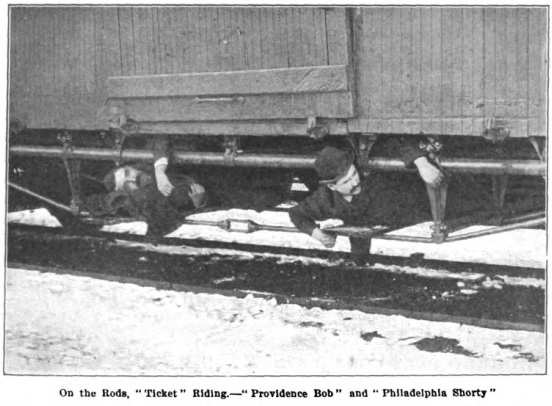

Woody Guthrie’s catalog is, in many ways, the deepest single voice in the hobo songbook. Guthrie’s Dust Bowl Ballads (Victor 1940), Hard Travelin’, “Pastures of Plenty,” “Do Re Mi,” and the long run of Library-of-Congress recordings he made for Alan Lomax in 1940 brought the Depression-era hobo voice into the mainstream of the American folk-music revival. Guthrie wrote about his own experience riding freights west from Oklahoma in the 1930s; the autobiographical novel Bound for Glory (1943) is the central first-person hobo memoir of the era. The line that runs from Guthrie through Pete Seeger and the New Lost City Ramblers to the urban folk revival of the late 1950s and 1960s is the line by which the hobo songbook entered bluegrass and old-time repertoires for the second time, decades after the original 1920s recordings.
Rambling beyond the rails
A third stratum of related material is the rambling song proper — not specifically about trains, but about a wandering male protagonist who cannot or will not stay put. “Going Down That Road Feeling Bad,” collected by John Lomax and recorded by Henry Whitter in 1923, by Woody Guthrie in the 1940s, by Bill Monroe in 1945, and by every working bluegrass band since, is the form’s central ballad. “Roving Gambler,” “Wandering Boy,” “Long Journey Home,” “Goodbye, Old Pal,” “I Ain’t Goin’ to Work Tomorrow” (from the Carter Family’s 1929 Victor catalog) — all sit on the same emotional terrain. The protagonist is leaving (or has left) a community, a job, a woman, a family. The song does not specify why.
This stratum bleeds into the older British-broadside rambling songs (“The Roving Journeyman,” “The Rambler from Clare,” “Erin’s Lovely Lee”), which had been crossed-pollinated with the American hobo and railroad material throughout the late nineteenth century. By the time the commercial recording industry began capturing the music in the 1920s, the British and the American material had merged into a single working repertoire that no contemporary bluegrass or old-time band needed to distinguish between. The Carter Family recorded both kinds. The Monroe Brothers (Bill and Charlie) recorded both kinds. Flatt and Scruggs recorded both kinds.
The Depression and the postwar industrial migration of southern people to Detroit, Cincinnati, Chicago, and Akron renewed the rambling-song tradition’s emotional charge. The Appalachian and southern populations who moved north for factory work in the 1940s and 1950s carried the older songs with them, and the songs took on a second life as the music of displacement — rambling not as a Depression-era survival strategy but as an industrial-economy condition. Hazel Dickens, herself a West Virginian who had moved to Baltimore for factory work, was one of the singers whose recordings of this material made the connection explicit; her 1980 Hazel Dickens by Herself contained both rambling songs and a coal-camp song catalog covered in the Mining Songs essay of this section.
The contemporary engagement
The 1971 release of Steve Goodman’s “City of New Orleans” — recorded by Arlo Guthrie as a single in 1972 that hit number eighteen on the Billboard Hot 100 — brought a new railroad ballad into the country and bluegrass repertoires for the first time in a generation. Goodman had taken the actual Illinois Central passenger train, the City of New Orleans, southbound from Chicago to New Orleans in the late 1960s; the song is a literal description of the journey, with the additional layer of writing about a railroad system that was, even then, visibly in decline. (The actual City of New Orleans train was discontinued in 1979 and replaced by an Amtrak service of the same name.) The Country Gentlemen recorded the song in 1973 on Vanguard; the Seldom Scene in 1972. It is not a bluegrass song so much as a popular song the bluegrass world adopted — the Gentlemen’s and the Scene’s versions sit among dozens of readings from every corner of American music.
Tony Rice’s catalog — through his solo records and his work with the Bluegrass Album Band, J.D. Crowe and the New South, and the David Grisman Quintet — revived rambling material throughout the 1980s. His readings of “Church Street Blues” and the folk material across the Rounder solo albums sit squarely inside the rambling songbook. Doc Watson’s catalog continues the same line; his 1968 Vanguard recording of “Train That Carried My Girl from Town” became the canonical reading.
The recent bluegrass and country-adjacent generation has continued to engage with the material. Tyler Childers’s “Whitehouse Road” (2017) and Sturgill Simpson’s “Living the Dream” (2014), both in the country-and-bluegrass overlap that the previous essay covered, sit in the rambling-protagonist tradition more or less directly. Sierra Ferrell’s “Bells of Every Chapel” and “In Dreams” (both from her 2021 Rounder debut Long Time Coming) draw on the older hobo aesthetic. The Earls of Leicester’s catalog — the Flatt-and-Scruggs tribute band covered in Chapter 7 of this section — revived “The Train That Carried My Girl from Town” and a half-dozen related songs for a contemporary audience.
What survives, and why
The bluegrass-and-old-time canon’s deep relationship with motion is, in the end, about the displacement of working people. Railroads carried the rural South’s working class to the industrial cities of the North between 1900 and 1960. Freight cars carried unemployed men across the country during the Depression. Steamships had carried earlier waves of Ulster Scots and Irish and German laborers across the Atlantic into the same Appalachian counties whose grandchildren rode the rails north a century later. The songs about all of this motion — the disaster ballads, the named-train celebrations, the hobo songbook, the rambling protagonist — are the form’s continuous documentation of what it cost to leave a place, and what was lost by leaving it.
American trains, today, are mostly freight. The Amtrak passenger services that survived the 1971 nationalization run a handful of long-distance routes on a partly degraded infrastructure. The hobo economy as a mass phenomenon ended with the postwar full-employment era and never recovered, even when unemployment did. What remains, in 2026, is the music — a deep catalog of songs about working people who could not stay where they were, sung by working musicians whose grandparents and great-grandparents were the people the songs are about.