Chapter 5: Bluegrass Comes of Age
In September 1986, the International Bluegrass Music Association held its first organizational meetings in Owensboro, Kentucky. The IBMA had been founded the previous year. It had no staff, no offices to speak of, no awards ceremony yet — it had a name, a board of directors, and an annual mailing list. By the time its first World of Bluegrass conference convened in October 1987, the organization had three hundred members. By 1990 it would have more than a thousand. By the late 1990s it would be running the largest annual gathering in the music’s history, with an awards show modeled loosely on the Country Music Association’s, a Hall of Fame, and trade-show floors that filled the Owensboro convention center for three days every year.
What the IBMA’s quiet first years represent is something the music had never had before: a settled institutional state. The argument that had occupied the previous chapter — over whether bluegrass was a fixed tradition or a moving target — had been answered, in the IBMA’s founding charter, by simply including all of it under one roof. The organization gave awards to Doyle Lawson and to the New Grass Revival. It admitted Bill Monroe and the New Grass Revival to its Hall of Fame in the same induction cohorts. By the late 1980s the trade body that bluegrass had spent forty years declining to build was up and running. The music had stopped wondering what it was.
This is the chapter about the fifteen years between roughly 1985 and 2000 when the music settled into the institutional shape it has held ever since. It is also the chapter in which Bill Monroe died. He died in September 1996, four days short of his eighty-fifth birthday, after a working life that had begun in 1934 when he and his brother Charlie left Indiana for a regional radio gig in Iowa. He had been on the Opry for fifty-seven years. He had been the most-recorded bluegrass musician of any era and, in the institutional sense, the only one whose name had become a noun. The interesting fact about his death — and the fact that this chapter wants to surface — is that the music continued. The IBMA’s annual conference in October 1996 went on as scheduled. The festival circuit ran without interruption. The bands he had taught, and the bands their bandmembers had taught in turn, kept playing. Compare Hank Williams’s death in 1953, which left country music with a void it would take twenty years and several musical generations to fill. Monroe’s death, in 1996, left no void at all. The music had, in the years immediately preceding, become large enough that no single death could threaten its survival.
This is also the chapter in which a teenaged fiddler from Decatur, Illinois walked into the bluegrass world and, over the course of fifteen years, became the most commercially successful musician the genre had produced. Alison Krauss signed with Rounder Records in 1985, at fourteen. Her first album came out in 1987. By 1995 she was on country radio, on adult-contemporary radio, in supermarket checkout aisles, and in the Country Music Hall of Fame’s conversation about whom it would invite next. She had done all of it without leaving the bluegrass instrumental palette behind. The Skaggs argument from Chapter 4’s last act — that bluegrass instruments could occupy mainstream commercial radio without compromising their identity — had been made again, more thoroughly, by a musician who had not had to leave bluegrass at any point to do it.
The chapter’s three load-bearing narratives — the McCoury family-band ascendancy, the Krauss arc, and the September 1996 pivot — happened simultaneously. The music did not choose between them. By 2000 it contained all three.
The settled world, 1986
The institutional architecture of bluegrass in the mid-1980s, if you stood back from it, was a strange and improbable thing. The genre had no major-label home of its own: Rounder Records out of Cambridge, Massachusetts, was the largest single label, with an annual release schedule of twenty to forty bluegrass and folk albums. Rebel Records out of Charlottesville handled the traditional center. Sugar Hill out of Durham, North Carolina handled the progressive side. Flying Fish out of Chicago handled the folk-adjacent. Pinecastle Records would launch in 1990; Mountain Home in 1995. Together these five independents constituted the entire commercial infrastructure of the music.
What worked, by 1986, was the festival circuit. MerleFest had not yet been founded; it would launch in April 1988 in Wilkesboro, North Carolina, as a memorial for Doc Watson’s son Merle, who had died in a tractor accident in 1985. Telluride had been running since 1973 and had become the West’s premier progressive festival. RockyGrass, in Lyons, Colorado, ran a more traditional sibling event. Bean Blossom in southern Indiana, the festival Bill Monroe had founded in 1967, was still anchored in June. Grey Fox in upstate New York (then still called Winterhawk) had been running since 1976. The IBMA’s World of Bluegrass, launching in 1987, would add an industry-conference layer to the festival ecosystem.
The musicians who had organized the IBMA — Pete Kuykendall of Bluegrass Unlimited, Sonny Osborne, the Sugar Hill executive Barry Poss, the bandleader Doyle Lawson, the journalist Dianne Sims, and others — had built the organization to do for bluegrass what the Country Music Association had been doing for country music since 1958: convene the industry, run an annual conference, give awards, and lobby Nashville’s commercial machinery on the music’s behalf. The IBMA’s first standalone awards show was held September 27, 1990, in Owensboro. The first Entertainer of the Year was Hot Rize. The first Female Vocalist of the Year was Alison Krauss; the first Male Vocalist of the Year was Doyle Lawson. Within two cycles the institution would feel as if it had always existed.
The Bluegrass Album Band continued to release records on Rounder through this period, the volumes arriving further and further apart: Vol. 4 in 1984, Vol. 5: Sweet Sunny South in 1989, Vol. 6: Bluegrass Instrumentals in 1996. The personnel rotated slightly — Mark Schatz replaced Todd Phillips on the later volumes; Vassar Clements occasionally guested — but the core remained J.D. Crowe, Tony Rice, Doyle Lawson, and Bobby Hicks. Six volumes across fifteen years, all of them traditional repertoire played at virtuoso level. By the mid-1990s the project had become the era’s definitive reference recording.
The progressive wave crests
In May 1989, in the small mountain town of Telluride, Colorado, five musicians convened in a hotel suite during the Telluride Bluegrass Festival and recorded what would become one of the most discussed acoustic instrumental albums of the decade. Sam Bush (mandolin), Béla Fleck (banjo), Jerry Douglas (dobro), Mark O’Connor (violin), and Edgar Meyer (bass) had been playing together informally at the festival for several years, sitting in on one another’s sets and trading studio dates. The MCA Master Series — an offshoot of MCA Records aimed at instrumental virtuosity — had offered to record them as a supergroup. They wrote five pieces for the album, one composed by each member featuring the other four. They called the band Strength In Numbers and the album The Telluride Sessions. It was released in 1989.

The Telluride Sessions did not sell the way the Bluegrass Album Band’s records had been selling. It won acoustic and progressive listeners; it lost most of the traditional festival audience. What it demonstrated was that the instrumental vocabulary of bluegrass had, by 1989, become a flexible enough idiom that musicians who had grown up on Bill Monroe records and Earl Scruggs records could now play composed instrumental music that drew on jazz, on classical chamber writing, on minimalism, and on improvisational technique, without any of them feeling that they had ceased to be bluegrass musicians. The album was, by some lights, the high-water mark of progressive acoustic music in the 1980s.
The New Grass Revival, meanwhile, was finishing its long run. The Bush-Cowan-Flynn-Fleck lineup that had defined the band’s late period had recorded On the Boulevard for Sugar Hill in 1984, then New Grass Revival (1986) and Hold to a Dream (1987) and Friday Night in America (1989) for EMI/Capitol. They had reached country radio with “Callin’ Baton Rouge” — a 1989 single that would, five years later, become a Garth Brooks hit when Brooks (who had been a New Grass Revival fan for most of the 1980s) recut it for In Pieces. They had played the festival circuit nationwide and had supported Brooks on his early-1990s arena tours. They played their last show on New Year’s Eve 1989. Béla Fleck had announced earlier that year that he was leaving to form a new band that would not be a bluegrass band at all.
Fleck’s new band, formed in 1989, was Béla Fleck and the Flecktones. Its lineup — Fleck on banjo, Howard Levy on piano and harmonica, the bassist Victor Wooten, and Wooten’s brother Roy “Future Man” Wooten on a percussion-synthesizer instrument the latter had built and called the Drumitar — was acoustic in no sense whatsoever. The music drew on jazz fusion, on world music, on funk, and on the harmonic vocabulary of the late-1980s adult-contemporary instrumental scene. Béla Fleck and the Flecktones, the self-titled debut, came out in 1990. By the mid-1990s the band would have a major-label deal with Warner Bros., a substantial touring audience, and a series of Grammy nominations in the contemporary-jazz category.
What Fleck did not do, despite his band’s evident remove from bluegrass conventions, was leave bluegrass behind. He continued to record acoustic bluegrass projects throughout the decade — The Bluegrass Sessions: Tales from the Acoustic Planet, Volume 2 (1999) with Tony Rice, Sam Bush, Mark Schatz, and Jerry Douglas — and would, in the 2000s, record extensively with Earl Scruggs. The progressive direction was a parallel career, not a substitution. Bush, similarly, would play the festival circuit nationally with various traditional projects throughout the 1990s while keeping his own progressive band, the Sam Bush Band, working.
The third major progressive band of the previous decade also reached the end of its working run in 1990. Hot Rize, the Boulder-based quartet that had become the most-loved progressive act in the Rocky Mountain West, played its last full-time touring date in the spring of 1990 when Tim O’Brien left to pursue a solo career. The rest of the band — Charles Sawtelle, Pete Wernick, and Nick Forster — continued in periodic-reunion form for the next decade. O’Brien’s solo records of the 1990s on Sugar Hill — Oh Boy! O’Boy! (1989), Odd Man In (1991), Red on Blonde (1996, an album of bluegrass-acoustic Bob Dylan covers), and the Grammy-nominated Songs from the Mountain collaboration with David Grier and Charlie Cushman (1998) — would be among the most-respected acoustic-music records of the decade. Charles Sawtelle died of leukemia on March 20, 1999, at fifty-two. The band would eventually reform in 2002 with the young Tennessee flatpicker Bryan Sutton replacing him.
The traditional center holds
While the progressive wing of the music was producing The Telluride Sessions and the Flecktones’ first records, the traditional center was producing what would become, in retrospect, the era’s most durable working bands. The most important of them was a North Carolina-based ensemble that had quietly been building since 1981, when a former 1963 Blue Grass Boy named Del McCoury hired his then-fourteen-year-old son Ronnie to play mandolin in his band the Dixie Pals.
Del McCoury had been born in 1939 in York County, Pennsylvania. He had grown up listening to the Grand Ole Opry on his family’s Philco. He had taught himself the banjo as a teenager, played in regional Maryland-area bands through the late 1950s and early 1960s, and in February 1963 had been hired by Bill Monroe — initially as a banjo player, then as a guitarist and lead vocalist when Bill Keith joined the band the following month. McCoury’s tenure with the Blue Grass Boys lasted only ten months, but the experience marked him. He went on to lead his own bands in Pennsylvania and Maryland through the 1970s and into the 1980s, recording sporadically and working a series of day jobs to support his family.
In 1981, his son Ronnie, then fourteen, joined the Dixie Pals on mandolin. In 1987, Del’s younger son Robbie, then sixteen, joined on banjo. The band renamed itself the Del McCoury Band the following year. They moved their base of operations to Tennessee. They began touring relentlessly. Through the 1990s they would become, almost without anyone noticing the transition, the most-loved working bluegrass band in America. They would win IBMA Entertainer of the Year in 1994, 1996, 1997, and then for four consecutive years from 1998 through 2001.

What made the Del McCoury Band the era’s signature ensemble was not any single innovation. The instrumental sound was hard and traditional — Robbie’s Scruggs-style banjo, Ronnie’s Monroe-influenced mandolin, Jason Carter (joining in 1992) on fiddle, the bassist Mike Bub from 1992 — and the vocal stack put Del’s high tenor in the center, Ronnie’s even higher tenor above, and a baritone below. The repertoire mixed traditional bluegrass standards with contemporary original songs that the band sourced from songwriters like Richard Thompson, Tom Petty, and Steve Earle. The McCourys recorded “1952 Vincent Black Lightning” (the Thompson song) and made it a bluegrass standard. They opened for the Lovin’ Spoonful at folk festivals; they opened for Steve Earle on country tours; they headlined at MerleFest and Telluride and Bean Blossom; they ran their own annual festival in Tennessee. By the late 1990s they were touring two hundred dates a year.
The Lonesome River Band, founded in 1983 by the guitarist Tim Austin in Floyd County, Virginia, became the other defining traditional band of the era. The LRB’s mid-1990s lineup — Sammy Shelor on banjo (a long-tenured player who would stay with the band into the 2010s), Ronnie Bowman on bass and lead vocals, Dan Tyminski on guitar and tenor, and Don Rigsby on mandolin and harmony — produced two records that defined the era’s traditional sound: Carrying the Tradition (Rebel, 1991) and Old Country Town (Rebel, 1993). Carrying the Tradition, the album, would become something of a manifesto for the traditionalist wing. Bowman’s lead singing on those records — unforced, even-keeled, the ache carried without strain — became the reference vocal sound of nineties traditional bluegrass; his co-writes would later top the country charts, but it is the LRB records that made his the voice other bands measured themselves against.
Two other traditional bands deserve space here. The Johnson Mountain Boys had formed in 1978 in the Washington-Baltimore corridor — the same DC-area scene that had produced the Country Gentlemen and the Seldom Scene — around the singer-guitarist Dudley Connell, the banjoist Hubert Davis, the bassist Marshall Wilborn, and the fiddler-radio-host Eddie Stubbs, who would later become one of the most influential bluegrass broadcasters at WSM in Nashville. The Johnson Mountain Boys recorded eight Rounder albums between 1981 and 1988, won the IBMA’s Vocal Group of the Year in 1988, and then — at the peak of their commercial visibility — disbanded that same year. They reunited briefly in the 1990s for occasional shows. Their disciplined hard-traditional sound, modeled deliberately on the Stanley Brothers and Flatt and Scruggs, made them, for the entirety of their working life, the band a substantial part of the genre’s traditional audience had organized itself around.
The Nashville Bluegrass Band, founded in 1984 by the singer-guitarist Pat Enright (formerly of the San Francisco-based Phantoms of the Opry) and the banjoist Alan O’Bryant, would over the next two decades become the era’s most-decorated traditional ensemble. Their gospel-quartet work — sometimes recorded with the Fairfield Four, the venerable Black gospel group from Nashville — bridged the parallel traditions that Chapter 1 had identified as separate. The Nashville Bluegrass Band won IBMA Entertainer of the Year three times: in 1991, 1992, and 1995. Mike Compton’s mandolin, Stuart Duncan’s fiddle (Duncan joined the band in 1985 at sixteen), and Roland White’s mandolin contributions across various lineups gave the band an unusually deep instrumental bench.
A band founded in 1994 in Kingsport, Tennessee deserves its own paragraph in this section. Tim Stafford, who had played guitar in Alison Krauss’s Union Station for several years, left to assemble a new band with the bassist Wayne Taylor (formerly of New Vintage), the dobro player Rob Ickes, the fiddler and mandolinist Shawn Lane, and the banjoist Jason Burleson. They called themselves Blue Highway. Their 1995 Rebel Records debut was followed by a long sequence of releases — It’s a Long, Long Road (1996), Midnight Storm (1998), Wondrous Love (2003), and onward through the 2010s and 2020s — that established them as one of the most respected traditional bluegrass bands of the generation that came up in the nineties. Stafford’s songwriting in particular contributed a substantial body of standards to the contemporary repertoire (“Lonesome Pine,” “Just to Hear the Pieces Fall,” “I Believed in You Darlin'”), and Rob Ickes won the IBMA’s Resophonic Guitar Player of the Year award fifteen times between 1996 and 2013, more wins than any other instrumentalist in any IBMA category.
Around these named bands a constellation of working traditional ensembles supported the era’s touring and recording economy. Dry Branch Fire Squad, formed in 1976 in Mountain View, Arkansas by the singer and mandolinist Ron Thomason, brought a comic, vaudeville-influenced stage presence to traditional repertoire and was one of the festival circuit’s most beloved working acts for the next forty years. The Bluegrass Cardinals, founded in Los Angeles in 1974 by Don Parmley and his son David, moved to Washington in 1976 and produced a long string of records on Sugar Hill and other labels through the 1990s. Lost and Found, the western-Virginia traditional band founded in 1973 by Allen Mills and Roger Handy, recorded continuously for forty years. Special Consensus, the Chicago-based band the banjoist Greg Cahill founded in 1975, became the city’s longest-running bluegrass institution and recorded a long sequence of Pinecastle records through the 1990s and 2000s. James King, the Virginia-based singer who recorded for Rounder beginning in 1992 and was widely regarded as the era’s most natural successor to Larry Sparks in the hard-traditional lead-vocal lineage, gave the period one of its most uncompromising voices. These were not bands that won IBMA Entertainer of the Year. They were bands that anchored the festival weekends and the regional touring economies that the IBMA Entertainer of the Year acts depended on for their living.
The Lynn Morris Band, founded by Lynn Morris in 1988, gave the era its most important woman-led traditional act. Morris — a Texas-born guitarist and banjo player who had won the National Banjo Championship twice in the 1970s — assembled the band specifically to play hard-driving traditional bluegrass with a woman lead vocalist. The band won the IBMA’s Emerging Artist of the Year in 1990 and went on to a long career. Morris won IBMA Female Vocalist of the Year in 1996, 1998, and 1999. Her band’s most-quoted song, “Mama’s Hand” — written by Hazel Dickens — won the IBMA’s 1996 Song of the Year.
Doyle Lawson and Quicksilver continued their gospel-focused run throughout the period. By the end of the 1990s, Lawson had become the IBMA’s most-honored gospel artist; his quartet arrangements had become the genre’s modern template. The personnel rotated through what would eventually be more than thirty members across forty years; the band’s gospel albums — Heaven’s Joy Awaits (1985), I Heard the Angels Singing (1989), I’ll Wander Back Someday (1993), There’s a Light Guiding Me (1998) — accumulated as a body of work that no other gospel artist in the genre could match.
The most consequential of the bands that emerged from Lawson’s training school was IIIrd Tyme Out. Russell Moore, the singer-guitarist who had spent five years with Quicksilver, left in 1990 and assembled IIIrd Tyme Out the following year with the banjoist Ray Deaton and the mandolinist Mike Hartgrove. The band’s hard-driving, Doyle-Lawson-influenced traditional sound and Moore’s unmistakable tenor voice would win them the IBMA’s Vocal Group of the Year award seven consecutive times between 1994 and 2000. Their commercial peak coincided exactly with the broader traditional-revival visibility the genre was enjoying through the second half of the decade.
What the Lonesome River Band, IIIrd Tyme Out, Doyle Lawson and Quicksilver, Blue Highway, and a handful of related ensembles had collectively built by the late 1990s was a coherent stylistic tradition with its own genre-internal nickname: Mash. The term, used affectionately and pejoratively in roughly equal measure by the music’s working community, identified a hard-driving, hot-picking, traditionalist sound — faster than 1960s bluegrass, harmonically more adventurous than Bill Monroe’s classic work, defined by virtuosic instrumental breaks and tight ensemble precision, and committed (in nearly every case) to the all-acoustic instrumentation Monroe had insisted on. Mash was, by 2000, the most commercially successful and audience-supported version of traditional bluegrass in the music. It would continue into the next two decades through bands like Mountain Heart (formed 1998), Cherryholmes (a family band working through the 2000s), Joe Mullins and the Radio Ramblers, Junior Sisk’s Ramblers Choice, Audie Blaylock and Redline, and a younger cohort that would emerge after 2010. The lineage from Bill Monroe’s classic lineup to the Mash bands is not a straight line. But it is a continuous one.
Alison Krauss
In the late summer of 1985, a fourteen-year-old fiddler from Decatur, Illinois named Alison Maria Krauss signed her first contract with Rounder Records. She had been playing the violin since the age of five and the bluegrass fiddle since the age of eight. She had won the Walnut Valley Festival’s National Fiddle Championship in Winfield, Kansas at thirteen, in 1984. She had been named Most Promising Fiddler in the Midwest by the Society for the Preservation of Bluegrass Music in America the same year. The Rounder contract was for an album to be recorded in 1986 and released in 1987. Her parents drove her to the sessions.
Too Late to Cry, her debut, was released in March 1987. Krauss was sixteen. The musicians backing her on the record included Jerry Douglas, Sam Bush, Bobby Hicks, Stuart Duncan, and Tony Trischka — every working session musician in bluegrass who was willing to give a teenager a day. The vocals were spare, untrained in the conventional sense, and immediately unmistakable: a clear high voice with no traceable Appalachian accent, occasionally cracking into a country yodel, more often resting in a quiet conversational register that the bluegrass world had not previously heard from a lead singer of any age.
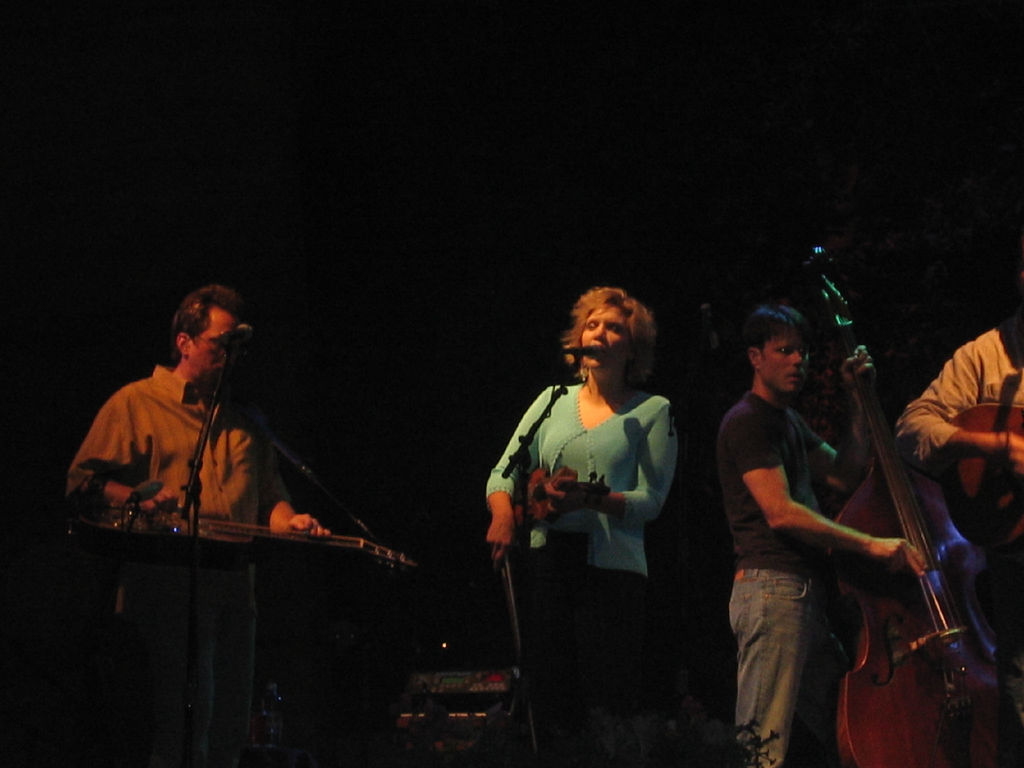
Krauss’s second album, Two Highways (1989), was the first credited to Alison Krauss and Union Station — the band she had assembled out of various Midwestern bluegrass scenes. The personnel of Union Station would stabilize over the next several years around four key members: the bassist Barry Bales (from Maryville, Tennessee, joined 1989); the multi-instrumentalist and singer Ron Block (who joined in 1991); the dobro player Adam Steffey (initially on mandolin; replaced by Jerry Douglas in 1998); and the guitarist and lead vocalist Dan Tyminski, who joined in 1994 after several years with the Lonesome River Band. The Tyminski hire — a hard-bluegrass tenor brought into Krauss’s softer arrangements — was the move that would make Union Station, over the next two decades, the most successful working bluegrass band in the world.
Krauss’s third album, I’ve Got That Old Feeling, came out on Rounder in October 1990. Its title track won her the Grammy for Best Bluegrass Recording in 1991. She was nineteen. She had become, in the space of two records, the most commercially successful young woman bluegrass had ever produced. The IBMA named her Female Vocalist of the Year in 1990, again in 1991, again in 1993, again in 1995. In 1993, at the age of twenty-one, she was inducted into the Grand Ole Opry — the youngest member in the institution’s history.
The album that turned her into a mainstream commercial phenomenon was a hits-and-favorites compilation released in February 1995 called Now That I’ve Found You: A Collection. The album included most of her standout tracks from the Rounder catalog — “Steel Rails,” “I’ve Got That Old Feeling,” “Forget About It,” “When You Say Nothing at All” — and was packaged for an audience that had not yet bought any of the earlier records. “When You Say Nothing at All,” a 1988 Keith Whitley song that Krauss had recorded for a Whitley tribute album in 1994, was released as a single in January 1995. It went to number three on the country chart. It won the Country Music Association’s Single of the Year. Now That I’ve Found You sold double platinum.
What Krauss had done, in the seven years between Too Late to Cry and Now That I’ve Found You, was something the genre had never accomplished without compromise. She had taken bluegrass instrumental sound — acoustic mandolin, fiddle, dobro, banjo, upright bass, with no drum kit and no electric instruments — onto mainstream country radio and adult-contemporary radio without modifying the instrumentation. The arrangements were quieter than what Ricky Skaggs’s Epic-era band had been playing in 1981; the production by John Pennell and the various Rounder engineers had a folk-revival cleanness to it; Krauss’s voice did not approximate the country-radio styles of the moment. But the records sold. They kept selling. By 2000 Krauss had won more Grammy Awards than any female artist in any genre — a record she would continue to break for another twenty years.
It is worth noting what Krauss did not do. She did not “save” bluegrass. The genre had been institutionally stable for a decade before her commercial breakthrough; the Del McCoury Band would have had the same career without her. She did not single-handedly bring bluegrass to a mass audience; the audience for Krauss’s hits was, in part, an audience that had no particular relationship to the rest of the genre and would not develop one. What she did was demonstrate that the music’s commercial ceiling, if its instrumentation was held to and its arrangements were thought about carefully, was higher than anyone in 1985 would have guessed.
Skaggs comes home
Ricky Skaggs’s country career, which Chapter 4 had ended in 1985 with his Country Music Association Entertainer of the Year award, continued through the late 1980s. He had hit after hit on Epic — “Highway 40 Blues” (1983), “Honey (Open That Door)” (1984), “Country Boy” (1985), “Cajun Moon” (1986). He won the CMA’s Entertainer award in 1985 and was nominated again in 1986. Then, around 1989, the country music industry shifted underneath him.
The shift was the arrival of what came to be called the hat acts. Garth Brooks’s debut album was released in April 1989. Clint Black’s, the same month. Travis Tritt’s, the next year. Alan Jackson’s, the year after that. The genre’s commercial center moved decisively toward stadium-arena country with rock-band production values: pedal steel and lead electric guitar over big drum tracks, songs about pickup trucks, stage shows with pyrotechnics and Garth Brooks running across overhead catwalks. Skaggs’s acoustic-leaning Epic records — even after he tried adjusting his production toward the new sound in 1990 and 1991 — stopped charting. By 1995 Epic was no longer renewing his contracts. In 1996, the same year Bill Monroe died, Skaggs’s relationship with the major-label country machine ended.
He responded by going home. He founded his own record label, Skaggs Family Records, in 1996. He assembled a new band, Kentucky Thunder, with the fiddler Bobby Hicks, the singer Paul Brewster, and the bassist Mark Fain. In 1997 he released Bluegrass Rules! — an album whose title was its argument. The repertoire was traditional. The instrumentation was acoustic. The production was unapologetically bluegrass.
Bluegrass Rules! won the IBMA’s Album of the Year and the Grammy for Best Bluegrass Album in 1998. Skaggs followed it with Ancient Tones in 1999, History of the Future in 2001, Soldier of the Cross in 1999 (gospel), and a long string of subsequent records into the 2010s. By the end of the decade he had become, by general agreement, the public face of mainstream traditional bluegrass — the genre’s most recognizable name to country-radio audiences who had stopped following the rest of it.
The Skaggs arc had become, by 1997, the mirror image of the Krauss arc. Krauss had walked into mainstream country with bluegrass instruments and had not had to leave. Skaggs had walked into country with bluegrass instruments, succeeded for fifteen years, then walked back out when the genre had moved away from him. Both arcs proved the same point about where the music’s commercial center of gravity could be. Bluegrass, for the first time in its history, was not commercially marginal. It was a place that musicians could choose to stand.
The festival circuit becomes a pilgrimage trail
The festival ecosystem that had taken its institutional shape under Carlton Haney and Bill Monroe in the late 1960s had, by the mid-1990s, developed into a national circuit with its own cultural geography. MerleFest, founded in 1988 in Wilkesboro, North Carolina, as a memorial for Doc Watson’s son Merle (who had been killed in a tractor accident on his father’s farm in October 1985), grew from a four-thousand-attendee event in its first year to a six-figure annual gathering by the late 1990s. Its programming was unusually broad: Doc Watson himself headlined every year, but the festival made a point of booking Americana, folk, and acoustic-country acts alongside the bluegrass main stage. The MerleFest “Traditional Plus” branding allowed the festival to host Sam Bush, Doyle Lawson, Alison Krauss, and Béla Fleck on the same lineup — a programming logic that no festival in the music’s first three decades would have attempted.
Telluride continued to anchor the West. RockyGrass anchored the more traditional Colorado scene. Grey Fox — which would change its name from Winterhawk in 2000 — was the Northeast’s major event. The IBMA’s World of Bluegrass, originally held in Owensboro from 1987 through 1996, moved to Louisville in 1997 and became, by the late 1990s, the largest single annual gathering in the music’s history: a four-day combined trade show, awards ceremony, professional conference, and music festival, with attendance approaching twenty thousand by the end of the decade.
What the festival circuit gave the music, beyond touring income, was a cultural geography. A working bluegrass musician in 1995 could plan the year around the circuit: SPBGMA’s Nashville convention in January, Merle in April, Telluride in June, Bean Blossom in late June, Grey Fox in July, RockyGrass in late July, IBMA in late September, then the long slow tour of regional fall festivals through October. The audience knew the schedule too. Bluegrass had become, by the mid-1990s, a touring music with a national audience that organized its own summer travel around the calendar.
September 1996
On the evening of March 15, 1996, Bill Monroe took the stage at the Grand Ole Opry for what would turn out to be his last public performance. He had been on the Opry for fifty-seven years. The lineup of the Blue Grass Boys that backed him that night was assembled from sidemen he had hired over the previous decade: Tom Ewing on guitar, Dana Cupp on banjo, Robert Bowlin on fiddle, Tater Tate on a second fiddle, Ernie Sykes on bass. None of them were household names. None of them would become household names. By the standards of any earlier Monroe lineup, this was a working backup band — competent, deferential, mostly anonymous.
In early April, Monroe suffered a stroke. He was admitted to the Skyline Medical Center in Nashville, then transferred to a hospice in Springfield, Tennessee. He was eighty-four. His condition deteriorated through the summer. On September 9, 1996, four days short of his eighty-fifth birthday, he died.
The bluegrass world had been preparing for the moment, in various ways, for a decade. The IBMA’s annual conference in October 1996 went on as scheduled — Owensboro felt, that year, more like a memorial gathering than a trade show, but it ran the planned programming. Bean Blossom held its 1997 festival in June, as it always had. The Del McCoury Band, Alison Krauss and Union Station, the Lonesome River Band, the Bluegrass Album Band, Doyle Lawson and Quicksilver, Hot Rize, the Seldom Scene, the Country Gentlemen, Larry Sparks, Ralph Stanley, and the dozen other working bands of the era all continued their tour schedules. None of them cancelled dates. None of them issued elegies that would have made any sense to people outside the music.
What Monroe’s death proved was the structural argument the previous chapter had been building toward without quite saying. By 1996, the music was not Bill Monroe’s anymore. It had been his to begin and his to name; for the first three decades of its existence it had been, in a real institutional sense, his band’s music. By 1985 it had become a genre. By 1990 it had become an industry. His death, in September 1996, changed none of that trajectory — the clearest measure of how completely the music he started had outgrown any one band, even his.
As Monroe’s era ended, Tony Rice’s voice was already failing. Rice had been the lead vocalist on the white album in 1975 and on every Bluegrass Album Band record from 1981 forward; he had recorded as a singer on his own albums throughout the 1980s and into the 1990s. In the early 1990s he began experiencing vocal fatigue and pitch instability that no rest seemed to cure. Doctors eventually diagnosed muscle tension dysphonia — a neuromuscular condition affecting the muscles of the larynx. In 1994, after a festival performance in which he felt he had lost vocal control onstage, Rice withdrew from singing publicly. He continued to record and tour as a guitarist for another two decades. He would not sing on a stage again. The loss was not as widely mourned as Monroe’s, but for the musicians who had grown up on the Rice records of the late 1970s and 1980s, the silence after 1994 was a permanent absence. Rice would die in December 2020.
The edge of 2000
In the late summer of 2000, three musicians who had grown up together in suburban San Diego — Chris Thile on mandolin, his childhood friend Sara Watkins on fiddle, and Sara’s brother Sean Watkins on guitar — released their first national album, Nickel Creek, on Sugar Hill Records. They had been playing together as a band since 1989, when Thile was eight years old. They had recorded several albums for small Southern California labels through the 1990s. The Sugar Hill album, produced by Alison Krauss, was their introduction to a national audience. It was certified platinum within three years.
Nickel Creek the album was barely bluegrass. The instrumentation was acoustic — mandolin, fiddle, guitar, bass — and the playing was at the virtuosic level the second-generation bluegrass world had established. But the songs were largely original; the harmonic vocabulary owed as much to chamber music and indie folk as to Bill Monroe; the production was clean and modern. The album was made for an audience that had not been listening to bluegrass and that, by buying the record, was incorporating bluegrass into its listening without quite knowing it.
Two other arrivals at the chapter’s edge would matter at least as much. In October 1999, the country superstar Dolly Parton had released The Grass Is Blue on Sugar Hill — the first of what would become a three-album bluegrass trilogy. After more than two decades of mainstream country crossover work, including the Trio records with Linda Ronstadt and Emmylou Harris, Parton had decided to record straight acoustic bluegrass with the genre’s working musicians: Sam Bush on mandolin, Jerry Douglas on dobro, Stuart Duncan on fiddle, Bryan Sutton on guitar, Barry Bales on bass, and a vocal trio that variously included Alison Krauss, Rhonda Vincent, Patty Loveless, and Claire Lynch. The Grass Is Blue won the IBMA’s Album of the Year and the Grammy for Best Bluegrass Album in 2000. The follow-up, Little Sparrow (2001), and the third record in the series, Halos & Horns (2002), would extend Parton’s bluegrass commitment for another four years. The trilogy was, by every commercial measure, the most successful set of bluegrass records any major country artist had ever made.
The other arrival was a Missouri singer named Rhonda Vincent. Vincent had been born in 1962 and raised in the Sally Mountain Show, her family’s bluegrass band, which had begun performing locally when she was five. She had spent the late 1980s and early 1990s attempting a mainstream Nashville country-music career — signing first with Rebel and then with Giant Records — and had concluded, by the late 1990s, that her musical home was bluegrass. In June 2000 she released Back Home Again on Rounder, her first record as a fully committed bluegrass bandleader. The IBMA named her Female Vocalist of the Year that year, the first of seven consecutive wins in the category (2000-2006) and the longest unbroken streak in any IBMA voting category. By 2001 she had also won Entertainer of the Year — the first woman ever to receive that award. The post-Krauss generation of women bandleaders had its second major star.
In December 2000, the Coen brothers released O Brother, Where Art Thou?, a film whose soundtrack — produced by T-Bone Burnett, released the following month — would, within two years, sell more than eight million copies and win the Grammy Album of the Year. The soundtrack’s opening track was a recording of the traditional ballad “I Am a Man of Constant Sorrow,” credited in the film to a fictional band called the Soggy Bottom Boys but performed in fact by Dan Tyminski, Ron Block, and a backing chorus of bluegrass musicians. Tyminski’s lead vocal — the same Dan Tyminski who had joined Alison Krauss and Union Station in 1994 — was lip-synced on screen by George Clooney. The recording would become, against every commercial expectation that anyone had brought to the project, the most widely heard bluegrass vocal of the early twenty-first century.
The chapter ends here, on the cusp of a commercial moment that nobody in 1985 had predicted. The genre had spent fifteen years building the institutional architecture, the touring economy, the second-generation bandleader bench, and the recording catalog that would, in 2001 and 2002 and through the rest of the decade, find itself in the unfamiliar position of being mainstream popular music. The audience for O Brother would be larger than any audience bluegrass had ever reached. The audience for Nickel Creek would grow into the audience for the Punch Brothers a decade later. The questions about how a genre handles unanticipated mass-cultural success — questions that bluegrass had never had occasion to ask before — would dominate the next chapter.
By December 2000, Bill Monroe had been dead for four years. The music he had not started alone, and never owned, was about to walk into rooms he never could have imagined.
Sources and further reading
- Neil V. Rosenberg, Bluegrass: A History (University of Illinois Press, 1985; rev. 2005). The standing scholarly history; covers the chapter’s first half.
- Murphy Hicks Henry, Pretty Good for a Girl: Women in Bluegrass (University of Illinois Press, 2013). Indispensable for the Alison Krauss, Lynn Morris, and Hazel Dickens material.
- Tom Ewing, Bill Monroe: The Life and Music of the Blue Grass Man (University of Illinois Press, 2018). The final chapters cover Monroe’s death and the immediate aftermath.
- Tim Stafford and Caroline Wright, Still Inside: The Tony Rice Story (Word of Mouth Press, 2010). On Rice’s vocal loss in 1994.
- The Bluegrass Music Hall of Fame & Museum for inductee biographies of the era’s bandleaders.
- The International Bluegrass Music Association for institutional and awards-show history.
- The MerleFest history page for the festival’s founding.
- Bluegrass Unlimited archives for the period’s working journalism.