Gospel, Faith, and the Road Home
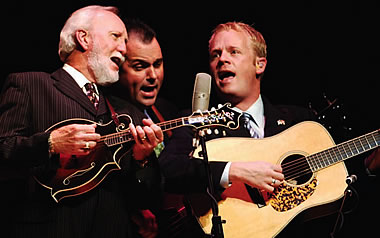
At nearly every bluegrass concert, somewhere in the second set, the band stops being a bluegrass band for ten or twelve minutes and becomes a gospel quartet. The instruments come down. The four vocalists move closer to a single condenser microphone. Someone counts off “Working on a Building” or “Angel Band” or “Wayfaring Stranger.” The audience knows what is happening. They settle in. The room gets quiet. The band sings something about death, salvation, and the road home, in the unaccompanied or sparely-accompanied quartet idiom the form has been using since at least the 1920s. After the song, the band picks the instruments back up and goes back to bluegrass. (The stripped-down staging is one register of the form, not a rule — plenty of gospel numbers run with the full band arrangement, and many bands do both inside the same set.)
That moment — the gospel set inside the secular concert — is one of the form’s most distinctive features. It is also one of the least examined, in scholarship and in the music’s own self-narration. The harmony lineage that produced bluegrass gospel singing is covered elsewhere in this section, in the first chapter’s account of how Sacred Harp shape-note singing, African-American spirituals, the white gospel quartet tradition, and the brother-duet recordings of the 1930s and 1940s combined to produce bluegrass’s trio-and-quartet vocal style. This essay covers something different: the content of bluegrass gospel. Why does the music keep returning, in every era and every band’s repertoire, to salvation, death and resurrection, the hard-times-to-hope arc, the gospel set at every concert? What does the bluegrass tradition keep doing with this material?
The Calvinist undertow
The bluegrass musicians who built the canon in the late 1940s and 1950s — Bill Monroe (Methodist), the Stanley Brothers (Primitive Baptist), Flatt and Scruggs (variously Baptist and Methodist), Reno and Smiley, the Osborne Brothers, Jim and Jesse, the early Country Gentlemen — came from a religious culture in which salvation was a continuous daily concern. Most of the founding musicians had been raised in evangelical Protestant traditions — primarily Baptist (Southern, Primitive, Free-Will, hard-shell), Methodist (Wesleyan), and Pentecostal (Holiness, Church of God) — in which doctrine took the human condition seriously: the world was fallen, sin was real, judgment was certain, and grace was a working concern, not a metaphor.
This is, in part, why the bluegrass canon does murder ballads and gospel songs at the same time and with the same vocal resources. The two bodies of work are doctrinally complementary, in the religious world the musicians came from. The murder ballads document what happens when sin runs its full course unchecked: Pretty Polly is murdered, the killer is hanged or escapes, the song does not end with redemption. The gospel songs document the other path: the soul that turns toward grace, the death that opens onto resurrection, the hard road that ends in glory. The same artists could record both kinds of songs because the world that produced them held both as parallel possibilities. The Stanley Brothers’ early Columbia catalog holds “Pretty Polly” and Carter Stanley’s gospel composition “The White Dove” side by side, and the musicians were not switching costumes. The two songs were two readings of the same moral universe.
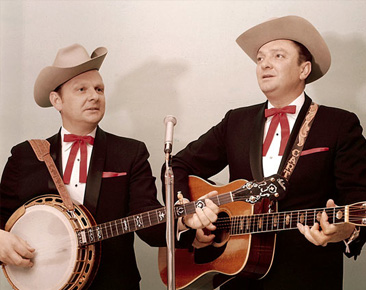
Ralph Stanley described his own theological orientation in interviews late in his life as Primitive Baptist Universalist — a small mountain-Baptist denomination that holds that Christ’s atonement was for the salvation of all souls, not just the elect. The denomination is concentrated in a few counties of southwestern Virginia, eastern Kentucky, and West Virginia, with a few churches elsewhere. Stanley grew up in it. His best-known gospel performance — the unaccompanied “O Death” he recorded for the O Brother, Where Art Thou? soundtrack in 2000, in which he sings as the soul pleading with the angel of death — came directly out of that tradition. The song is older than him; it had been a Baptist death-ballad standard since at least the 1920s. T Bone Burnett, the soundtrack’s producer, had originally asked Stanley for a banjo arrangement; Stanley persuaded him to let him sing it a cappella in the Primitive Baptist Universalist style. The performance won him the 2002 Grammy for Best Male Country Vocal Performance, beating Tim McGraw, Ryan Adams, Willie Nelson, Johnny Cash, and Lyle Lovett for the award.

The standard gospel repertoire
The bluegrass gospel canon stabilized around a relatively small set of songs that effectively every working band knows and performs. The deepest layer is older than country music itself — nineteenth-century white-evangelical hymnody that came down through the shape-note songbooks and the Sunday-evening gospel singings of the rural South. “Sweet By and By” (S. Fillmore Bennett and Joseph Webster, 1868), “Where the Soul of Man Never Dies” (William Golden, 1914), “Will the Circle Be Unbroken” (Ada Habershon and Charles Gabriel, 1907; rewritten by A.P. Carter and recorded by the Carter Family for Victor in 1935 as “Can the Circle Be Unbroken”), “Beulah Land” (Edgar Stites, 1876), “When the Saints Go Marching In” — the songs are old, and they had been bluegrass repertoire since the founding generation got to them.
The middle layer is twentieth-century gospel composition that the bluegrass world adopted: Albert E. Brumley’s “I’ll Fly Away” (1929), Lee Roy Abernathy and Ira Stanphill’s “Mansion Over the Hilltop” (1949), Stuart Hamblen’s “It Is No Secret” (1950); “Working on a Building,” a traditional spiritual the Carter Family recorded for Bluebird in 1934 (with the copyright registered to A.P. Carter). Brumley’s catalog in particular — he wrote roughly seven hundred gospel songs across his career — supplied bluegrass with a substantial portion of its working gospel repertoire.
The top layer is bluegrass-internal composition. The Stanley Brothers built their gospel sets from writers inside the tradition — “Cry From the Cross” came from Johnnie Masters — and Carter Stanley wrote gospel of his own, “The White Dove” and “The Angels Are Singing” among them. Doyle Lawson, working from the late 1960s onward as a mandolinist and then as a bandleader with Quicksilver, wrote dozens of original gospel songs and arranged dozens more. The Lewis Family, in southern Georgia, recorded gospel records continuously from 1951 to 2009 and wrote hundreds of songs. The bluegrass gospel canon was a working composition idiom across the entire postwar period, not a fixed repertoire.
Death and the road home
The deepest organizing concern of the bluegrass gospel canon is death — specifically, the working musician’s own death, and the question of where the soul goes after it. The songs are not, on the whole, abstract theological documents. They are first-person narratives in the voice of a singer who is preparing for the moment of his or her own dying, often visualizing the angels coming to bear the soul away, often imagining the heavenly home as a specific architectural place (a mansion, a city, a riverbank, a great gettin’-up morning).
“Angel Band” is the form’s clearest example. The song is in the first person, addressed to the angels: “Bear me away on your snow white wings to my immortal home.” The dying singer’s voice is intimate, not desperate; the angels are familiars, not strangers. “Wayfaring Stranger” is structurally similar: the singer is a traveler in a hostile world (“a poor wayfaring stranger, traveling through this world of woe”) who is bound for a home where there will be “no sickness, toil, nor danger.” “Beulah Land” places the singer just at the boundary, looking across “the river of death” into the eternal country. “I’ll Fly Away” makes the death-as-flight metaphor explicit: when the soul leaves the body, it flies away to a place where time does not move the same way.
The connection to the rambling and home material covered in other essays of this section is direct. The bluegrass gospel song is, structurally, a rambling song in which the destination is heaven. The traveler is en route; the world being left behind is hard; the home ahead is the one the singer should have been in all along. The same musical and lyrical vocabulary that the rambling and home essays cover is here, transferred to a religious setting. The melodies and harmonies are sometimes literally the same — set “Hallelujah, I’m Ready” next to “How Mountain Girls Can Love” and you are hearing one melodic family in sacred and secular clothes.
The hard-times-to-hope arc
A particular sub-form of bluegrass gospel song works on what the musicians call the hard-times-to-hope arc — a first-person narrative in which the singer recounts the depth of his sin, addiction, or estrangement, and then describes the moment of his conversion or his redemption. “Tear My Stillhouse Down,” written by Gillian Welch and David Rawlings and recorded for her 1996 debut Revival, is one of the form’s clearest contemporary examples. The narrator, a moonshiner on his deathbed, asks his family to tear down the still that has been his livelihood, so his children won’t have to live with what he made. The song is a conversion narrative without the conversion explicitly named.
The same arc — the deep sinner who is offered grace — runs through “Amazing Grace” (which is in nearly every bluegrass band’s set), “I Saw the Light” (Hank Williams’s 1948 song that has become standard bluegrass-gospel repertoire), “He Was a Friend of Mine,” “Just a Closer Walk With Thee,” and a dozen others. The form takes seriously the proposition that the worst sinner is the one whose conversion will be the most dramatic and the most theologically interesting. Bluegrass gospel does not, on the whole, write songs about people who have always been good. It writes songs about people who needed redemption and got it.
This relates directly to the prison-song tradition (which is covered separately in the Outlaws essay of this section), since prison songs and conversion songs share the same arc: the protagonist has done wrong, has come to recognize it, and is on the road back. Johnny Cash’s prison-concert recordings are the most-visible instance of the convergence between the two forms.
The Stanley Brothers’ gospel records
Two influential Stanley Brothers gospel albums are Hymns and Sacred Songs (1959, King) and Hymns of the Cross (1964, King). Both were recorded with the band’s working lineup (Carter Stanley lead vocal and guitar, Ralph Stanley banjo and tenor harmony, plus a rotating cast of fiddler and mandolinist and bassist), with the gospel quartet handled by the band members themselves rather than by guest singers. The records together contain “I’ll Meet You in Church Sunday Morning,” “White Dove,” “Daniel Prayed,” “Will the Circle Be Unbroken,” “How Beautiful Heaven Must Be,” and “Beautiful Star of Bethlehem.” They became, between them, the template for what a bluegrass gospel record sounded like for the next sixty years.
The records also did, retrospectively, something the brothers themselves probably did not intend: they preserved a vernacular religious culture that the urban gospel-music industry of the 1960s and 1970s would otherwise have replaced. Mainstream gospel by the 1970s — the Bill Gaither homecoming videos, the Imperials, the Cathedral Quartet, the Statler Brothers’ country-gospel records, the rest of the Southern Gospel-industry mainstream — was using larger arrangements, electric instruments, pop production. The bluegrass gospel canon stayed close to the older quartet form. It did so partly because the bluegrass world is conservative about arrangements, and partly because the older form does specific theological work that the bigger arrangements do not. A bluegrass quartet singing “Angel Band” sounds like four neighbors at a wake. A Southern Gospel quartet with backing track sounds like a record. The two registers are not interchangeable.
Doyle Lawson and the gospel-bluegrass professional class
The figure who turned bluegrass gospel into a discrete commercial subgenre, separable from the broader bluegrass marketplace, was Doyle Lawson. Born in Ford Town, Tennessee, in 1944, Lawson had joined Jimmy Martin’s Sunny Mountain Boys on banjo in 1963 (later switching to mandolin, the instrument he would become known for), then played mandolin with the Country Gentlemen from 1971 to 1979. In 1979 he founded his own band, Quicksilver, with the explicit goal of recording bluegrass gospel as its primary work. Quicksilver’s first record was a secular bluegrass album; everything after that was gospel-leaning, and the band’s identity became, by the late 1980s, exclusively a gospel-bluegrass identity.
Lawson’s catalog — over forty albums for Sugar Hill, then Rounder, then his own Mountain Home label — standardized the modern gospel-bluegrass production aesthetic. Tight quartet vocals; minimal instrumental embellishment; a song selection that mixed the traditional bluegrass gospel canon with newer compositions by Lawson and his band members. The band has had numerous lineup changes across its forty-five years of operation, but the records sound remarkably continuous. Quicksilver became, by the 2000s, the institutional standard against which other gospel-bluegrass bands were measured. The Isaacs (a family band working in a similar idiom since the 1980s), Joe Mullins and the Radio Ramblers, Junior Sisk, and a number of contemporary touring bands continue working in the form Lawson set up.
Why the music keeps coming back
The closing question worth taking seriously is why, in 2026, with the religious culture that produced this material in significant retreat across most of bluegrass’s working audience, the music keeps doing the gospel set anyway. The answer is partly inertia — the form has done it for seventy-five years and the audience expects it. But the deeper answer is that bluegrass gospel does work that the rest of the music cannot.
The instrumental bluegrass set is fast, virtuosic, often emotionally light. The murder-ballad set is dark but distant; the killings are over and done. The rambling and home set is wistful but secular; the home is gone, the singer has accepted it. What the gospel set offers, inside the same evening of music, is a register the others do not have: the literal address to one’s own death. The singer is not preparing for some other person’s death. He is preparing for his own. The audience, sitting in the second-set quiet of a thousand-person concert hall in Galax or Wilkesboro or Telluride, is preparing for theirs.
This is, in the end, what bluegrass gospel keeps doing. It is the form in which the audience and the musicians together face, for ten or twelve minutes, the fact that they will all eventually die. The instruments come down. The four voices move to the microphone. They sing about home. The room gets quiet. Then the song ends, the instruments come back up, and the band plays “Bluegrass Breakdown” or something equally fast, and the audience returns to its life. But for the duration of the gospel set, the question that the rest of the music makes a virtuosic distraction from has been the actual subject of the music. That is what the form does. It is the reason the form survives.