Country Music and Bluegrass: A Long Conversation
The two-week stretch in late July and early August 1927 when the New York record-company scout Ralph Peer set up a Western Electric microphone in a hat warehouse on State Street in Bristol, Tennessee, is the moment country music gets its official founding date. Across those weeks Peer recorded the Carter Family for the first time and Jimmie Rodgers for the first time, along with seventeen other acts who were never heard from again. The Carter Family came down from Maces Spring, Virginia, in a Model A; A.P. and Sara and Maybelle had been singing locally but had never been on a record. Jimmie Rodgers, twenty-nine years old and tubercular, had come over from Asheville with the borrowed clothes of a railroad brakeman who had become an entertainer because his lungs would no longer let him work the trains. Peer paid each act fifty dollars for the session and the standard royalty arrangement of two cents per record. Nothing in the room marked itself as the start of an industry.
The records Peer made that week — the Carters’ “Bury Me Beneath the Willow” and “Single Girl, Married Girl,” Rodgers’s “The Soldier’s Sweetheart” — were sold by Victor as “hillbilly music.” That was the commercial term in 1927. Country would replace it in the late 1940s. Bluegrass would arrive around 1957. What the Bristol sessions produced was the recorded foundation that both labels would eventually be applied to, retroactively, by people sorting out a catalog that had been a single shelf when it was made.
This piece is about how country and bluegrass have moved across each other in the ninety-eight years since — and, along the way, about the country canon a bluegrass listener should know. The two genres diverged after they had already started together. They built parallel institutions for decades. They reabsorbed each other through certain artists in certain eras. They are, in 2026, closer than they have been since the Bristol sessions themselves. The story is harder to follow without knowing the country names, so this is also a primer on those.
The Bristol founding and the pre-history
The first commercial country record is usually credited to Fiddlin’ John Carson, whose June 1923 recording of “The Little Old Log Cabin in the Lane” for Ralph Peer at OKeh Records in Atlanta sold well enough to convince the major labels there was a rural-music market to chase. The next four years — 1923 through 1927 — brought the first wave of hillbilly recordings: Henry Whitter, Vernon Dalhart (whose 1924 record of “The Wreck of the Old 97” backed with “The Prisoner’s Song” became the first country record to sell a million copies), Riley Puckett, Gid Tanner and the Skillet Lickers, Charlie Poole and the North Carolina Ramblers, Uncle Dave Macon, the Carolina Tar Heels, Bradley Kincaid. The Carter Family and Jimmie Rodgers were not the first country records. They were the first acts who became commercial stars on the strength of recordings. After Bristol, the industry knew what it was looking for.
Jimmie Rodgers, recording continuously between 1927 and his death from tuberculosis in May 1933, became country music’s first national star. Twelve “Blue Yodels,” each numbered — “T for Texas” was Blue Yodel No. 1 — mixed Mississippi blues with white-southern vocal phrasing in a way nobody had recorded before. He sold an estimated twenty million records before he died at thirty-five. Every country and bluegrass singer who came after him heard him; Bill Monroe’s “Mule Skinner Blues” is a Jimmie Rodgers cover, recorded in 1940 in Rodgers’s exact form.
The Carter Family — A.P. as collector and arranger, Sara as lead singer, Maybelle as the guitar innovator whose thumb-and-fingers “Carter scratch” technique carried the melody on the bass strings with the thumb while the fingers brushed the chords — cut around three hundred sides between 1927 and 1941. The catalog they built (“Wildwood Flower,” “Will the Circle Be Unbroken,” “Keep on the Sunny Side,” “Wabash Cannonball,” “I’m Thinking Tonight of My Blue Eyes,” “Worried Man Blues”) became the working songbook of country and bluegrass simultaneously. Their last commercial recording sessions were in October 1941, and the original group broke up in 1943 after their broadcast residency at WBT Charlotte ended. A.P. and Sara had divorced; Sara had moved to California. Maybelle and her daughters (June, Helen, Anita) continued performing as Mother Maybelle and the Carter Sisters, and June would marry Johnny Cash twenty-seven years later.
Across the 1930s, two other branches of the music developed. Gene Autry — born in Tioga, Texas, in 1907, working out of Tulsa as the “Yodeling Cowboy” through the early 1930s — signed with Republic Pictures in 1934 and became the dominant singing-cowboy film star of the decade. Roy Rogers, Tex Ritter, the Sons of the Pioneers, and the Bob Wills western-swing bands shared this audience. The cowboy-singer aesthetic was country music’s first national mass image — rural-southern voices wearing rhinestones in front of a movie-set saloon — and it stayed dominant through World War Two.
The Grand Ole Opry, broadcast weekly from Nashville’s WSM since November 1925, was the form’s institutional center. Uncle Dave Macon was on the original cast. Roy Acuff joined in 1938 and became the show’s anchor singer of the 1940s — “Wabash Cannonball,” “The Great Speckled Bird,” “Wreck on the Highway.” Bill Monroe joined in October 1939, six years before Earl Scruggs walked onto the stage with him. Ernest Tubb arrived in 1943 and brought the electric guitar with him. By the mid-1940s, the Opry was a coast-to-coast Saturday-night fixture and country music had a working national audience.
Hank Williams and the honky-tonk peak
The genre’s first short golden age ran roughly from 1947 through the mid-1950s and is anchored by Hank Williams. Born September 17, 1923, in Mount Olive, Alabama, Williams led his own band, the Drifting Cowboys, from his late teens, signed with Sterling Records in 1946 and MGM in 1947, and was a national star by his Opry debut on June 11, 1949 — where the audience called him back for six encores of “Lovesick Blues.” He died of heart failure in the back of a Cadillac on New Year’s Day 1953, twenty-nine years old.
The output between 1947 and 1953 — “I’m So Lonesome I Could Cry,” “Your Cheatin’ Heart,” “Cold, Cold Heart,” “I Saw the Light,” “Honky Tonk Blues,” “Hey, Good Lookin’,” “Jambalaya,” “Move It On Over” — became the catalog every subsequent country artist had to define themselves against, and the catalog every subsequent bluegrass artist drew heavily from. The Stanley Brothers recorded Hank’s songs throughout the 1950s and 1960s. Bill Monroe recorded them too. Flatt and Scruggs played them on the Martha White morning show. The bluegrass musicians did not think of themselves as covering country songs. They thought of themselves as drawing on the shared southern songbook that Hank Williams happened to be its most prolific recent contributor to.
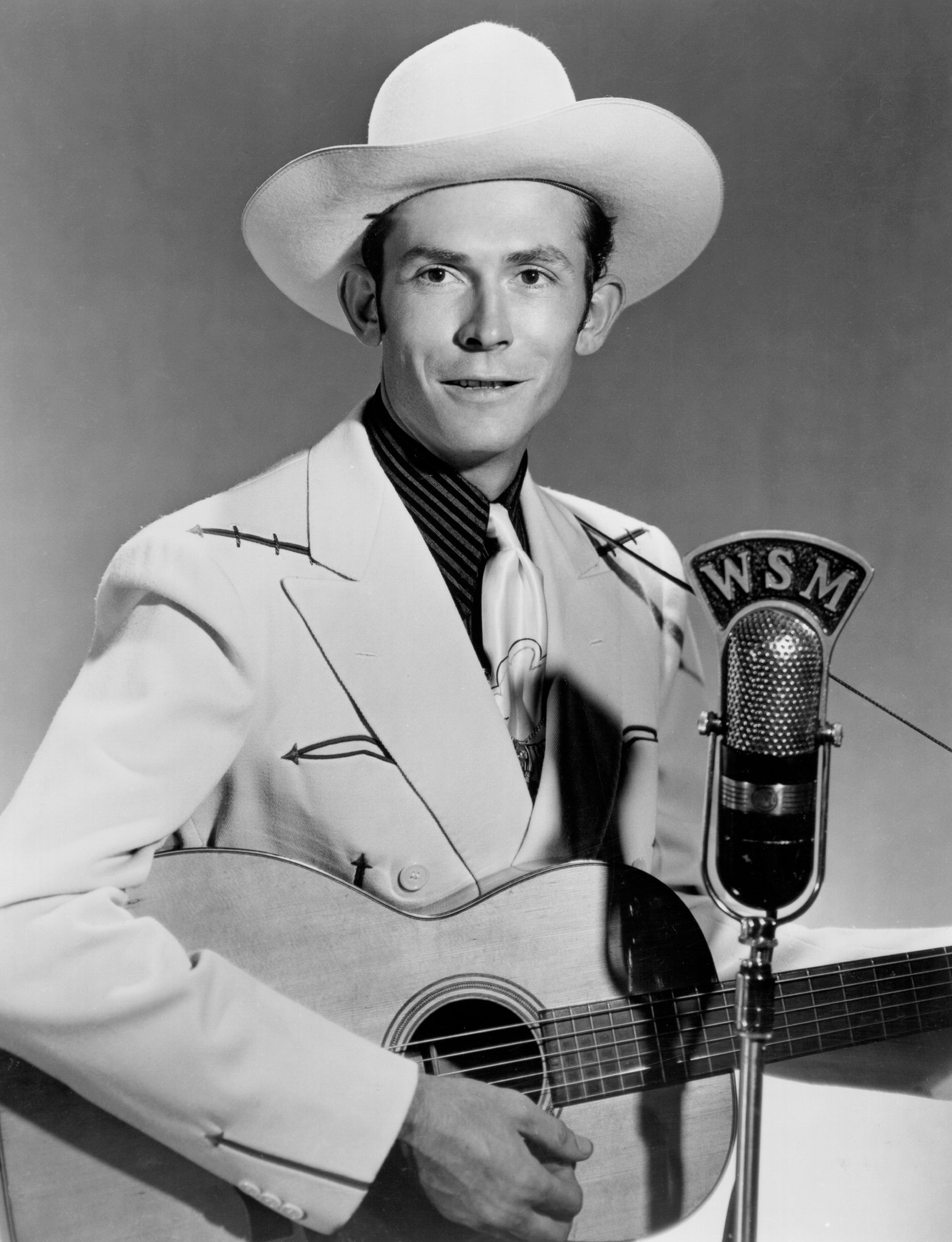
Around Hank, the honky-tonk era had its own cast. Ernest Tubb defined the form — the lonesome bar-room singer with the small electric combo — on his 1941 hit “Walking the Floor Over You” and continued through the next four decades. Lefty Frizzell, who showed up on Columbia in 1950, was the vocal stylist Merle Haggard would later describe as the most important singer he ever heard. Webb Pierce dominated the Billboard country chart through the mid-1950s, with thirteen number-one singles between 1952 and 1957. Hank Snow brought the Canadian-prairie variant of the same idiom into the American country chart starting with his 1950 number-one “I’m Movin’ On.” Kitty Wells, with her 1952 single “It Wasn’t God Who Made Honky Tonk Angels,” became the first major woman country star and the first woman to take a country single to number one.
This is the world bluegrass first hardened inside. Until Elvis Presley walked into Sun Records in July 1954, what Bill Monroe and Flatt and Scruggs and the Stanley Brothers were doing was being sold by the same labels, played on the same Opry, and bought by the same listeners as what Hank Williams and Kitty Wells were doing. The split was not yet visible.
The Sun Records pivot, July 1954
The night Elvis Presley walked into Sam Phillips’s Sun Records studio at 706 Union Avenue in Memphis and picked up his guitar during a break, the musicians on the session were Scotty Moore on guitar and Bill Black on upright bass. After several unsuccessful hours on slow ballads, Elvis started fooling around with a Bill Monroe song. Monroe had recorded “Blue Moon of Kentucky” for Columbia on September 16, 1946, in 3/4 waltz time, with Chubby Wise’s fiddle carrying the slow melody. Elvis sang it in 4/4 — faster, looser, with a slap-bass shuffle from Bill Black underneath. Phillips heard it through the control-room glass and ran into the studio. The tape rolled. The single was released two weeks later, on July 19, 1954, as the B-side of “That’s All Right (Mama).”
What the Elvis pivot did, structurally, was take the audience. The rural-American teenagers and twenty-year-olds who had bought Hank Williams records bought Elvis and Buddy Holly and Carl Perkins and Jerry Lee Lewis records instead. The late 1950s through the early 1960s are the period when both country and bluegrass, as commercial categories, hit their lowest postwar point. Bluegrass’s response to the rock-and-roll audience-collapse is the subject of the History chapters of this section. Country’s response — which was different, and which forced bluegrass into its identity — is the subject of the next part of this piece.
Nashville Sound versus Bakersfield Sound
Two competing producers’ visions defined country in the late 1950s and 1960s. The Nashville Sound, built by Chet Atkins at RCA Victor’s Nashville studio from 1957 onward and by Owen Bradley at Decca through the same years, was a deliberate move to recapture the country audience for adult pop. Atkins and Bradley used full orchestras, the Anita Kerr Singers or the Jordanaires for backing vocals, prominent drums, and electric instruments mixed forward. Fiddle, banjo, and dobro — the sounds that read as hillbilly in 1958 — were pushed out by design, and even the steel guitar was reined in.
The Nashville Sound succeeded enormously. Patsy Cline, who recorded for Decca under Bradley’s production from 1960 until her death in a March 1963 plane crash, produced “Crazy” (1961), “I Fall to Pieces” (1961), “She’s Got You” (1962) — records that defined a country-pop singer’s idiom that every woman in the format afterward had to negotiate. Jim Reeves had similar success at RCA under Atkins (“He’ll Have to Go,” 1959; “Welcome to My World”) and died in the same kind of light-aircraft accident in July 1964. Brenda Lee, Bradley’s other key star, crossed from rockabilly to country-pop and back, charting on both pop and country radio through the 1960s. Eddy Arnold, who had been a Tennessee Plowboy in the 1940s honky-tonk world, reinvented himself under Atkins as a tuxedo-wearing supper-club singer and had his biggest hit (“Make the World Go Away”) in 1965. Marty Robbins, working slightly outside the Atkins-Bradley orbit, anchored the era’s outlaw-narrative side — “El Paso” in 1959, “Big Iron,” “Don’t Worry,” “Devil Woman.”

The Country Music Association, founded in November 1958 to lobby radio programmers, formalized the Nashville Sound’s industrial goals. By the mid-1960s, country radio had recovered the audience share it had lost to rock and roll, and the Opry’s mainstream stars were selling to listeners who had never been near a barn dance. What the Nashville Sound also did, deliberately, was leave bluegrass without a commercial home inside country radio. The disc jockeys and record-store racks that needed a name for what Monroe and Flatt and Scruggs and the Stanleys were doing began using bluegrass — the word coming from the name of Monroe’s band — around 1957. Bluegrass Unlimited magazine launched in 1966. The genre had to invent itself, in commercial terms, because its older home had stopped having room for it.
Two thousand miles west of Nashville, a counter-tradition formed. Buck Owens, born in Sherman, Texas, in 1929 and raised in Mesa, Arizona, had moved to Bakersfield, California, in 1951 to play in the working-class country bars that served Dust Bowl migrants. He signed with Capitol Records in 1957. His band, the Buckaroos, with Don Rich on lead guitar, played electric honky-tonk — loud, fast, no strings, no orchestral arrangements. The records (“Act Naturally,” 1963; “Together Again,” 1964; “Tiger by the Tail,” 1964) lined up fifteen consecutive number-one singles between 1963 and 1967. The Bakersfield Sound, as it came to be called, was the West Coast rejection of Nashville’s countrypolitan production model. It was country radio with the rough edges back in.
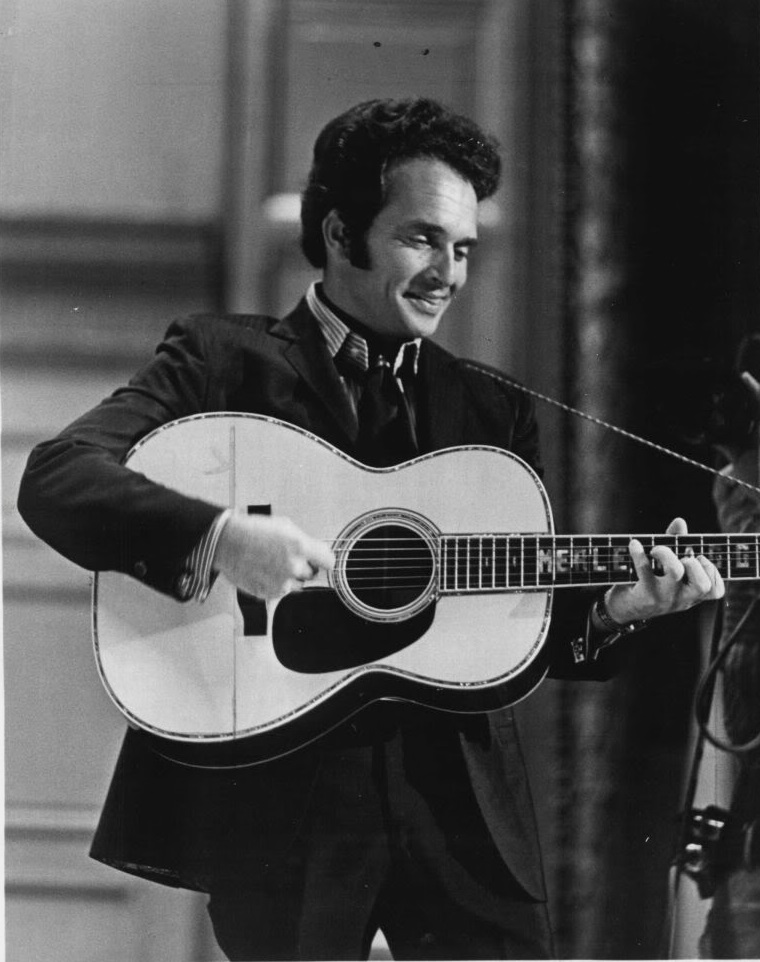
Merle Haggard, born in Bakersfield in 1937, came up through the same scene. He had served two years and nine months in San Quentin for burglary as a teenager, was paroled in 1960, and signed with Capitol in 1965. His records (“Mama Tried,” “Sing Me Back Home,” “Workin’ Man Blues,” “Okie from Muskogee”) brought a working-class first-person voice into country music that nobody had been writing for since Hank Williams. Hag became, over the next four decades, one of country’s three or four most important artists.

The golden age in country, 1960s and 1970s
Across the two decades after the Nashville Sound consolidated, country built its deepest catalog of singer-defined records. The list of central figures from this period that any country listener needs to know is short, but each is essential.
Johnny Cash. Born in Kingsland, Arkansas, in 1932; raised in a Dyess Colony resettlement farm during the Depression. Cash signed with Sun Records in 1955 — the same label as Elvis — and broke through with “I Walk the Line” (1956). He moved to Columbia in 1958 and had a forty-five-year career with that label. The defining records were the live prison concerts — At Folsom Prison (recorded January 13, 1968) and At San Quentin (recorded February 24, 1969) — which between them sold roughly ten million copies in the years after their release. His 1969-1971 ABC television variety show brought Bob Dylan, Joni Mitchell, Neil Young, Roy Orbison, and the Carter Family into the same hour of network television. His third act, the Rick Rubin-produced American Recordings series from 1994 onward, redefined what a late-career country record could be. He died September 12, 2003, in Nashville. His daughter Rosanne Cash has continued the family’s recording career.
George Jones. Born in Saratoga, Texas, in 1931. First hit (“Why Baby Why”) in 1955. Across the next fifty years, Jones became what every serious country writer eventually called him — the greatest country singer of the century. The voice was a soft baritone with extraordinary phrasing control; the catalog included “She Thinks I Still Care” (1962), “The Race Is On” (1965), “The Grand Tour” (1974), “He Stopped Loving Her Today” (1980), and a long succession of duets with his second wife Tammy Wynette. He battled alcoholism and cocaine addiction publicly for decades; he died April 26, 2013.
Tammy Wynette. Born Virginia Wynette Pugh in Itawamba County, Mississippi, in 1942. Signed with Epic in 1966; produced by Billy Sherrill, who built her records around her keening soprano. “Stand By Your Man” (1968) became, in spite of its later feminist criticism, the best-selling single ever recorded by a woman in country music up to that point. “D-I-V-O-R-C-E” (1968), “Til I Can Make It on My Own” (1976), and the Jones duets defined the wronged-woman ballad’s late-century form. She died April 6, 1998.
Loretta Lynn. Born in Butcher Hollow, Kentucky, in 1932. A coal miner’s daughter who started singing at her husband’s urging while raising six children. Her 1970 autobiographical record Coal Miner’s Daughter became the title of her bestselling memoir and the 1980 film of the same name. The catalog — “Don’t Come Home A-Drinkin’,” “You Ain’t Woman Enough,” “The Pill” — brought the Appalachian working-class woman’s voice into mainstream country radio in plain sight. She died October 4, 2022.
Conway Twitty. Born Harold Lloyd Jenkins in Friars Point, Mississippi, in 1933. He started as a rockabilly singer in the late 1950s, then crossed to country in 1965. “Hello Darlin'” (1970), the long string of duet records with Loretta Lynn (“Lead Me On,” “Louisiana Woman, Mississippi Man,” “Feelin’s”), and fifty-five number-one country singles across the next twenty years made him the most chart-successful artist of his generation. He died June 5, 1993.
Charley Pride. Born in Sledge, Mississippi, in 1934 to a Black sharecropping family of eleven children. Pride played semi-professional baseball in the Negro American League and country-and-western on the side, signed with RCA’s Nashville office in 1965 (Chet Atkins took the risk), and through the next twenty years had thirty number-one country singles — “Kiss an Angel Good Mornin'” (1971), “Is Anybody Goin’ to San Antone,” “All His Children.” He was the first Black artist to be a mainstream country star and remained, for most of his life, one of only two or three Black artists working in the format at any major scale. He died December 12, 2020, of Covid complications.
Dolly Parton. Born in Sevierville, Tennessee, in 1946. Country radio star from 1967 through the late 1970s; pop crossover star from 1977 onward; film star from 1980 (“9 to 5”). Parton’s bluegrass and Appalachian roots stayed in her catalog the whole way through, but she is canonically a country artist whose third act has been an Americana and bluegrass act. The 1987 Trio record with Linda Ronstadt and Emmylou Harris, the 1999 Trio II follow-up, and the three-record bluegrass trilogy — The Grass Is Blue (1999), Little Sparrow (2001), and Halos & Horns (2002), all recorded on Sugar Hill with Jerry Douglas, Stuart Duncan, Bryan Sutton, Sam Bush, and Alison Krauss — brought the mainstream country audience into bluegrass record stores in a way no previous record had.
Around these central figures, the era had a deep supporting cast. Tom T. Hall, the “Storyteller,” wrote and sang miniature short-story ballads (“Harper Valley P.T.A.” for Jeannie C. Riley, “Old Dogs, Children, and Watermelon Wine” for himself). Glen Campbell crossed country and adult-pop with the Jimmy Webb songbook (“Wichita Lineman,” “Galveston,” “Rhinestone Cowboy”). Anne Murray and Crystal Gayle had similar country-pop crossover success. Buck Owens hosted Hee Haw from 1969 alongside Roy Clark. The format had its institutional consolidation; it also, by the early 1970s, had its internal rebellion ready to launch.
John Hartford. Born in New York City in 1937, raised in St. Louis, moved to Nashville in 1965 to work as a session musician and staff songwriter. In 1967 he wrote “Gentle on My Mind,” which Glen Campbell took to #1 country and then to pop in 1968; the song won four Grammys and became one of the most-performed songs in BMI’s licensing history. The royalty stream from “Gentle on My Mind” funded Hartford’s quiet pivot back to acoustic-string-band music a few years later: Aereo-Plain (Warner Bros., 1971), recorded with Norman Blake on guitar, Vassar Clements on fiddle, Tut Taylor on dobro, and Randy Scruggs on bass, would be widely cited as the founding moment of newgrass (see our What is Bluegrass chapter for the bluegrass-side story). Hartford spent the rest of his career as a country-and-bluegrass crossover figure, a licensed Mississippi riverboat pilot (he held an actual steamboat-pilot’s license, not a metaphor), and a stage performer in a derby hat tap-dancing on a sheet of plywood. He died June 4, 2001.
Outlaw country, 1973 and after
The outlaw country movement — which is the subject of a dedicated essay elsewhere in this History section — was the internal rejection of the Nashville Sound’s production model by artists who wanted to record with their own bands instead of session players, write their own songs instead of working from Music Row publishers, and put acoustic instruments back in the mix. The movement’s documentary moment is Waylon Jennings’s Honky Tonk Heroes (1973), recorded with his touring band the Waylors and with songs almost entirely by Billy Joe Shaver. Willie Nelson’s Shotgun Willie (1973) and Phases and Stages (1974) and Red Headed Stranger (1975) were the parallel manifestos. The 1976 Wanted! The Outlaws compilation (Waylon, Willie, Jessi Colter, Tompall Glaser) became the first country album to be certified platinum.
What the outlaws shared with bluegrass was the production aesthetic — small bands, acoustic instruments mixed honestly, songwriting that respected the song over the arrangement. Willie’s Stardust (1978) was cut with a four-piece touring band and went on to sell five million copies. Merle Haggard’s Same Train, Different Time (1969), a double album of Jimmie Rodgers covers, was the kind of Jimmie Rodgers reading no bluegrass band had ever made but that any bluegrass band would have recognized as familial. Johnny Cash’s late-1960s prison concerts and his 1970s Cash-family-and-friends television show had the same instinct toward a stripped-back live presentation. Kris Kristofferson, who had been a Rhodes Scholar and an Army helicopter pilot before he moved to Nashville in 1965 as a janitor at Columbia’s studios, wrote “Me and Bobby McGee,” “Sunday Mornin’ Comin’ Down,” and “Help Me Make It Through the Night” for other artists before his own 1970 debut. Townes Van Zandt — never a chart artist himself, never financially successful in his lifetime — became, over the decades after his January 1997 death, one of the most-covered songwriters inside the bluegrass canon as well as the country one.
The neo-traditional 1980s and the bluegrass migration
By the early 1980s, mainstream country had drifted toward Urban Cowboy production and slick adult-pop crossover (Mickey Gilley, Eddie Rabbitt, Crystal Gayle). The 1980 film Urban Cowboy had codified a Nashville-disco aesthetic that, by 1984 or 1985, was beginning to feel exhausted to listeners and to the format’s own programmers. The reaction came from two directions at once.
The first was the neo-traditional movement. George Strait, born in Poteet, Texas, in 1952, signed with MCA in 1981 and built a career on the straight Texas-honky-tonk template that Bob Wills and Lefty Frizzell had used three decades earlier. Strait’s first single (“Unwound”) came out in May 1981; he had sixty number-one country singles between then and 2017, more than any artist in the format’s history. Randy Travis, signed by Warner Bros. in 1985, brought the baritone-and-fiddle Hank Williams idiom back to country radio with Storms of Life (1986) and Always & Forever (1987). Reba McEntire, who had been signed to Mercury in the late 1970s without major chart impact, moved to MCA in 1984 and became the era’s defining woman in country music — with twenty-four number-one country singles across her career. The Judds (Naomi and Wynonna), Dwight Yoakam (whose 1986 debut Guitars, Cadillacs, Etc., Etc. brought Bakersfield-Sound electric honky-tonk back), and Alabama (the first major self-contained country group, with five Entertainer of the Year awards between 1982 and 1985) shared the same neo-traditional moment.
The second direction the reaction came from was bluegrass. Several of the leading country stars of the 1980s came up through bluegrass and brought the music’s vocabulary into mainstream country radio.
Ricky Skaggs, born in Cordell, Kentucky, in 1954, had played mandolin in Ralph Stanley’s Clinch Mountain Boys at fifteen, joined J.D. Crowe and the New South in 1974 for the band’s classic Rounder 0044 lineup with Tony Rice, formed Boone Creek in 1977, and joined Emmylou Harris’s Hot Band as her duet partner and bandleader in 1977. In 1981 he signed to Epic Records as a solo country artist. The first record, Waitin’ for the Sun to Shine, was recorded with his own bluegrass-trained band — Bobby Hicks on fiddle, Jerry Douglas on dobro on later sessions — and went to number one on the country charts. The single “Crying My Heart Out Over You” reached number one in February 1982. Highways and Heartaches (1982) produced two more number-ones, “Heartbroke” and “Highway 40 Blues.” In October 1985, Skaggs was named CMA Entertainer of the Year. He was thirty-one. He had taken bluegrass production values — acoustic instruments out front, no strings, no big background voices — to the top of country radio.
Keith Whitley followed a parallel arc. Born in Sandy Hook, Kentucky, in 1954, Whitley had been Ralph Stanley’s lead singer in the Clinch Mountain Boys from 1970 through 1972 with Skaggs as his teenaged tenor partner. He spent the late 1970s in J.D. Crowe’s band, signed to RCA as a country solo artist in 1983, and broke through with the 1988 record Don’t Close Your Eyes, which produced three consecutive number-one singles. “When You Say Nothing at All,” released as a single in November 1988, hit number one in January 1989. Whitley died four months later, on May 9, 1989, of alcohol poisoning, thirty-four years old. The song would be revived by Alison Krauss and Union Station in 1994 and become the most widely-known bluegrass-adjacent song of the 1990s.
Vince Gill, born in Norman, Oklahoma, in 1957, had played bluegrass through high school, joined Mountain Smoke and then Boone Creek and then Pure Prairie League (where he sang lead on “Let Me Love You Tonight” in 1980), and went solo as a country artist in the mid-1980s. By the early 1990s he was the most successful male country singer in Nashville — “When I Call Your Name” (1990), “I Still Believe in You” (1992), “Go Rest High on That Mountain” (1995). He has, across the decades since, sat in with bluegrass bands and recorded bluegrass guest spots more than most country stars of his rank.
Marty Stuart, who had been Lester Flatt’s mandolin player as a thirteen-year-old in 1972 and Johnny Cash’s lead guitarist through most of the 1980s, became a country solo artist in the late 1980s. He is now, in his sixties, the most prominent living bridge between bluegrass and country traditionalism — he hosted The Marty Stuart Show on RFD-TV from 2008 to 2014 and has recorded for his own Superlatone label since.
Patty Loveless, born in Pikeville, Kentucky, in 1957 — a cousin of Loretta Lynn and Crystal Gayle — was a country radio star from her mid-1980s MCA arrival through the late 1990s. In 2001 she released Mountain Soul, an acoustic bluegrass record made with Ricky Skaggs and Jerry Douglas. Mountain Soul II followed in 2009. The two records did what Dolly’s bluegrass trilogy was simultaneously doing: a mainstream country star going home, on record, to the bluegrass and Appalachian sound she had come from.
Garth Brooks and the 1990s
What the neo-traditionalists set up, Garth Brooks consolidated and then outgrew. Brooks, born in Tulsa in 1962, signed with Capitol Nashville in 1988. The first record (Garth Brooks, 1989) sold three million copies on the strength of “If Tomorrow Never Comes” and “The Dance”; the second (No Fences, 1990) sold seventeen million; the third (Ropin’ the Wind, 1991) became the first country record ever to debut at number one on the Billboard 200 across all genres. The combined sales of his catalog had passed one hundred million in the United States by the early 2000s — the second-highest of any solo artist in any genre in American recorded-music history, behind only Elvis. He was the country format’s first stadium-headlining touring artist.
Around Brooks, the 1990s built an arena-pop country roster: Brooks & Dunn (“Boot Scootin’ Boogie,” 1992), Clint Black, Tim McGraw, Faith Hill, Toby Keith, Trisha Yearwood. Mary Chapin Carpenter and Mary Stuart (no relation to the Marty above) brought a literate-songwriter strain. Shania Twain, born in Canada in 1965 and produced by Robert “Mutt” Lange, made Come on Over (1997), which sold forty million copies worldwide and became the best-selling album by a woman in any genre. The Dixie Chicks — Natalie Maines, Martie Maguire, Emily Robison — took the same arena-country production format and added bluegrass-trained instrumental work; their 1998 record Wide Open Spaces sold twelve million copies. (Vince Gill’s role across this whole period, as the writer of “Go Rest High on That Mountain” and the producer of multiple Dixie Chicks-era women’s records, is bigger than his own chart numbers indicate.)
The 1990s were also when bluegrass-country crossover artists started recording mainstream country radio in larger numbers. Patty Loveless’s mid-1990s records had Ricky Skaggs on harmony vocals. Alison Krauss and Union Station scored two number-one country adult-contemporary singles (“When You Say Nothing at All” in 1995, “Baby Mine” from the Dumbo soundtrack in 2010). The wall the Nashville Sound had built in 1957 was being dismantled, slowly, by artists on both sides who were not paying attention to it.
O Brother, Raising Sand, and the convergence decade
The 2000s opened with the kind of pop-culture moment country and bluegrass had not seen in twenty-five years. The O Brother, Where Art Thou? soundtrack, released December 5, 2000, sold roughly eight million copies in the US and won Album of the Year at the 44th Grammys in February 2002. The roster — Ralph Stanley, Alison Krauss, Gillian Welch, Emmylou Harris, the Cox Family, the Whites, Norman Blake — was a who’s-who of contemporary bluegrass and old-time. The record’s success forced both country and bluegrass to acknowledge how much audience was waiting outside the gates they had been guarding.
The follow-on was Robert Plant and Alison Krauss’s Raising Sand, released October 23, 2007, on Rounder Records. Produced by T Bone Burnett with Krauss’s Union Station rhythm section, the record was a sustained duet on country-folk-blues material — Townes Van Zandt’s “Killing the Blues,” the Everly Brothers’ “Gone Gone Gone,” Mel Tillis’s “Stick With Me Baby.” It sold approximately two and a half million copies in the United States and won Album of the Year at the 51st Grammys in February 2009.
The 2000s also brought the rise of Americana as a chart-and-radio category — a format that explicitly held country and bluegrass and folk together. The Americana Music Association incorporated in 2000. Its annual awards and its No Depression-magazine ecosystem became, across the next decade, the institutional home for artists who could not be sorted neatly into either of the older formats: Lucinda Williams, Steve Earle, Buddy and Julie Miller, Old Crow Medicine Show, Justin Townes Earle, Hayes Carll, Jason Isbell, Brandi Carlile.
The Stapleton era and after
The convergence between country and bluegrass that O Brother and Raising Sand had set up has, across the 2010s and 2020s, become the dominant condition of both genres. Chris Stapleton, born in Lexington, Kentucky, in 1978, is the central figure of this convergence. He came up playing bluegrass with the SteelDrivers, the band he co-founded in 2005 with Mike Henderson, Tammy Rogers, Mike Fleming, and Richard Bailey. The SteelDrivers’ first record (2008) was a high-volume modern bluegrass project — minor-key songs, hard country writing, Stapleton’s voice already enormous. He left the band in 2010 to write for Nashville publishers; “Whiskey Lullaby” (Brad Paisley and Alison Krauss, 2003), “Drink a Beer” (Luke Bryan, 2013), and “Either Way” (Lee Ann Womack, 2014) were all his cuts. His own first solo record, Traveller, came out on Mercury Nashville on May 5, 2015. It debuted at number one on the Billboard country albums chart; after Stapleton’s surprise duet performance of “Tennessee Whiskey” with Justin Timberlake at the 2015 CMA Awards in November, the album surged to number one on the all-genre Billboard 200 and stayed in the top fifteen of that chart for the following twenty weeks. Stapleton has won CMA Male Vocalist of the Year six times and Entertainer of the Year twice.
What Stapleton’s records do, structurally, is import bluegrass songcraft and gospel singing into mainstream country production. The acoustic instruments are mixed honestly. The vocals are not buried under string pads. The songs are written tight and sung loose. His best records sound like SteelDrivers records cut with a country-radio budget.
Around Stapleton, an adjacent generation has been working in the same overlap. Tyler Childers, born in Lawrence County, Kentucky, in 1991, has been the Eastern-Kentucky hillbilly-country voice of the 2010s; his records pull as heavily on Hazel Dickens and Ralph Stanley as on anything country radio plays. Sturgill Simpson, born in Jackson, Kentucky, in 1978, recorded Cuttin’ Grass Vol. 1 (Butcher Shoppe Sessions) in October 2020 and Vol. 2 (Cowboy Arms Sessions) two months later — two records of his own catalog re-recorded as bluegrass, with Sierra Hull, Stuart Duncan, Tim O’Brien, Mike Bub, and Scott Vestal on the sessions. Jamey Johnson, working out of Alabama, has carried the outlaw-country voice into the 2010s with records that sit closer to Waylon Jennings than to anything on contemporary country radio. Eric Church and Miranda Lambert — both major arena-touring country stars — have built catalogs that pull on songwriter-country traditions older than the format’s current pop production. Luke Combs has been the format’s biggest-selling artist of the late 2010s and 2020s but also one of the most catalog-aware, recording with Joe Diffie and covering Tracy Chapman’s “Fast Car” to a number-one country single in 2023.
The hard-traditional turn has produced its own current cohort. Zach Top, who broke through in 2024 with Cold Beer & Country Music, sings in a Strait-Travis idiom that draws closely on bluegrass phrasing. Charley Crockett, working out of Texas and Louisiana, plays country and country-blues and western swing inside a single set, with the bluegrass songbook visible in his repertoire selections. Cody Jinks has built a cult-touring outlaw catalog. Sierra Ferrell, Margo Price, Colter Wall, and Vincent Neil Emerson are working in adjacent corners.
Bluegrass musicians, meanwhile, have been moving in the other direction at the same pace. Billy Strings has appeared on the CMA Awards stage. Molly Tuttle has played the Opry. The Del McCoury Band has, for decades, sat in with Bonnie Raitt and Phish and Steve Earle. The wall between the two industries that the Nashville Sound built has been disassembled by both sides, slowly, since the 1980s, and is now closer to permeable membrane than to wall.
What the genres are, at this point, is two related ways of using a shared musical vocabulary. Country has taken the commercial-radio and arena-touring path; bluegrass has taken the festival-circuit and acoustic-purist path; both draw on the same Hank Williams catalog and the same Carter Family catalog and the same Bristol-1927 founding. The dividing line is real. The shared bloodstream underneath is older than the line. It has been the case the whole time.